Chemical Process Scale-Up with Stainless Steel Reactors: The Mixing Review
Selecting a stainless steel jacketed reactor for chemical process scale-up starts with a mixing question: can the larger batch maintain the material distribution needed for a consistent reaction? Vessel capacity matters, but it does not describe how quickly an addition disperses, whether solids remain suspended, or how agitation responds when viscosity increases.
This review focuses on agitation requirements, changing physical properties, and the trial evidence needed to support equipment selection. A stainless steel jacketed reactor can be considered for this work, with materials and configuration selected for the actual process rather than assumed from the vessel name.
Define the mixing duty before choosing reactor capacity
A useful scale-up specification describes what mixing must accomplish. A fully miscible liquid blend may primarily require bulk circulation and a measurable blending time. A slurry may require suspension near the vessel bottom. A two-phase process may depend on dispersion, while a shear-sensitive product may need agitation that avoids excessive particle damage.
These duties can coexist during one batch. The initial charge may be easy to circulate, yet a later addition can introduce solids or create a thicker mixture. Review the most demanding process stage, not only the starting liquid. Record the intended working batch volume separately from the stated reactor volume, because fill level affects circulation, free-surface behavior, and impeller coverage.
- Blending: define an acceptable concentration variation and the time allowed after each addition.
- Solids handling: identify particle size, solids concentration, settling behavior, and the need for resuspension after a pause.
- Phase contact: describe whether uniform distribution or controlled dispersion is needed.
- Product protection: identify sensitivity to shear, foaming, air entrainment, or particle breakage.
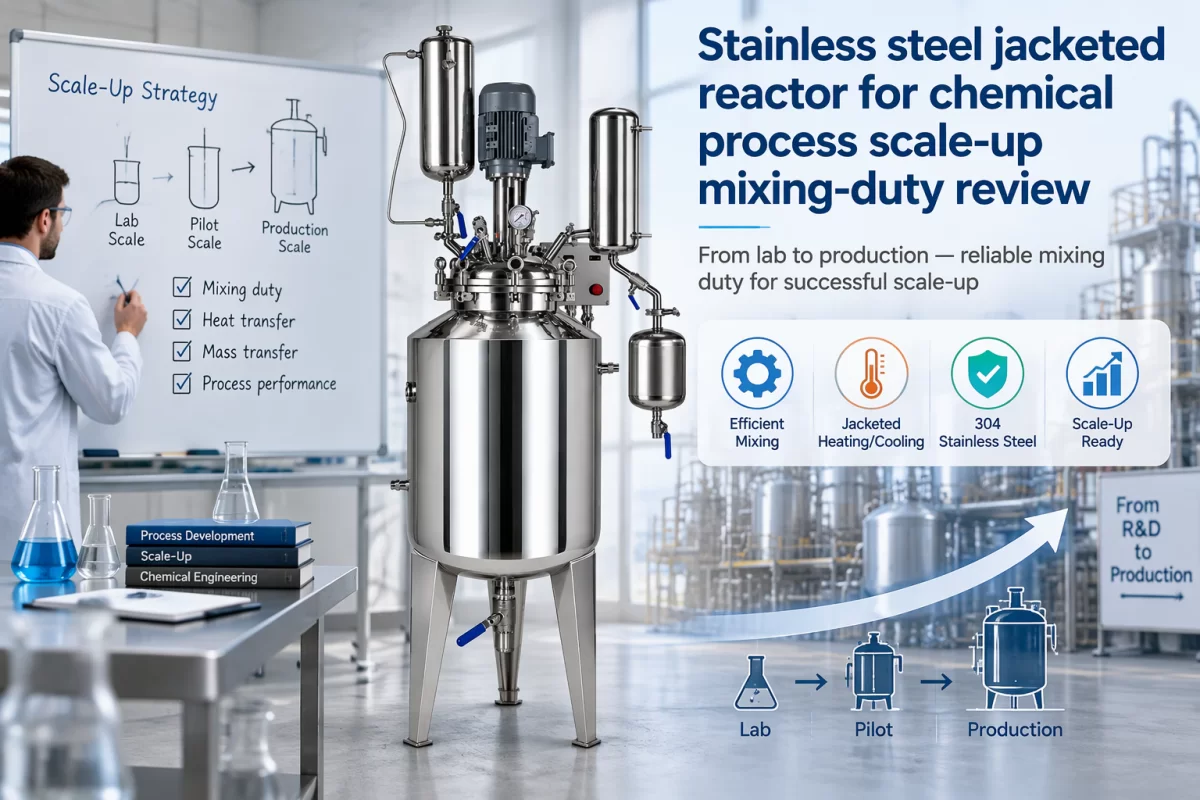
Does matching stirrer speed preserve mixing during scale-up?
My recommendation is to treat rotational speed as a recorded setting, not as proof of equivalent mixing. Impeller diameter, blade geometry, vessel proportions, and liquid properties also matter. Matching rpm alone does not establish comparable circulation, tip speed, or power per unit volume. The scale-up basis should follow the mixing duty and be checked against trial results.
Follow physical-property changes through the batch
Viscosity is often the first property to review, but a single viscosity value can hide the real challenge. Measure or characterize the material at relevant temperatures and process stages. Where the mixture is shear-dependent, a viscosity reading should be accompanied by its measurement conditions. Density, solids content, particle-size distribution, and phase separation behavior also help explain changes in mixing response.
Increasing viscosity can weaken bulk circulation even when the drive maintains its selected speed. Settling solids can create a poorly mixed region near the outlet. A surface vortex may look active while material elsewhere exchanges slowly. These observations make representative sampling and appropriate process measurements more useful than judging performance from stirrer motion alone.
For a process that forms crystals, include particle-size and suspension observations in the review. A dedicated crystallization reactor is a relevant equipment category to consider when crystallization becomes the central duty; its suitability still depends on the process requirements and selected configuration.
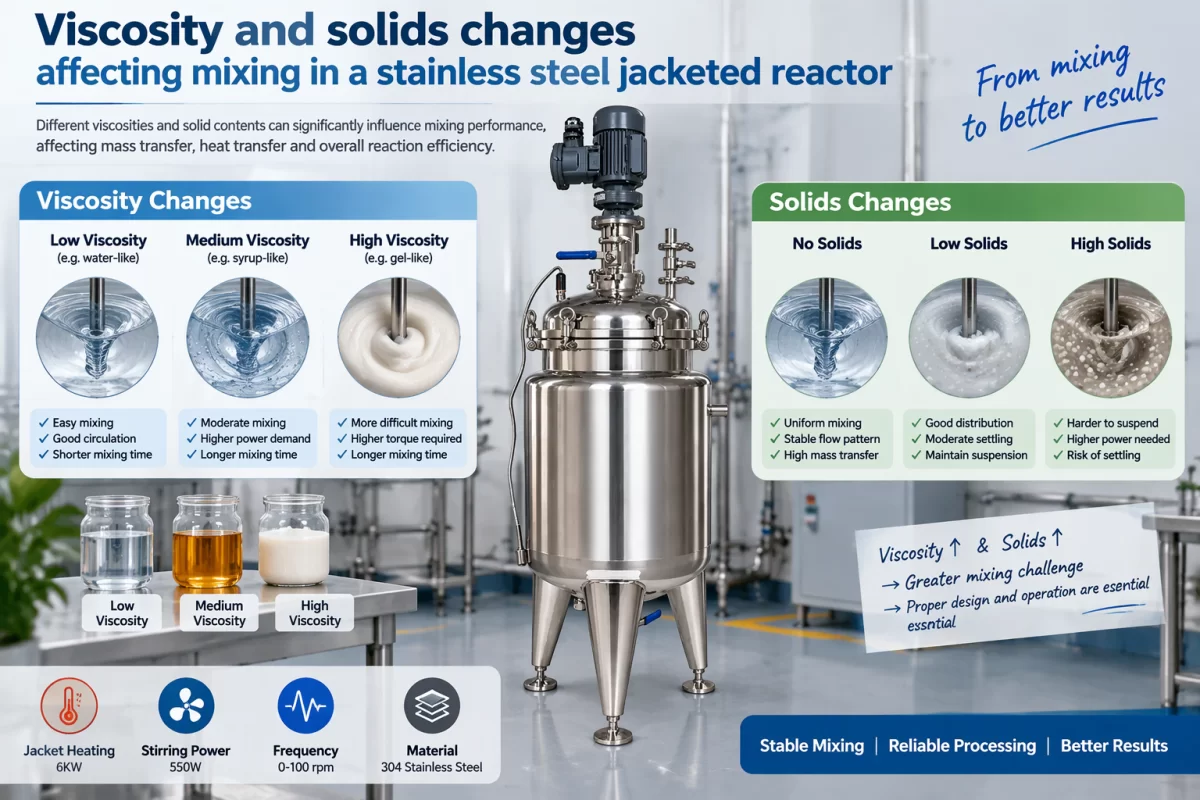
Which batch stage should govern the agitation review?
I would prioritize the stage with the most demanding combination of viscosity, solids loading, phase behavior, and addition rate. That stage may occur before the final product is formed. I would also examine restart conditions, because resuspending settled material can impose a different demand from maintaining an already moving slurry.
Stainless steel jacketed reactor selection: a documented laboratory starting point
The Stainless Steel Jacketed Reactor product is a relevant starting point for a configuration discussion. For the SS-5L model, the documented details below provide a practical laboratory reference. They describe that model only and should not be treated as the specifications of a larger reactor.
| Parameter | Documented specification | Relevance to the review |
|---|---|---|
| Model | SS-5L | Identifies the laboratory configuration discussed here. |
| Reactor volume | 5 L | Record the actual working charge separately. |
| Reactor material | 316 stainless steel | Review compatibility with the intended process chemistry. |
| Frame and pipe material | 304 stainless steel | Distinguishes these components from the reactor material. |
| Stirring rod | 304 stainless steel; three blades | Include the stirring assembly in the materials assessment. |
| Stirring speed | 0–600 rpm | A speed range, not a demonstrated mixing-performance result. |
| Speed control and display | Frequency converter; digital display | Supports recording selected speed during trials. |
| Power supply | 220 V / 60 Hz | Check compatibility with the installation supply. |
| Discharge method | Ball quick-discharge valve | Assess drainage and solids behavior during discharge trials. |
These specifications apply to SS-5L. Mixing suitability depends on the working batch, material properties, and selected agitation arrangement.
The reactor and stirring rod use different stainless steel grades in this configuration, so compatibility assessment should cover the wetted assembly rather than the vessel body alone. Consider feed materials, intermediates, cleaning agents, and operating conditions. Stainless steel selection does not by itself establish suitability for every chemical service.
Build scale-up decisions around repeatable trial data
A useful trial plan connects an operating setting to a measurable outcome. Keep the charge sequence, sampling method, and acceptance criteria consistent when comparing runs. Record temperature as a condition affecting material properties, while keeping the primary review focused on mixing rather than jacket heat-load calculations.
- Document the setup: record vessel geometry, impeller geometry and position, working volume, and any baffles or other internal features.
- Map the process stages: record composition, viscosity measurement conditions, solids content, and addition timing.
- Measure the mixing response: use a suitable tracer or analytical method to evaluate blending, and compare samples from representative locations where safe and feasible.
- Check difficult conditions: evaluate the thickest mixture, the highest relevant solids loading, and controlled restart behavior.
- Review the product: compare concentration uniformity, conversion, particle characteristics, or other process-specific quality measures.
Where suitable instrumentation is available, measured torque or power can strengthen the review. Do not substitute motor nameplate power for measured power delivered to the liquid. Likewise, a successful small-batch result is evidence for developing a larger-scale trial plan, not an automatic guarantee of the same outcome at increased capacity.
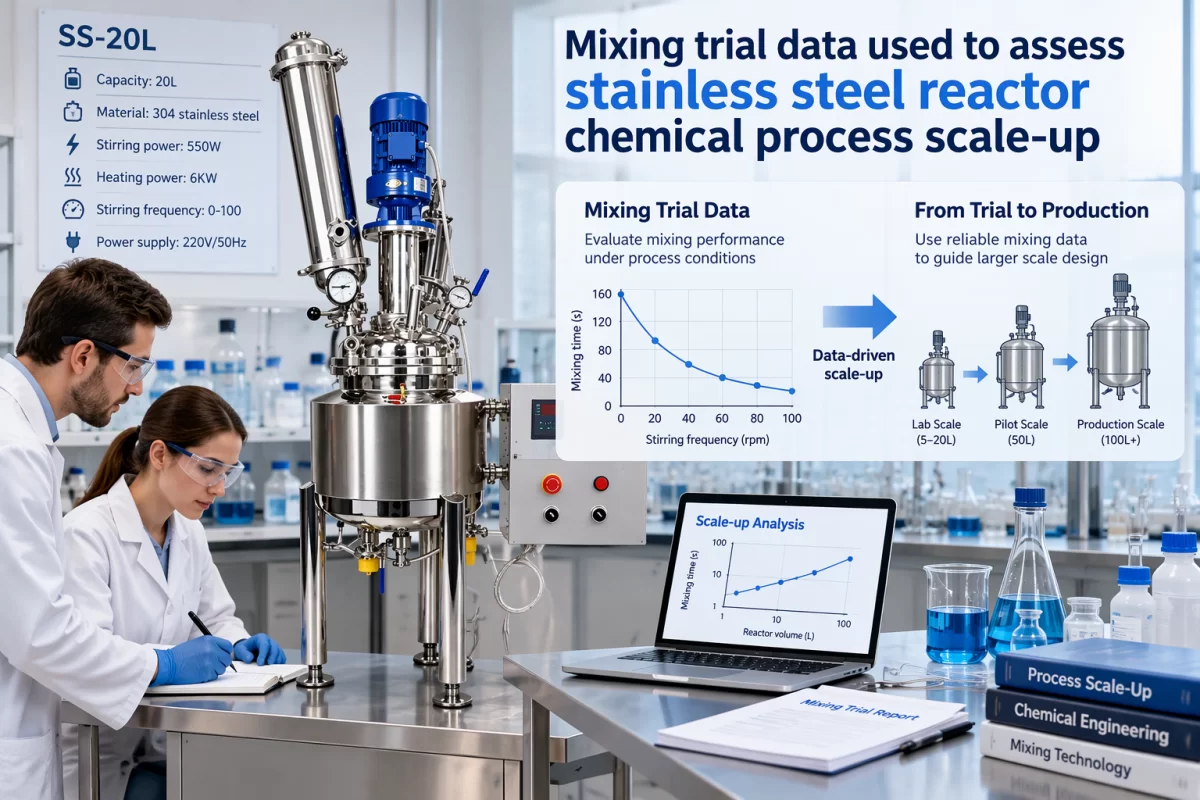
What information supports a meaningful larger-reactor quotation?
I recommend supplying the material system, intended working batch, property changes, mixing objective, addition sequence, and trial observations. Include operating conditions, required wetted materials, utilities, cleaning expectations, and instrumentation needs. This gives the supplier a process basis for discussing the vessel and agitator together.
Reference pricing and configuration planning
Price should be considered alongside the required mixing duty and equipment scope. Clarify what the proposed supply includes: vessel, agitator, sealing arrangement, connections, discharge hardware, controls, and any associated equipment. An attractive reference figure is not a substitute for a configuration-specific proposal.
Our company’s reference price: US$2,042. The actual quotation is subject to the selected configuration and the result of the inquiry. This reference is not a model-specific quotation for the SS-5L configuration described above.
Choose the reactor around proven mixing needs
A stainless steel jacketed reactor for chemical process scale-up should be evaluated as a complete mixing system, not simply as a larger container. Define the duty, track physical-property changes, and use representative trial data to judge circulation, suspension, and product consistency.
For a configuration proposal, provide the material composition, target working batch, operating conditions, mixing results, and required accessories. Those inputs support a more focused discussion of stainless steel materials, agitation arrangement, and quotation scope.