Choosing a Mini Spray Dryer for Food Powders: Match Equipment to Ingredient Goals
Understanding how to choose a mini spray dryer for food powders starts with the ingredient, not the largest capacity on a specification sheet. A beverage powder that disperses easily, a protein ingredient that retains useful functionality, and a fruit powder with acceptable flavor each require different evaluation priorities.
For research and small-batch trials, the right equipment should support manageable feed quantities, useful operating adjustments, and enough collected powder for meaningful testing. The selection process below connects those needs to laboratory spray dryer specifications without treating equipment ratings as guaranteed food powder results.
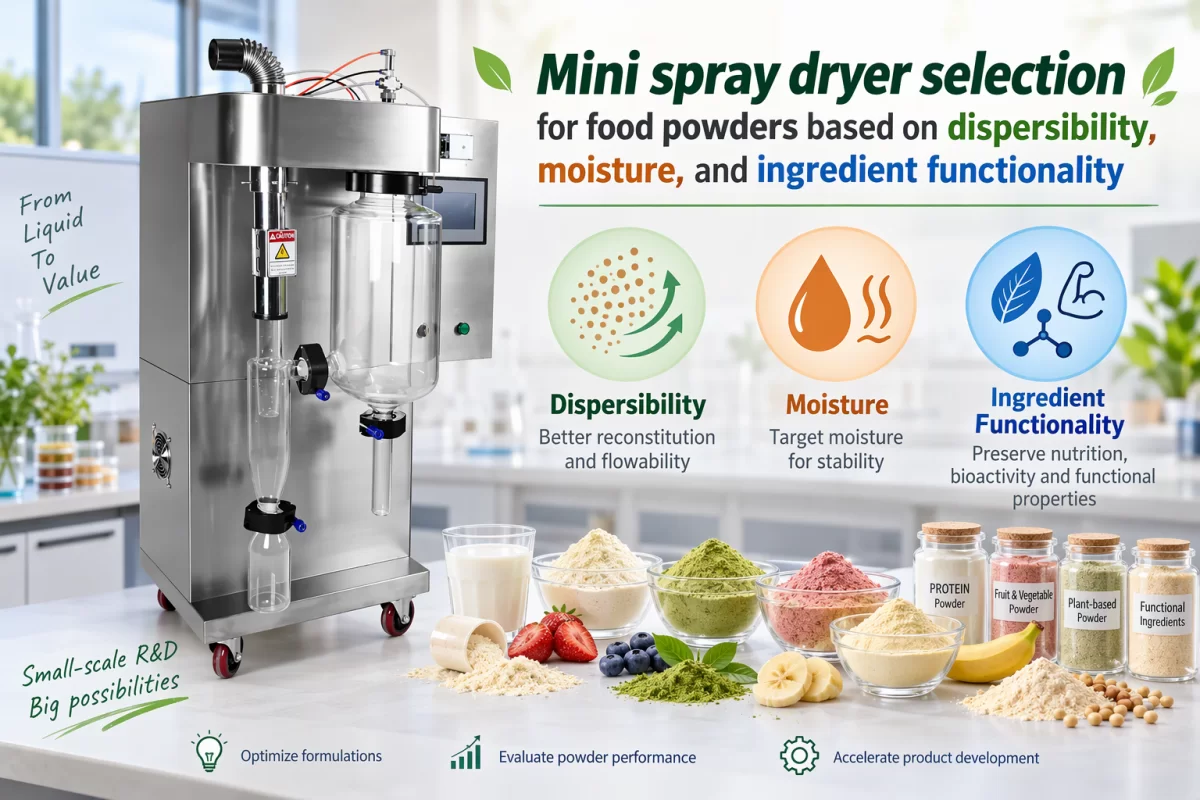
Start with food ingredient goals and measurable powder features
Define what the powder must do in its intended application before choosing a dryer. “Dry powder” is only a starting point: a sample can look satisfactory while still dispersing poorly, losing aroma, or developing caking during storage. Select a small set of tests that can distinguish successful formulations from unsuccessful ones.
- Instant beverage ingredients: measure wetting time, dispersibility, sediment after reconstitution, and flavor under a fixed preparation method.
- Milk, egg, and protein ingredients: evaluate moisture, reconstitution behavior, and the relevant functional property, such as emulsification or foaming.
- Fruit juice and sugar-rich formulations: assess wall deposition, powder collection, color, and caking tendency; carrier choice may need its own trial series.
- Flavor or emulsion powders: compare aroma, surface oil where relevant, and emulsion behavior after reconstitution.
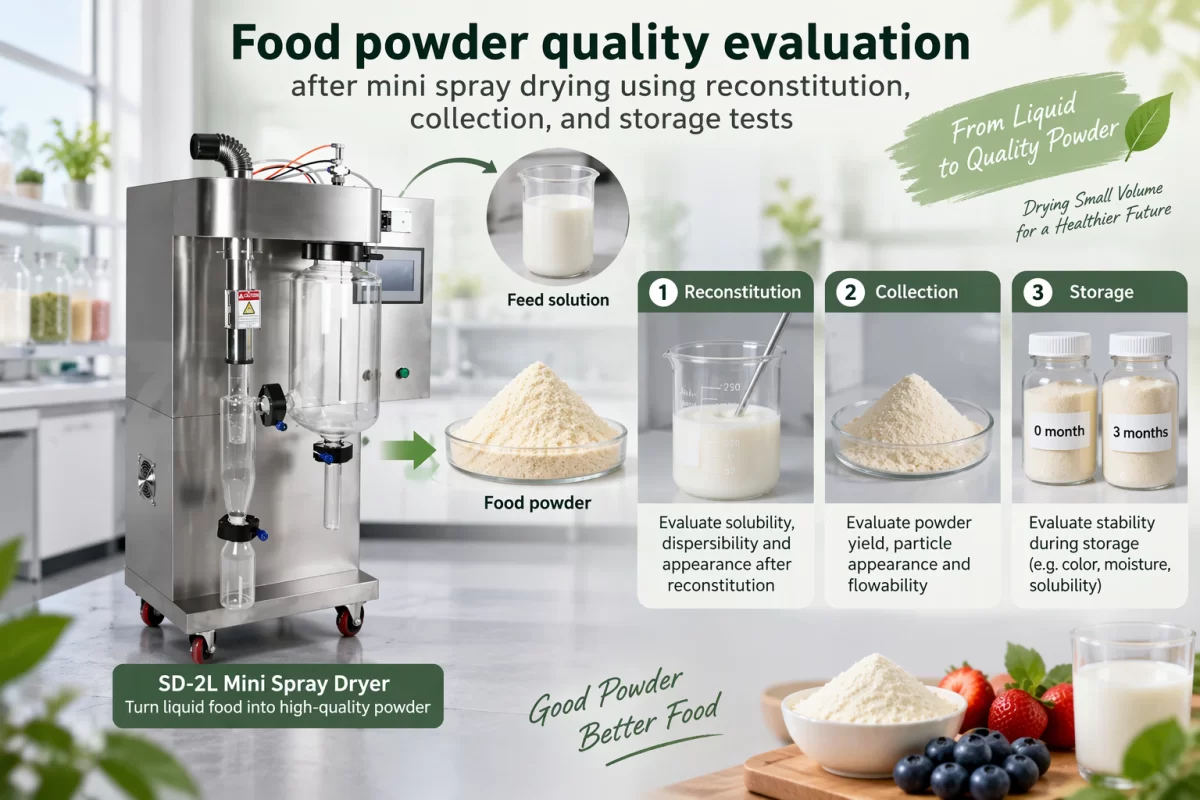
Set acceptance criteria before a run and use consistent test conditions. For example, dispersibility results are more useful when water temperature, powder concentration, and mixing time remain unchanged. For broader application context, explore these examples of spray drying applications.
Which powder property should guide mini spray dryer selection first?
I recommend starting with the property most closely tied to the ingredient’s intended use. For an instant drink, that may be reconstitution; for a functional protein, it may be retained functionality. I would then add moisture and collection measurements so that a promising result is not judged on appearance alone.
Match trial capacity to the available feed and sample demand
Estimate how much liquid is available for each formulation and how much powder the analytical plan requires. Reserve material for startup, feed-line hold-up, repeat measurements, and unsuccessful trial conditions. A minimum feed quantity is an equipment specification, not a promise that every small sample will produce enough recoverable powder for every test.
Keep liquid feed rate, water evaporation capacity, and collected powder output separate. A dryer’s water evaporation rating describes moisture removal; it does not state kilograms of finished food powder per hour. Actual powder collection depends on feed solids, residual moisture, deposition, and collection losses.
The SD-2L lists a maximum feed volume of 2,000 mL/h, evaporated water of 1,500–2,000 mL/h, and a minimum feed quantity of 50 mL. These specifications make it a candidate to evaluate for limited-material laboratory work, while the actual trial volume should be planned around the formulation and sampling requirements.
For larger small-batch investigations, the LPG-5 and LPG-10 list maximum moisture evaporation capacities of 5 kg/h and 10 kg/h, respectively. Their listed spray-head speeds are both 25,000 rpm, with 50 mm spray discs. These are different equipment specifications from those of the SD-2L and should not be treated as interchangeable operating settings.
Read mini spray dryer specifications as trial-planning tools
A useful specification sheet helps define the experiment and installation needs. Temperature control ranges indicate available controls, while nozzle size and feed delivery help frame feed-preparation discussions. They do not establish a universal recipe for milk, coffee, fruit, or protein formulations.
| Parameter | SD-2L specification | Selection relevance |
|---|---|---|
| Inlet air temperature control | 30–300 °C | Available inlet control range, not a food-specific recipe |
| Outlet temperature control | 30–150 °C | Consider alongside feed rate and observed drying behavior |
| Evaporated water | 1,500–2,000 mL/h | Moisture-removal rating, not finished powder output |
| Maximum feed volume | 2,000 mL/h | Upper feed-volume specification for run planning |
| Minimum feed quantity | 50 mL | Starting point for planning limited-sample trials |
| Feeding method | Peristaltic pump adjustment | Adjustable feed delivery during development work |
| Nozzle diameter | 1.00 mm | Relevant to feed particle size and blockage assessment |
| Electric heater | 3.5 kW; AC 220 V, single-phase, grounded | Heater rating and electrical supply requirement |
| Compressed air working pressure | 2–3 bar | Air-supply planning for the listed equipment |
| Dimensions, L × W × H | 600 × 700 × 1,200 mm | Equipment footprint before service clearance is added |
| Equipment weight | 130 kg | Placement, handling, and support planning |
The heater power is not the total connected equipment load. Site planning should also account for the fan, compressor, suitable grounding, exhaust arrangements, and access for cleaning and maintenance. Assess feed viscosity, suspended particles, foaming, and emulsion stability before committing valuable material to a run.
Does a higher inlet temperature guarantee a better food powder?
I would not use inlet temperature alone as a quality indicator. Drying conditions need to be judged against moisture, deposition, reconstitution, and ingredient stability. The inlet air setting is not a direct measurement of particle temperature, and the best trial condition depends on both the formulation and the complete operating setup.
Use a repeatable small-batch food powder trial plan
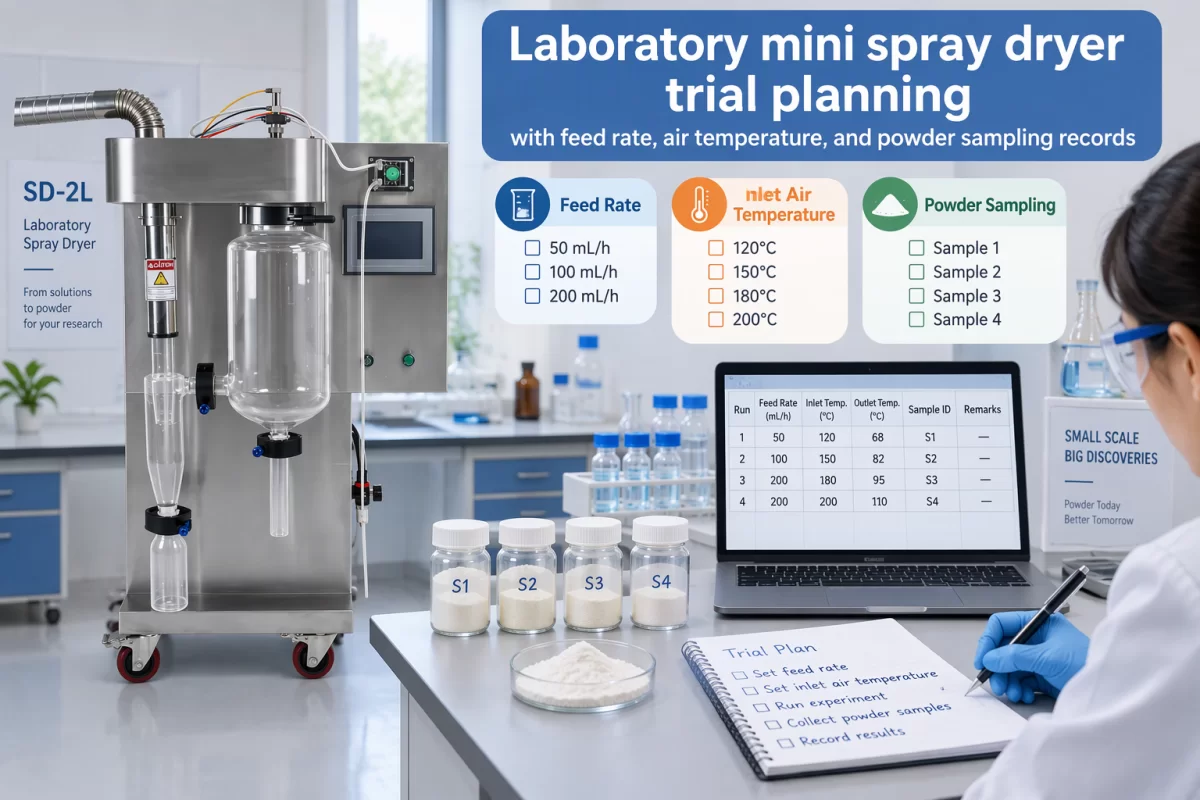
A compact dryer is most useful when it supports a disciplined comparison. Begin with a consistent feed preparation method and record solids content, preparation temperature, and any filtration or homogenization steps. Changes in the feed can otherwise be mistaken for changes in dryer performance.
- Establish a baseline formulation. Choose a representative feed and define the intended powder tests before drying.
- Change one factor at a time initially. Compare a feed adjustment or operating setting while keeping other conditions as consistent as possible.
- Record collection and deposition. Track feed solids introduced, powder collected, and visible material retained in the equipment.
- Test the intended function. Measure the application-specific property alongside moisture and, where appropriate, water activity.
- Repeat promising conditions. Confirm reproducibility before using a single successful run to justify a larger trial.
For yield comparisons, define the calculation clearly. Collected powder mass divided by liquid feed mass is not the same as solids recovery. Consistent sampling, storage containers, and storage conditions also matter when comparing powders that absorb moisture readily.
Food trials require a separate assessment of product-contact materials, cleaning access, allergen changeover, and the laboratory’s hygiene procedures. Drying should not be assumed to provide a validated microbial kill step. Larger equipment also requires fresh process development: matching one temperature setting across scales does not demonstrate equivalent powder quality.
Compare the equipment fit before finalizing the budget
Review the Lab Scale Spray Dryers product range with a defined trial brief: ingredient type, solvent system, available feed quantity, planned throughput, and required powder measurements. This makes the equipment discussion more specific than a request for a generic “food powder machine.”
Our company’s reference price:US$2,800–3,250. This is a budgeting reference, not a model-specific quotation. The actual quotation depends on the selected configuration and the inquiry outcome.
Compare quotation scope as well as price. Identify the included feed system, air-supply arrangement, collection components, and any requested accessories. Explain whether the work involves aqueous food feeds, temperature-sensitive ingredients, or another solvent system; a standard laboratory setup should not be assumed suitable for every material.
What information makes a mini spray dryer quotation more useful?
I recommend providing the ingredient, solvent, solids content, approximate viscosity, available batch volume, and the desired powder tests. I would also include site power and space constraints. Together, these details help connect the quotation to the intended research task rather than to capacity alone.
Choose a mini spray dryer around the ingredient goal
How to choose a mini spray dryer for food powders comes down to a practical sequence: define the powder’s intended function, select measurable acceptance criteria, match feed and evaporation needs, and evaluate repeatable small-batch results. Capacity and temperature controls matter, but they are tools for developing the ingredient—not substitutes for testing it.
For a focused equipment recommendation and quotation, prepare a brief covering the material, working batch size, target operating conditions, and configuration needs. A well-matched laboratory spray dryer can support food powder research while keeping the decision grounded in the properties that matter to the final application.