Compact Mini Spray Dryers for Lab Powders: Planning a Day of Experiments
Choosing a compact mini spray dryer for laboratory powder production is partly an equipment decision and partly a scheduling decision. A useful trial day must accommodate feed preparation, operating checks, monitored drying, powder collection, and cleaning—not just the time spent pumping liquid.
Build the day around comparable powder samples
For development work, the objective is usually a traceable sample and an interpretable result rather than maximum daily output. Start by defining the intended comparison: a change in feed concentration, a different drying condition, or a repeat run to assess consistency. Keep the number of variables manageable so that observations can be connected to a specific change.
The Mini Spray Dryer product page is a relevant starting point for an equipment inquiry. For the practical planning below, the SD-2L specifications provide a model-specific basis. Temperature control ranges and maximum feed rates describe equipment capabilities; they are not a recipe for every formulation.
Prepare the feed before starting the mini spray dryer
Reserve the first part of the morning for sample preparation and equipment readiness. Label feed vessels and collection containers before operation. Record the formulation, liquid volume, solids concentration, and any relevant preparation history. If settling is possible, define how feed uniformity will be maintained using a method suitable for that material.
The SD-2L lists a minimum feed quantity of 50 mL. That is useful when considering limited research samples, but it should not be interpreted as a promise of sufficient recovered powder for every analysis. The amount of solids introduced, material retained in the equipment, and collection losses all affect the usable sample.
Check the installation area as well as the feed. The specified SD-2L dimensions are 600 × 700 × 1200 mm, and its listed weight is 130 kg. A compact footprint does not remove the need for appropriate support, safe positioning, service access, and clearance for collection and cleaning.
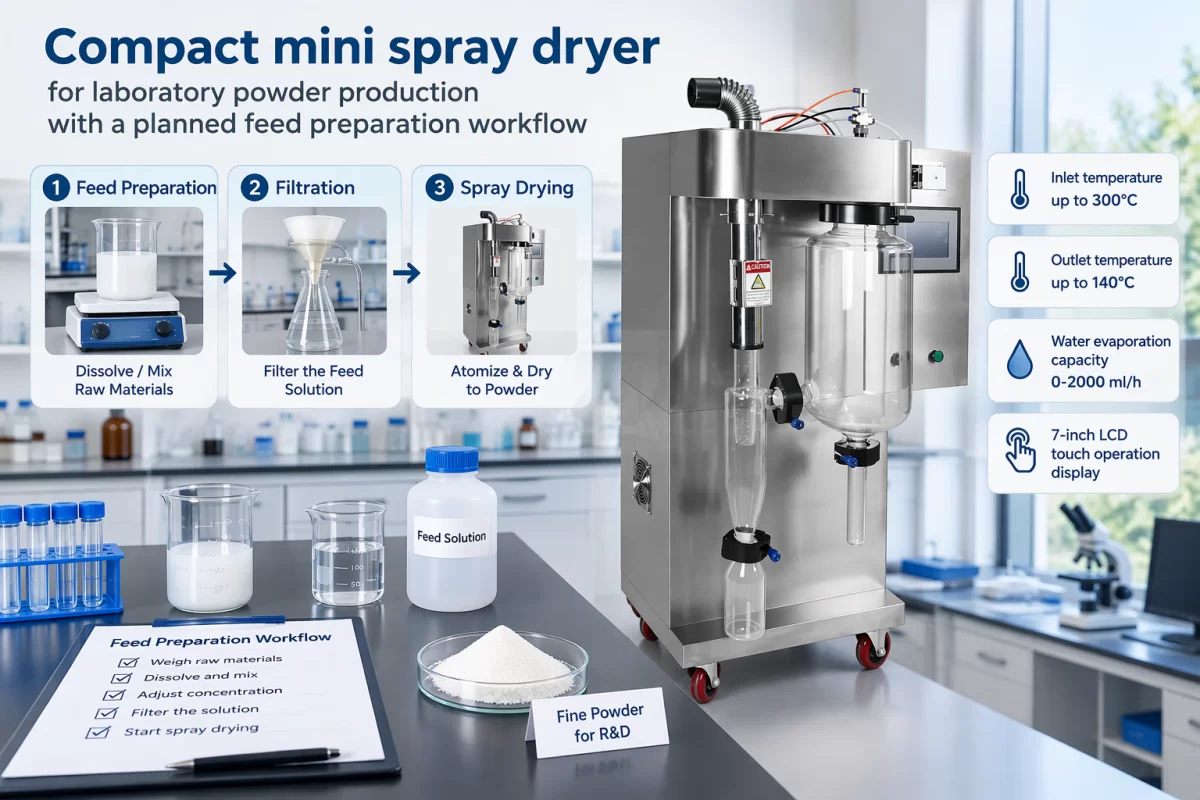
SD-2L specifications that shape the workday
These selected SD-2L values help establish the operating envelope and installation requirements. Inlet and outlet temperature control ranges should be considered separately; neither range establishes a suitable product temperature or demonstrates compatibility with a heat-sensitive formulation.
| Parameter | SD-2L value | Planning relevance |
|---|---|---|
| Inlet air temperature control | 30–300 °C | Available control range, not a universal setpoint |
| Outlet temperature control | 30–150 °C | Record outlet conditions during each trial |
| Water evaporation | 1500–2000 mL/h | Water-removal specification, not powder output |
| Maximum feed volume rate | 2000 mL/h | Upper feed-rate specification |
| Minimum feed quantity | 50 mL | Starting point for limited-sample planning |
| Feeding method | Peristaltic pump adjustment | Record the feed setting and delivered quantity |
| Electric heater power and supply | 3.5 kW; AC 220 V, single-phase, grounded | Heater specification, not total equipment power |
| Compressed-air working pressure | 2–3 bar | Operating utility requirement |
| Nozzle diameter | 1.00 mm | Relevant to feed suitability and nozzle care |
Allow time for stabilization, feeding, and observation
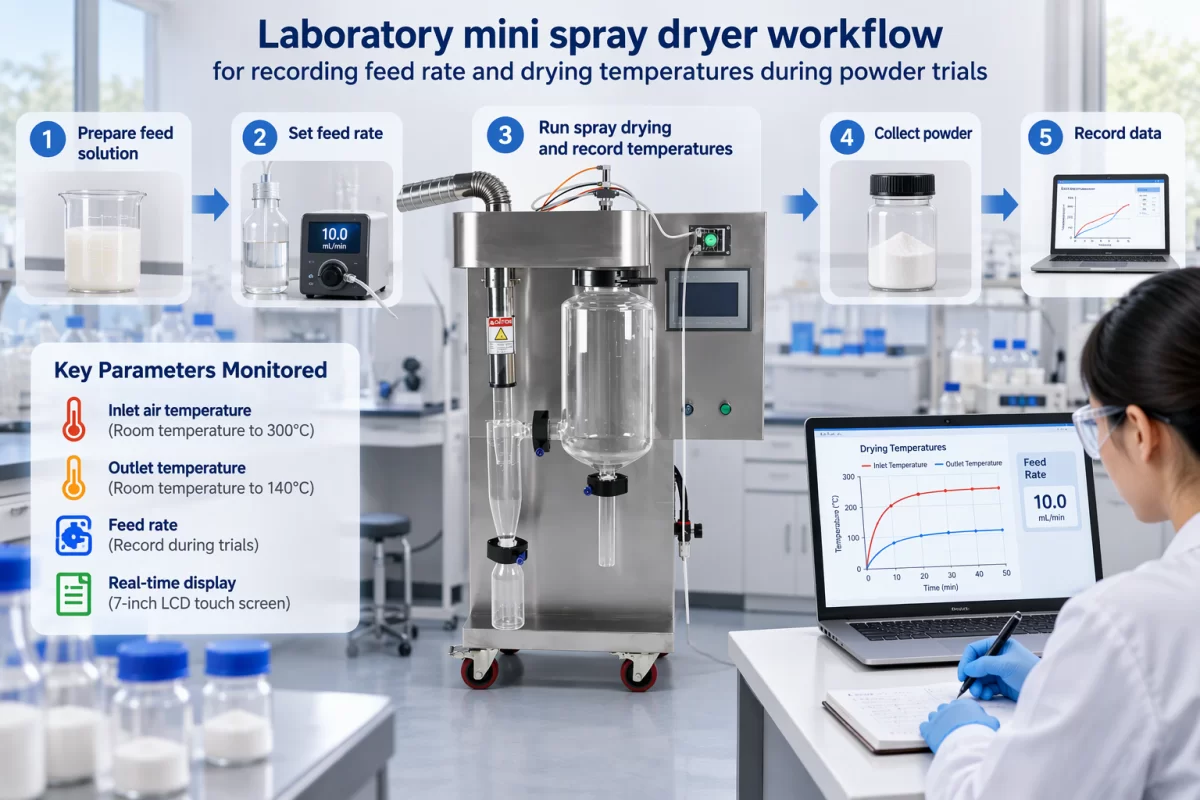
Begin operation according to the equipment instructions and the laboratory’s approved procedure. Allocate time for operating conditions to stabilize before collecting a comparison sample. During feeding, record inlet and outlet conditions, feed settings, actual feed consumption, and observations such as deposits or interruptions.
For scheduling, divide the liquid volume by the planned feed rate—not automatically by the maximum. As an arithmetic example, 500 mL at 1000 mL/h requires 30 minutes of feeding. That calculation excludes preparation, stabilization, interruptions, collection, and cleaning, and it does not establish that the selected rate is suitable for a particular material.
Keep the first run conservative in scope. Changing feed concentration and several operating settings together may produce a powder sample, but it makes the result harder to interpret. Broader context can be found in these examples of spray-drying applications; each laboratory formulation still needs its own suitability assessment.
Make powder collection part of the experiment
Follow the prescribed shutdown and cooling procedure before handling hot components or collecting material. Transfer the powder into a labeled, pre-weighed container using a handling method appropriate to its hazards and moisture sensitivity. Record the collected mass and distinguish it from material remaining elsewhere in the equipment.
Where feed solids are known, calculate the recovered fraction against the dry solids introduced. Use this as a trial result rather than assuming a fixed recovery percentage. Appearance, flow behavior, and visible deposits can guide the next experiment, but they do not replace moisture, particle-size, or other relevant analytical measurements.
Use the early afternoon to review the first run before committing to another. A repeat may be more informative than an additional formulation, especially if feeding was interrupted or the collection procedure changed. Include the required cleaning or changeover between samples in that decision.
Protect the next trial with a complete cleaning window
Cleaning is a core part of the workload, not a task to fit into leftover minutes. Follow the manufacturer’s instructions for shutdown, isolation, disassembly, and reassembly. Select cleaning agents and methods compatible with both the feed residue and the equipment’s wetted components.
Pay attention to the feed path, nozzle, drying surfaces, and collection components. Inspect for residual deposits and ensure components are dry where the procedure requires it before reassembly or storage. Avoid unapproved tools that could damage the nozzle or sealing surfaces.
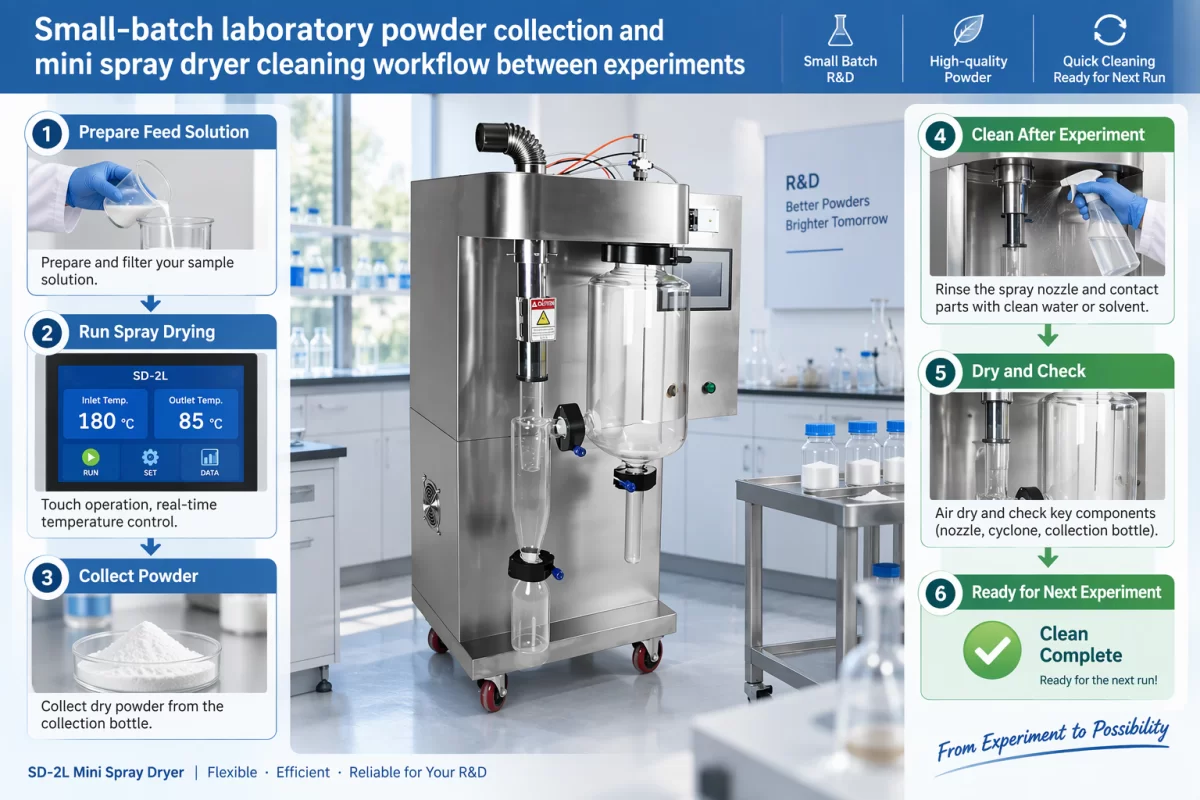
Close the day by linking sample labels to the run sheet, recording cleaning completion, and listing the next experimental change. This makes the following trial easier to reproduce and reduces the risk of losing context when analytical results arrive later.
Reference pricing and a focused equipment inquiry
Our company’s reference price range is US$2,800–3,250. This is a budgeting reference, not a model-specific quotation. The actual quotation depends on configuration and the inquiry outcome.
For a useful proposal, provide the feed material, solvent system, working batch volume, solids concentration, desired powder quantity, target operating conditions, and available laboratory utilities. Include any hazardous-material or containment requirements. Do not assume that a standard mini spray dryer is suitable for flammable solvents or that it includes vacuum operation, explosion protection, or a closed-loop system.
A compact laboratory powder workflow starts with a realistic plan
A compact mini spray dryer for laboratory powder production can be considered for R&D and small-batch experiments when the feed, operating requirements, and installation conditions suit the selected configuration. The most useful plan balances preparation, monitored feeding, traceable powder collection, and thorough cleaning.
Use the SD-2L specifications to frame the equipment discussion, then build the daily schedule around the actual material and required analyses. A carefully documented trial is more valuable than a crowded schedule that leaves too little time to understand the powder or prepare the dryer for the next experiment.