Drying Oven · Pharmaceutical Research
Energy Use in Pharma Research Vacuum Ovens: How to Plan a Fair Comparison
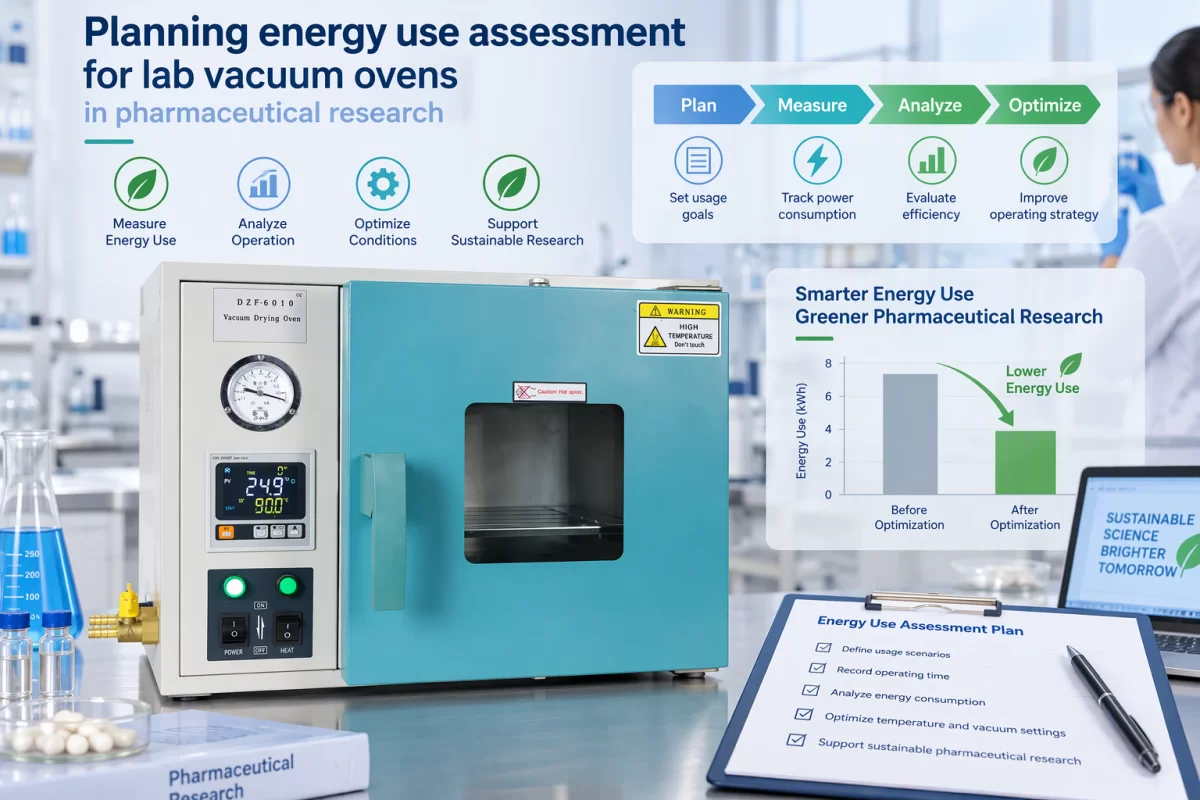
Assessing the energy use of lab vacuum ovens in pharmaceutical research starts with a clear question: how much electricity does each system consume to complete the same acceptable drying task? Input power is useful for equipment screening, but it does not establish energy consumption per batch.
Define a fair vacuum oven energy comparison
A meaningful comparison connects electricity consumption to a documented research outcome. Two ovens running for the same number of hours may not produce equivalent samples. Conversely, two systems with different input powers may reach the same endpoint at different times. Neither a smaller wattage nor a larger chamber proves lower energy use for a particular task.
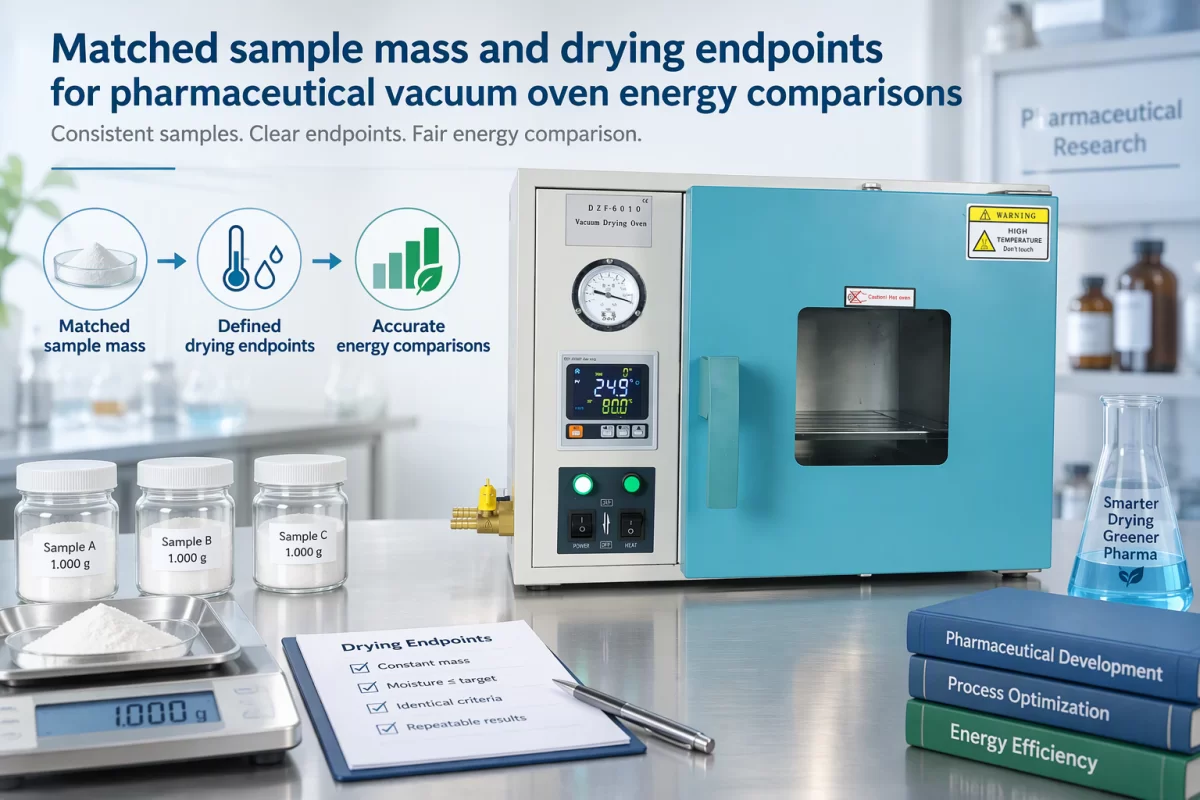
Start by defining the sample material, initial moisture or solvent condition, loading mass, container geometry, layer thickness, and acceptable final condition. In pharmaceutical research, that final condition might involve a residual-solvent limit, a moisture result, or a justified constant-mass criterion. Select the endpoint according to the material and research protocol; do not assume that one criterion applies to every formulation or intermediate.
For equipment screening, the Lab Vacuum Drying Oven product page provides a relevant starting point for discussing a DZF configuration. The supplied specification sheet supports the model details discussed below, but it does not contain measured batch-energy results or evidence of pharmaceutical process qualification.
Does lower input power mean lower energy consumption per batch?
Alice: I would not draw that conclusion from the specification alone. Input power is expressed in watts; batch energy is measured over time in kilowatt-hours. Heater cycling, drying duration, pump operation, and loading all affect the result. I would compare measured electricity only after confirming equivalent sample endpoints.
Match the drying task, not just the temperature setting
Prepare a written protocol before testing. If the objective is to compare equipment under identical operating conditions, hold the validated temperature and pressure profiles constant. If the objective is to compare complete drying workflows, each workflow may use different sample-validated conditions, but both must deliver the same required quality and batch output. Clearly label which comparison is being performed.
- Control the starting material. Use representative aliquots from a comparable sample lot, and document initial moisture or solvent content where relevant.
- Standardize loading. Record sample mass, tray material, exposed area, layer thickness, shelf position, and number of occupied shelves.
- Document the environment. Record room temperature and the oven’s initial thermal state. A warm-start run should not be treated as equivalent to a cold-start run.
- Track actual conditions. Record temperature and pressure throughout the run. Use suitable, calibrated measurement equipment and identify sensor locations.
- Verify the endpoint. Apply the same acceptance method to each compared run and document any sample-quality failure.
Upstream handling also matters. When samples originate from a crystallization reactor, differences in retained mother liquor or particle characteristics can alter the drying task. Keep those starting conditions comparable rather than attributing every change in drying time to the oven itself.
Measure electricity across a clearly defined system boundary
Decide whether the measurement covers only the oven or the complete drying system. For a system-level assessment, include the vacuum pump and any electrically powered accessories used during the task, such as a cooled trap where fitted. Meter components separately when practical, then total the readings without double counting. Any exclusions should appear beside the reported result.
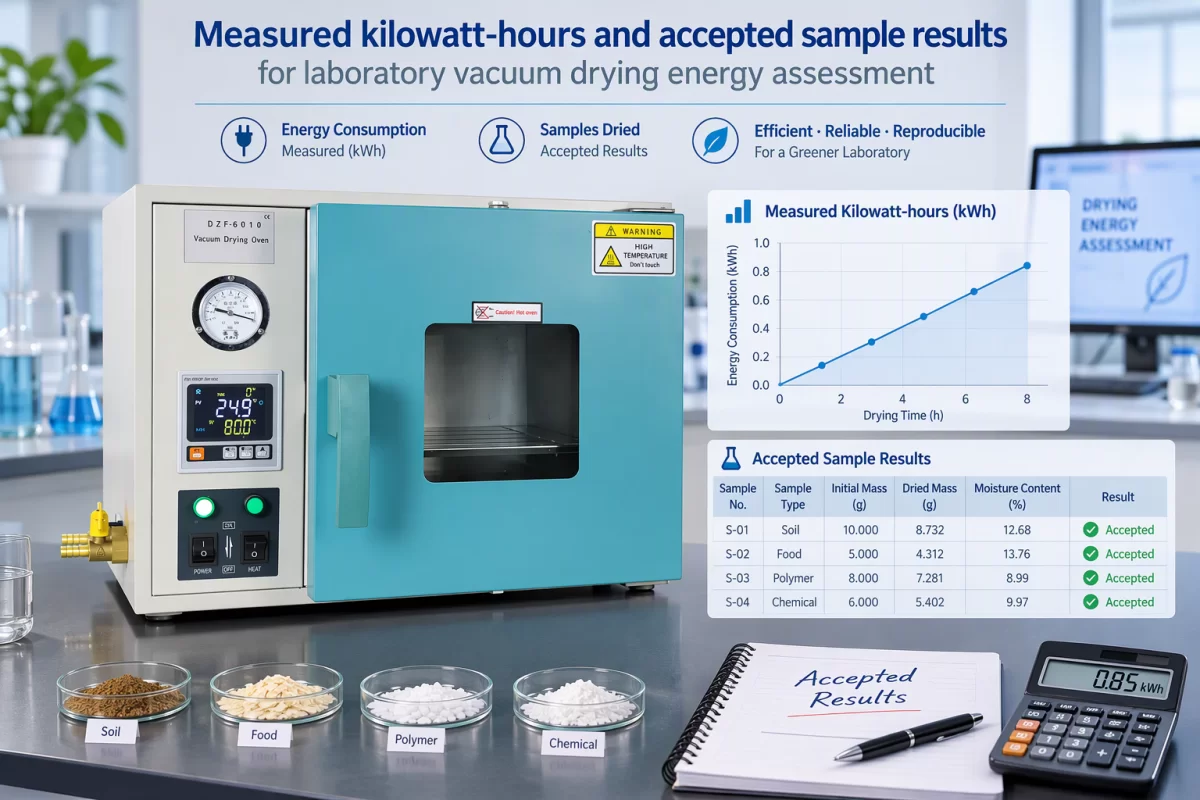
Use an electricity meter suitable for the actual supply and connected load, installed according to laboratory electrical-safety procedures. Record cumulative kWh, elapsed time, and process events. Useful stages include warm-up, pump-down, drying hold, and any powered cooling or standby period included in the defined workflow. A heater input-power value multiplied by total cycle time is not a substitute for measured energy because the heater may cycle and auxiliary loads may differ.
Specific energy (kWh/kg) = total task energy ÷ accepted dry product mass
For very small research samples, kWh per accepted batch may be more useful than kWh/kg, which can become sensitive to small mass differences. Report the normalization basis, the accepted output, and any unsuccessful runs separately. Repeat comparable runs and present variation and measurement limitations rather than relying on a single favorable result.
Should vacuum pump electricity be included in an oven comparison?
Alice: For a complete drying-task comparison, I would include it. Pump electricity is part of the energy required to operate the vacuum workflow. An oven-only comparison can still be useful, but I would label it explicitly and report pump operating time and energy separately when available.
DZF drying oven specifications: useful inputs, not energy results
The supplied model-specific records list the following values for four smaller DZF models. Their input powers and chamber capacities help shortlist equipment for a proposed load. These values do not establish drying time, batch electricity consumption, temperature uniformity under load, or suitability for a particular pharmaceutical sample.
| Model | Input power (W) | Chamber capacity (L) | Inner W × D × H (mm) | Shelves (pcs) |
|---|---|---|---|---|
| DZF-6010 | 400 | 8 | 200 × 200 × 200 | 1 |
| DZF-6020 | 700 | 25 | 300 × 300 × 270 | 1 |
| DZF-6050 | 1,400 | 55 | 400 × 400 × 345 | 2 |
| DZF-6090 | 2,000 | 90 | 450 × 450 × 450 | 2 |
These four model-specific records list a 304 stainless-steel liner, temperature stability of ±1.0°C, an operating-environment range of +5 to +40°C, and a timer range of 1–9999 minutes. The listed maximum vacuum degree is 0.098 MPa. Because the pressure reference is not explained in the supplied sheet, this should not be presented as a confirmed absolute chamber pressure. Obtain clarification before translating it into a test pressure specification.
An explosion-proof configuration is listed as optional. That entry alone does not establish certification, hazardous-area suitability, or permission to dry flammable solvents. Confirm the exact construction, applicable documentation, pump compatibility, and laboratory risk assessment before selecting a solvent-handling setup. Actual drying temperature, pressure, loading, and duration must be validated with the intended sample.
Keep reference price separate from operating-energy evidence
Sorting the supplied company price entries from low to high places the middle reference price at US$610. This is our company’s reference price from the supplied list, not a confirmed quotation for a specific DZF model or complete oven-and-pump package. The actual quotation is subject to configuration and inquiry results. No prices from other companies are used here.
Purchase price and electricity consumption answer different questions. For an operating-cost estimate, multiply measured task energy by the laboratory’s applicable electricity tariff. Keep equipment purchase, maintenance, consumables, analytical testing, and staff time separate unless the study explicitly includes them. The supplied documents contain no measured energy savings, so a savings percentage would not be supported.
What should a defensible comparison report contain?
Alice: I would include the exact configuration, sample preparation, loading pattern, temperature and pressure records, metering boundary, measured kWh, cycle duration, acceptance results, and repeated-run variation. I would also identify unresolved specification details and failed runs so that the conclusion reflects the complete test rather than a selected result.
Conclusion: compare equal research outcomes
A credible assessment of the energy use of lab vacuum ovens in pharmaceutical research compares the electricity required for the same acceptable drying task. Define the sample endpoint first, control starting conditions, measure the relevant system loads, and verify the resulting sample quality. Use DZF input power and chamber dimensions to shortlist a configuration—not to claim unmeasured energy savings.
Before requesting a quotation, prepare the expected batch mass, tray arrangement, solvent or moisture characteristics, required endpoint, and intended test conditions. Confirm disputed specification fields and safety requirements, then validate actual drying conditions with representative samples. This creates a practical basis for selecting a lab vacuum drying oven and making an evidence-led energy comparison.