Stainless Steel Reactor · Acceptance Testing
Industrial Steel Reactor Temperature Control: Defining an Acceptance Test
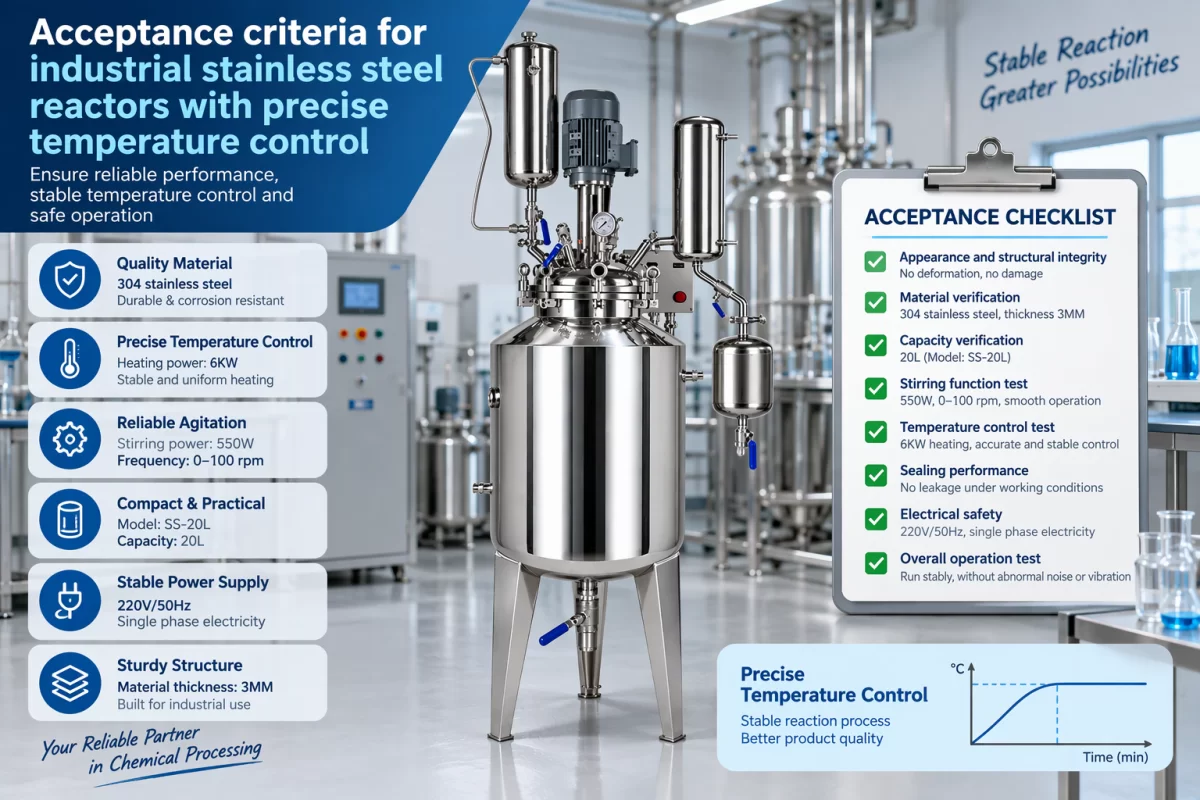
Selecting industrial stainless steel reactors with precise temperature control starts with defining what “precise” means for the process. A temperature display, a jacket, or a stated operating range does not independently establish batch stability or temperature uniformity. A useful acceptance test connects the required performance to a specific material, working batch, agitation condition, and heating or cooling arrangement.
The purchasing objective should be a measurable agreement: what will be tested, how it will be measured, and which results will constitute acceptance. This approach makes a stainless steel reactor proposal easier to evaluate without relying on unsupported accuracy claims.
Define precise temperature control as separate performance criteria
Temperature-control performance has several distinct components. Setpoint deviation describes the difference between the measured process temperature and the target. Stability describes variation at a measurement location during a defined holding period. Uniformity describes differences between locations in the batch. Dynamic response covers heating, cooling, overshoot, and recovery after an agreed disturbance.
These criteria should not be combined into a single “accuracy” statement. A stable reading at one probe may coexist with a warmer or cooler region elsewhere in the vessel. Likewise, a fast jacket-temperature change does not necessarily mean that the process liquid follows at the same rate.
Does a digital temperature display prove precise batch control?
I would not treat the display alone as proof. It reports the signal from its connected sensor, while the acceptance test must establish how that measurement relates to the process. I recommend checking the sensor location, calibration evidence, and comparison with an independent reference before evaluating control performance.
Connect the reactor configuration to the test conditions
A stainless steel jacketed reactor is an option for processes that transfer heat through a circulating jacket medium. Selection still requires a review of material compatibility, working batch size, viscosity, operating temperature, pressure conditions, seals, and utility availability. The vessel material and associated configuration should be selected for the actual service.
The SS-5L provides a specific small-scale example for discussing a test setup. The following features describe that model only; they are not temperature-control acceptance results or specifications for other reactor sizes.
| Item | SS-5L specification | Relevance to acceptance planning |
|---|---|---|
| Reactor volume | 5 L | Define the working test charge separately from vessel volume. |
| Reactor material | 316 stainless steel | Assess suitability for the intended process fluid and cleaning conditions. |
| Frame and pipe material | 304 stainless steel | Identify component materials when reviewing the installation. |
| Heating method | Circulation heating | Include the selected circulation equipment and medium in the protocol. |
| Stirring speed | 0–600 rpm | Record the selected test speed rather than assuming all speeds give equivalent mixing. |
| Temperature indication | PT100 sensor with digital display | Document probe position and compare readings with a calibrated reference. |
| Electrical supply | 220 V / 60 Hz | Plan compatible electrical service for this configuration. |
A PT100 sensor designation does not, by itself, establish the accuracy of the complete measurement chain.
Write the acceptance protocol before the trial
First, identify the supplied system boundary: reactor, agitator, temperature sensor, controller, circulation equipment, connecting hoses, and any insulation included in the test. Record the test liquid, charge quantity, initial temperature, ambient conditions, and agitation setting. For a surrogate liquid, explain which process properties it represents and which it does not.
Next, agree on the test setpoints and numerical acceptance limits with the supplier. Limits should reflect process needs and measurement capability rather than an assumed tolerance. Define the stabilization rule before starting the holding period, and identify whether temperature measurements refer to the batch, jacket inlet, or jacket outlet.
| Test item | Measurement definition | Agreement required |
|---|---|---|
| Setpoint deviation | Process temperature minus target temperature, in °C | Measurement location, evaluation method, and permitted deviation |
| Holding stability | Maximum minus minimum temperature at each probe, in °C | Holding duration, sampling interval, and permitted variation |
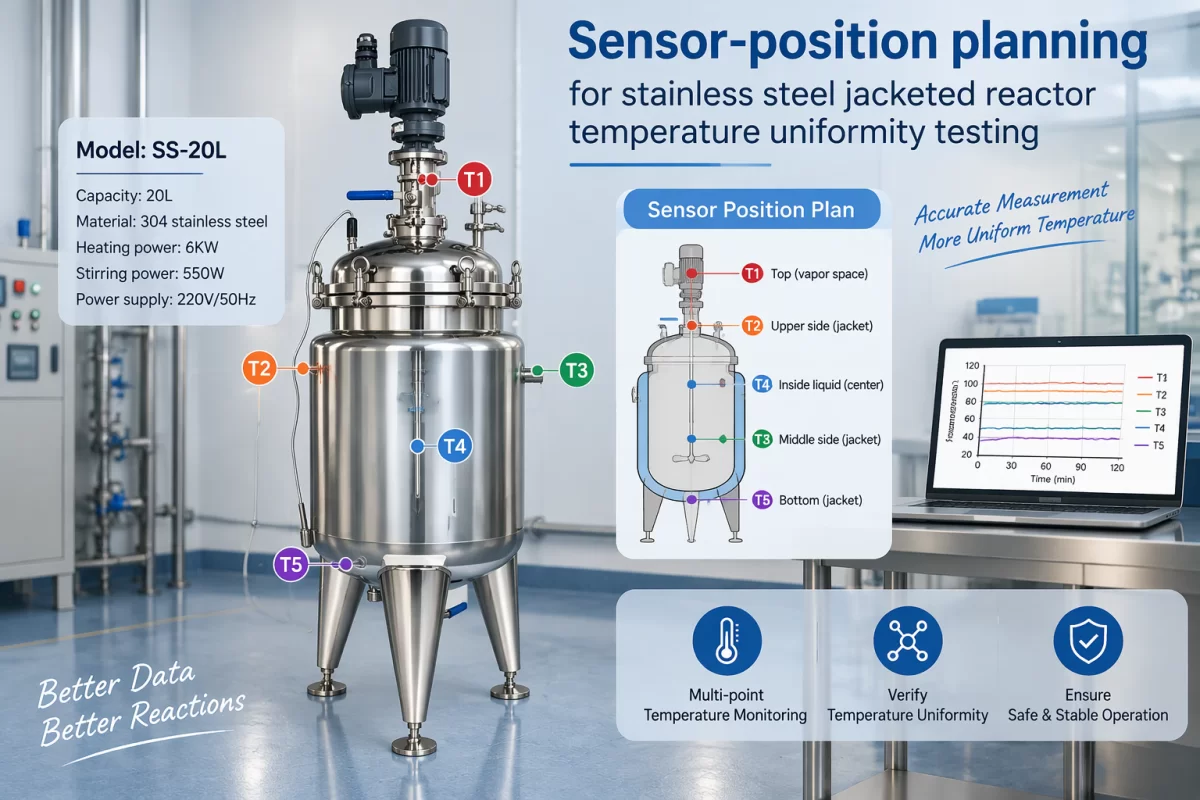
| Batch uniformity | Difference between simultaneous probe readings, in °C | Probe locations and maximum permitted spatial difference |
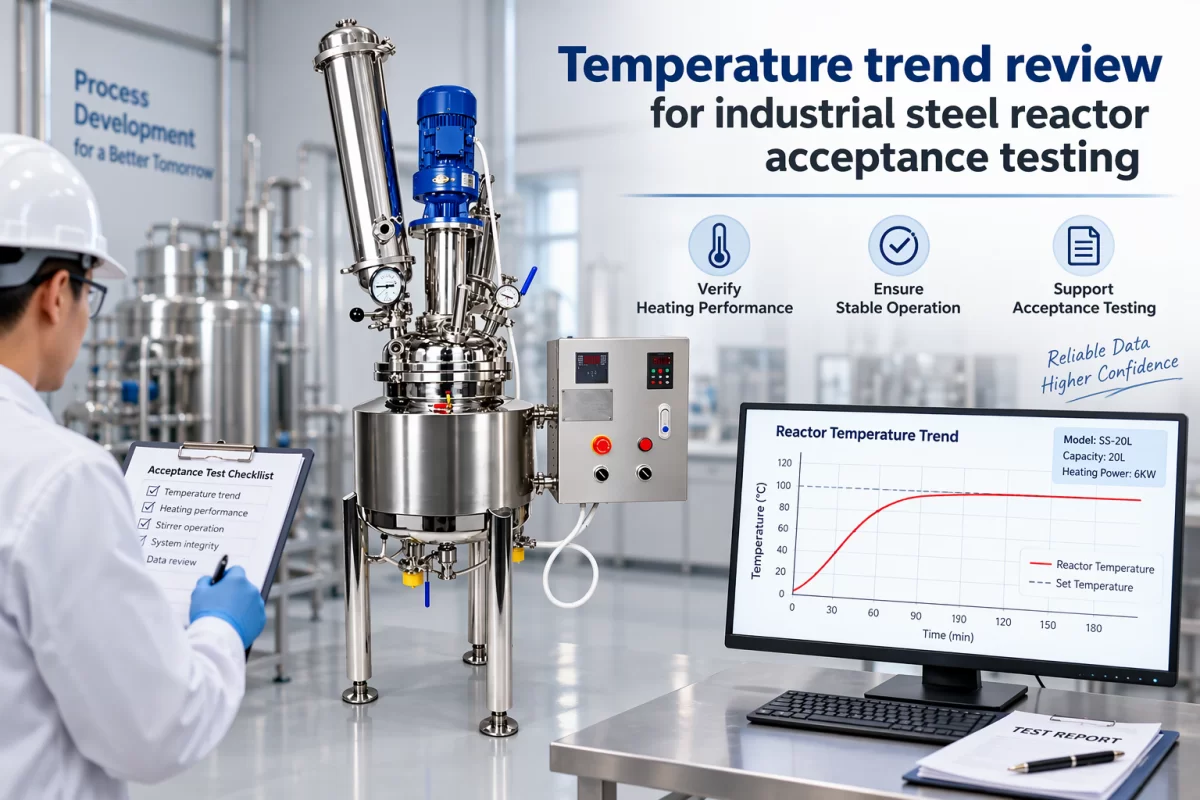
| Heating and cooling response | Elapsed time to enter and remain within the agreed band, in minutes | Starting conditions, endpoint rule, and allowed time |
| Disturbance recovery | Peak excursion in °C and recovery time in minutes | Defined disturbance, safe procedure, and acceptance limits |
Can a water trial establish performance for a viscous production batch?
I use a water trial as a useful baseline, not as automatic proof of production performance. Viscosity, solids, mixing behavior, and reaction heat can change the temperature response. Where these differences matter, I recommend a safe representative fluid or a separately agreed process-validation step.
Run the test and preserve the evidence
Before testing, review safe operating limits for the complete assembly and the compatibility of the heat-transfer fluid. Install independent reference probes at agreed locations, avoiding unintended contact with the wall or agitator. Record calibration status and measurement uncertainty so that instrument limitations are considered when evaluating results.
- Establish the baseline. Record the initial batch and utility conditions before applying the target setpoint.
- Measure the transition. Capture process temperature and, where instrumentation is available, jacket inlet and outlet temperatures during heating or cooling.
- Evaluate the hold. Apply the agreed stabilization rule, then assess deviation, stability, and uniformity over the specified period.
- Test an agreed disturbance. If safe and relevant, introduce a defined change such as a controlled feed addition and measure recovery.
- Retain the record. Save time-stamped readings, configuration details, observations, and a pass/fail result for each criterion.
Use suitable external recording equipment if data logging is not part of the supplied configuration. Manual readings can support a limited check, but short temperature excursions may be missed if the sampling interval is too long. Any repeat test should identify what changed and preserve the original result.
Should factory and site acceptance tests use the same criteria?
I recommend keeping the core performance definitions consistent while documenting differences in installation conditions. Site utilities, hose routing, ambient temperature, and the working charge may differ from the factory setup. A site test should establish whether the installed system satisfies the agreed operating requirements.
Prepare a configuration-specific quotation request
A useful inquiry includes the material being processed, working batch quantity, target temperature profile, viscosity, solids content, expected heat release, pressure or vacuum conditions, available utilities, and preferred instrumentation. Include the proposed acceptance protocol so that the reactor and temperature-control arrangement can be considered together.
Specify which components contact the process and which material grades are required for those components. Stainless steel grade alone is not a universal compatibility guarantee; seals, valves, connections, and cleaning requirements also belong in the selection discussion.
Company reference price
Our company reference price is US$2,042. This is a reference across the supplied company listings, not a quotation for the SS-5L or a complete temperature-control package. The actual quotation depends on the selected configuration and the inquiry result.
Make temperature performance an agreed deliverable
Industrial stainless steel reactors with precise temperature control should be evaluated through defined conditions and recorded results—not through a display reading alone. Separate deviation, stability, uniformity, and response requirements; select compatible materials and equipment; and agree on the measurement method before testing.
For a stainless steel jacketed reactor proposal, provide the intended process conditions and acceptance objectives together. That gives the supplier a practical basis for recommending a configuration and preparing a relevant quotation.