Laboratory equipment selection
Microwave Chemical Reactor Heating: Set Realistic Capacity and Uniformity Targets
Microwave chemical reactor heating capacity and uniformity should be treated as measurable selection criteria, not as automatic benefits of microwave operation. A useful equipment comparison separates electrical ratings, vessel compatibility, working batch size, and actual temperature behavior. These factors help a laboratory define what successful heating means for its particular material and reaction.
The WBFY-201 and WBFY-205 provide concrete starting points for comparing microwave chemical reaction equipment. Their specifications describe power, frequency, dimensions, and electrical requirements. Process suitability still depends on the intended load and operating arrangement: neither a larger power rating nor a chamber dimension alone establishes usable reaction capacity or uniform heating.
Read the power ratings before setting heating targets
Rated power consumption and rated maximum output power describe different quantities. Power consumption concerns the equipment’s electrical input, while maximum output power is a separate microwave output rating. Neither value should be interpreted as the heat absorbed by a particular reaction mixture. Absorption depends on the material, its composition, temperature, and the vessel arrangement.
The two models have the same rated power consumption, but different rated maximum output powers. This distinction matters when comparing equipment; it does not establish a proportional difference in heating rate. A load that couples differently to microwave energy can behave differently even when the selected equipment has a higher output rating.
| Parameter | Unit | WBFY-201 | WBFY-205 |
|---|---|---|---|
| Rated power consumption | W | 1100 | 1100 |
| Rated maximum output power | W | 750 | 650 |
| Maximum input current | A | 7.8 | 7.8 |
| Operating voltage | V | 220 | 220 |
| Frequency | MHz | 2450 ± 50 | 2450 ± 50 |
| Chamber dimensions | mm | 290 × 295 × 190 | 290 × 295 × 190 |
| Overall dimensions | mm | 480 × 340 × 280 | 480 × 340 × 380 |
| Gross weight | kg | 20 | 35 |
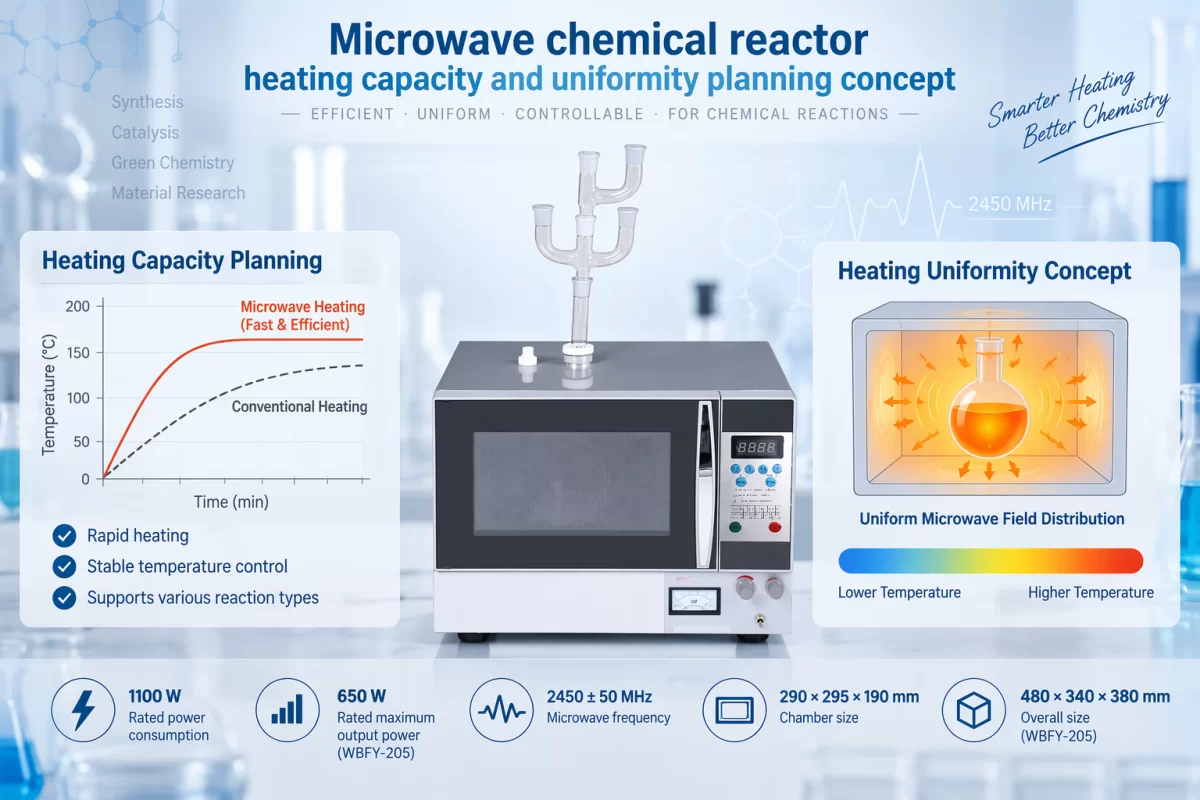
Does higher maximum output power guarantee a faster reaction?
I would not use output power alone to predict reaction time. A mixture may reach its target temperature sooner under some conditions, but reaction progress also depends on chemistry, mixing, concentration, and the required hold period. I recommend comparing temperature histories and reaction outcomes under equivalent conditions rather than assuming every reaction will accelerate.
Define working capacity around the vessel and material
Chamber dimensions describe an enclosure, not a validated liquid working volume. A reaction vessel needs an appropriate operating arrangement, and its nominal capacity is not necessarily its safe or useful working batch. Headspace, material expansion, foaming, mixing needs, and any approved accessories can affect the usable load.
Begin capacity selection with the proposed material and batch mass or volume. Then identify the vessel geometry, material compatibility, and intended operating conditions. Any pressure, reflux, temperature-sensing, or agitation requirement should be included in the equipment inquiry rather than assumed to be part of a standard configuration.
The Microwave Synthesis Reactor product page is a relevant starting point for discussing microwave reaction equipment. A useful inquiry connects the equipment request to a defined experiment, rather than asking only for the largest chamber or highest power.
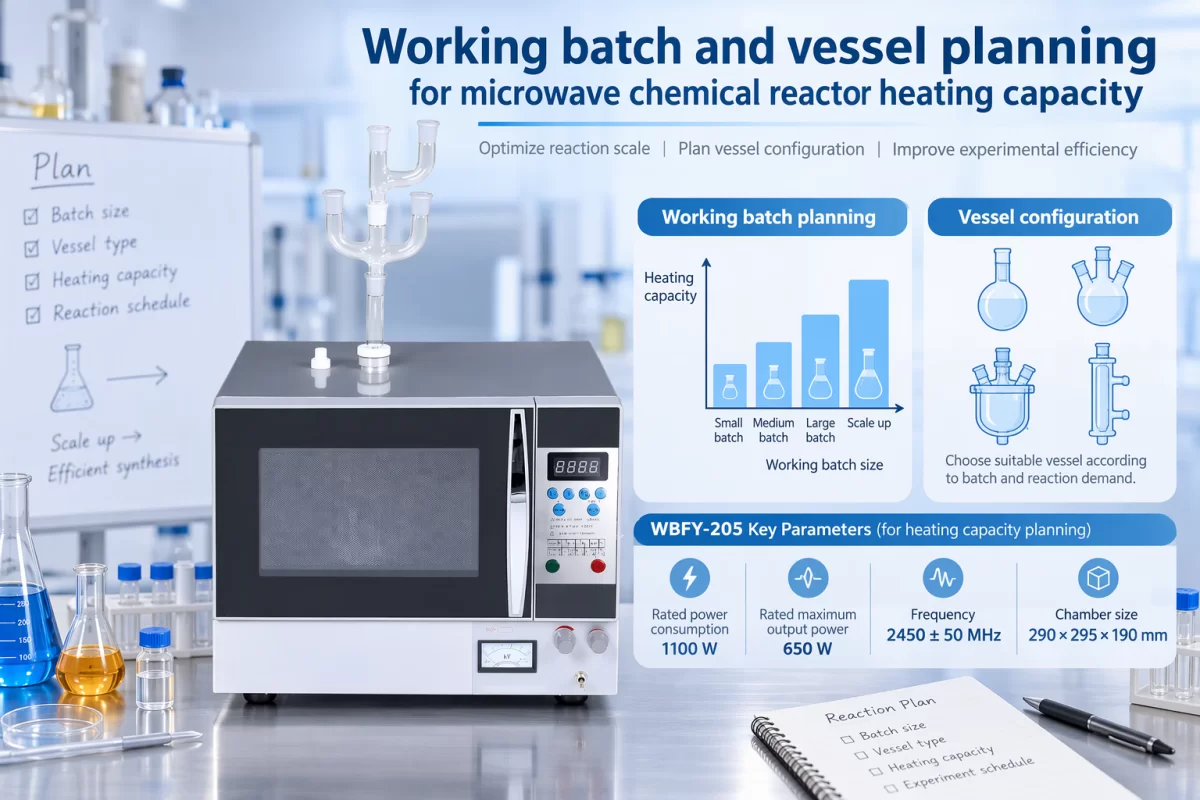
Can chamber dimensions establish a reactor’s usable batch volume?
I treat chamber dimensions as a fit constraint, not a batch-volume rating. The appropriate working load depends on the vessel and process. I would specify the intended batch separately and evaluate it with the proposed setup before using that load as a routine operating target.
Make heating uniformity a testable acceptance criterion
“Rapid, uniform heating” is best framed as a performance target to test. Microwave heating can vary with dielectric behavior, vessel geometry, load position, and mixing. A bulk temperature reading does not necessarily describe every part of the mixture, and a final temperature alone does not reveal differences during the heating ramp.
Define uniformity in terms of the process requirement. For a temperature-sensitive material, the relevant issue may be local overheating. For another reaction, reproducible hold conditions may matter more. The temperature measurement method should be compatible with the microwave environment and approved for the intended equipment arrangement.
- Heating target: Specify the starting condition, target temperature, and acceptable time to reach it.
- Temperature spread: Define an acceptable difference between relevant measurement locations and when that difference will be evaluated.
- Hold behavior: Record temperature stability over the required process duration.
- Repeatability: Repeat the assessment with consistent material, load, placement, and operating settings.
- Process outcome: Evaluate yield, conversion, or product quality alongside temperature data, as appropriate to the reaction.
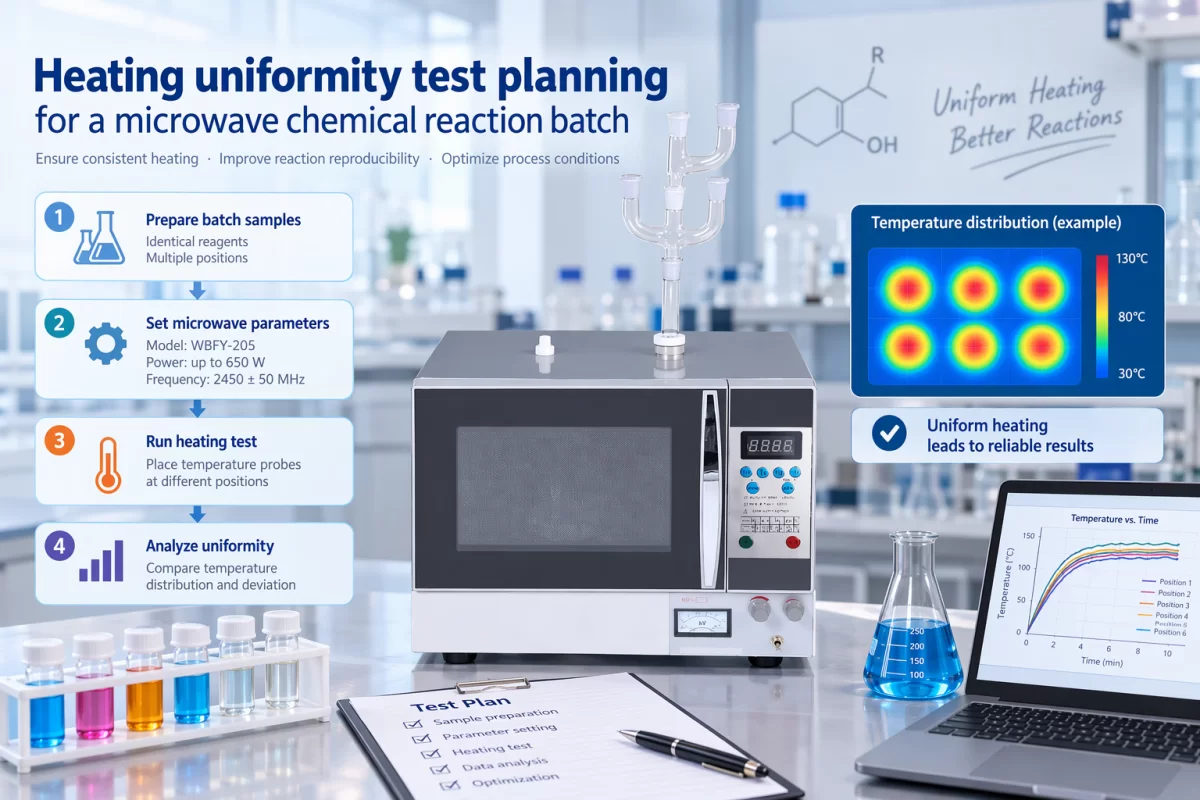
What is a practical first test for microwave heating uniformity?
I recommend a representative-load trial using an approved temperature measurement arrangement. Record the heating ramp and hold period, assess temperature differences where the setup permits, and repeat the trial. This provides a more useful basis for selection than a single endpoint temperature or an unloaded demonstration.
Build a useful equipment inquiry and budget
A well-defined inquiry helps match microwave chemical reaction equipment to laboratory needs. Include the material or solvent system, intended working batch, vessel requirements, target temperature profile, and any mixing or accessory requirements. Describe the acceptance criteria as desired process outcomes, without treating them as already demonstrated equipment performance.
- Identify the reaction and the properties that make heating control important.
- State the intended batch and vessel arrangement.
- Define measurable heating and uniformity targets.
- Request the corresponding configuration and a quotation.
The company’s reference price is US$492, based on the median of its single-value listed prices. This is a general budgeting reference across listings, not a model-specific quotation for the WBFY-201 or WBFY-205. The actual quotation is subject to the configuration and inquiry results.
For additional purchasing context, the microwave reactor cost and application guide can accompany the product inquiry. Keep the final comparison focused on the proposed configuration and its ability to meet the intended experimental requirements.
Choose measurable targets over broad heating claims
Microwave chemical reactor heating capacity and uniformity are most useful when tied to a defined vessel, material, batch, and temperature profile. The WBFY-201 and WBFY-205 specifications support an initial equipment comparison, while representative testing establishes whether the proposed setup meets the process targets.
Share the material, working batch, target conditions, and configuration needs with KD Instrument to discuss a suitable microwave chemical reaction equipment proposal and quotation. Treat faster heating and improved uniformity as outcomes to demonstrate—not assumptions attached to every reaction.