Organic synthesis • Scale-up planning
Microwave Organic Synthesis Scale-Up: Decide What a Pilot Trial Must Demonstrate
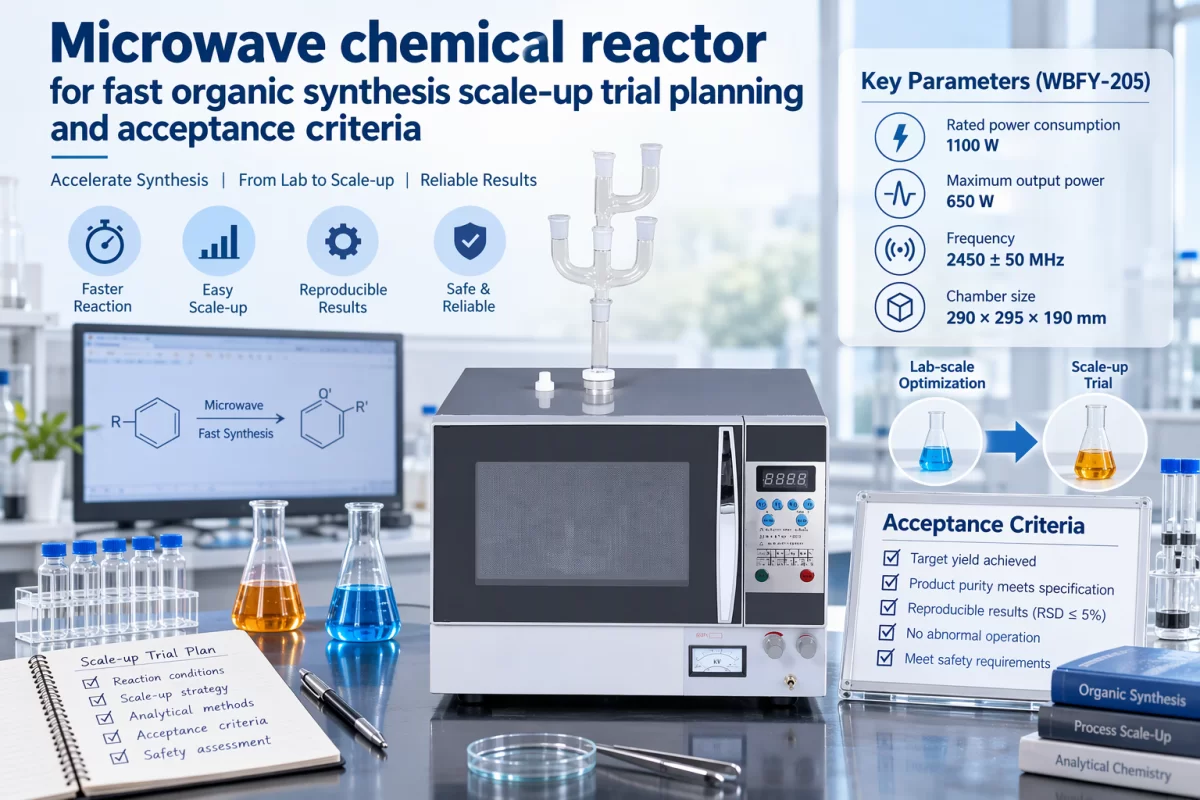
Searching for a Microwave chemical reactor for fast organic synthesis scale-up should begin with a measurable trial objective, not an assumed speed advantage. A useful pilot trial must show whether a particular reaction, material load, and operating arrangement can meet agreed quality, process-time, repeatability, and safety requirements.
Microwave chemical reaction equipment can support synthesis development, but a successful small-scale experiment does not establish production-scale performance. The practical question is what evidence will justify the next scale step—and what result should stop it.
Define microwave synthesis acceptance criteria before the trial
Start with a written trial brief. Identify the reaction, solvent system, reactant concentrations, catalyst loading, intended working batch, and required product specification. Document the existing process as a baseline, including heating, reaction hold, cooling, transfer, isolation, and cleaning. This prevents a shorter reaction hold from being mistaken for a shorter overall manufacturing cycle.
Acceptance limits should come from the process requirements rather than from equipment marketing. Set numerical limits where the development team has a defensible basis, and identify the measurement method for each limit. Agree on these criteria before reviewing the results.
| Acceptance area | Evidence to collect | Decision supported |
|---|---|---|
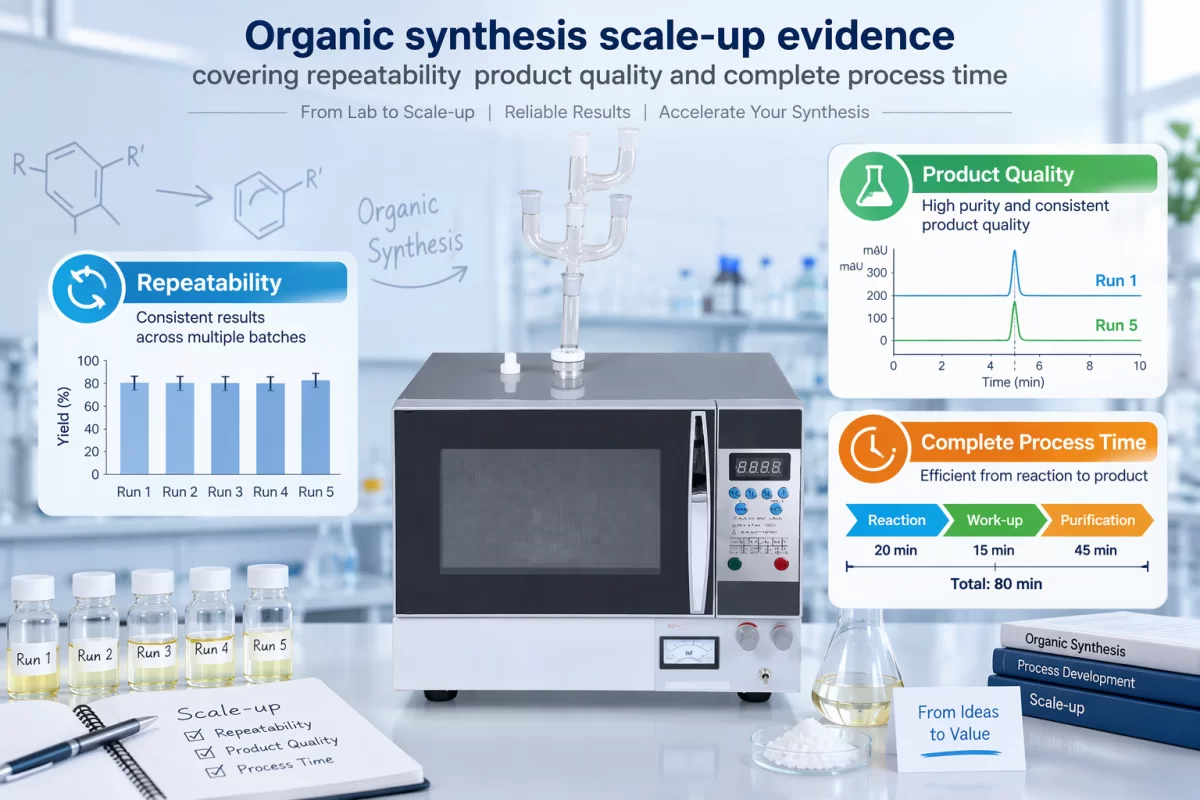
| Product quality | Conversion, isolated yield, assay, and relevant impurity results using defined analytical methods | Whether the product meets the agreed specification |
| Process time | Separate timestamps for loading, heating, holding, cooling, workup, and cleaning | Whether any time benefit remains across the complete cycle |
| Repeatability | Results from independently repeated batches under the same documented conditions | Whether the outcome is sufficiently consistent to advance |
| Operating behavior | Temperature history, mixing observations, and pressure records where applicable | Whether the tested operating arrangement is controllable |
| Material recovery | Input, recovered product, residues, samples, and documented losses | Whether the yield and workup conclusions are credible |
Does a shorter microwave reaction hold prove faster scale-up?
I would not accept that conclusion on its own. I would compare complete cycle times at equivalent product quality and a clearly stated batch basis. Faster heating or a shorter hold may be useful, but longer cooling, difficult isolation, or additional cleaning can offset that benefit.
Match the microwave chemical reactor to the test arrangement
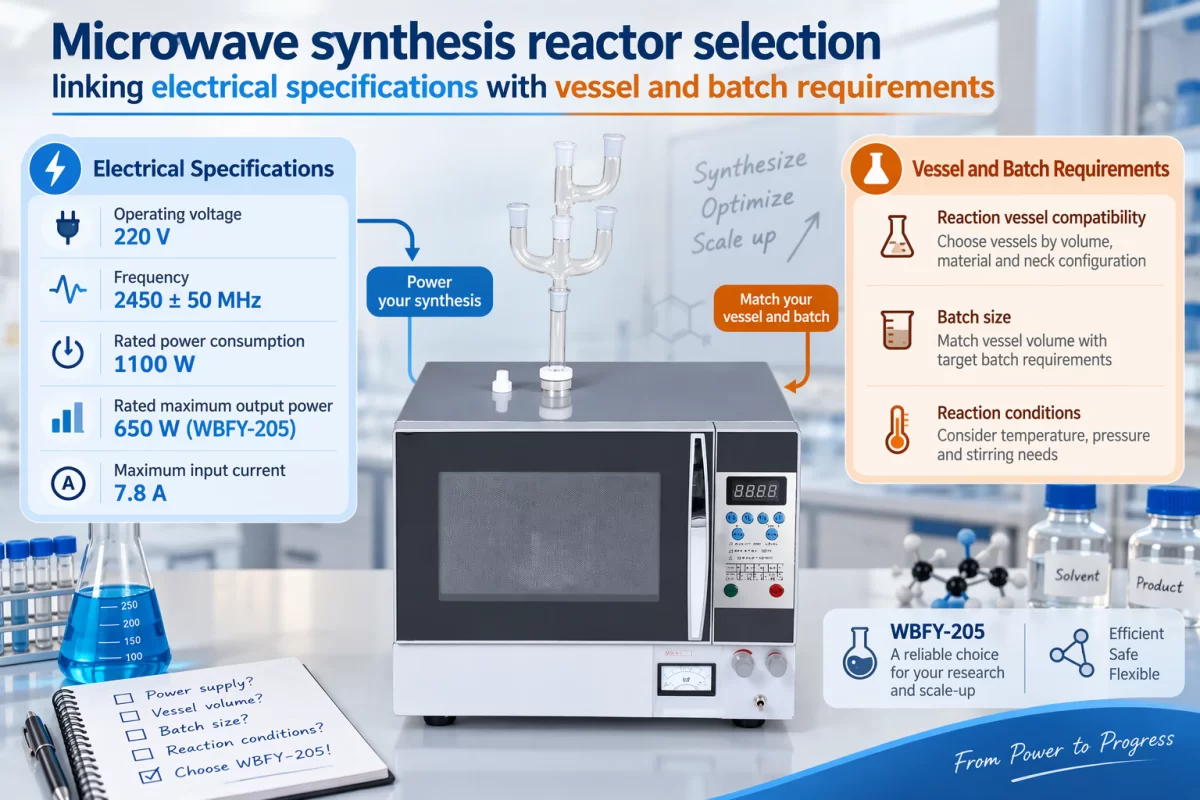
KD Instrument offers a Microwave Synthesis Reactor product page as a starting point for equipment inquiries. The WBFY-201 and WBFY-205 specifications below provide electrical and dimensional information for initial comparison. They do not establish a usable reaction volume, permitted reaction pressure, or maximum process temperature.
Keep chamber dimensions separate from vessel working capacity. A vessel must fit the intended arrangement, but physical fit alone does not demonstrate chemical compatibility, adequate mixing, or suitability for a proposed operating condition. Likewise, rated microwave output is not a direct measure of reaction throughput or absorbed energy.
| Specification | Unit | WBFY-201 | WBFY-205 |
|---|---|---|---|
| Rated power consumption | W | 1,100 | 1,100 |
| Rated maximum output power | W | 750 | 650 |
| Maximum input current | A | 7.8 | 7.8 |
| Operating voltage | V | 220 | 220 |
| Frequency | MHz | 2,450 ± 50 | 2,450 ± 50 |
| Chamber dimensions | mm | 290 × 295 × 190 | 290 × 295 × 190 |
| Overall dimensions | mm | 480 × 340 × 280 | 480 × 340 × 380 |
| Gross weight | kg | 20 | 35 |
Dimensions are presented in the listed order. Chamber dimensions are not a reaction-volume rating.
Does higher rated microwave output guarantee a better synthesis result?
I would treat output power as an equipment characteristic, not a performance verdict. The trial must establish how the selected vessel, formulation, load, and operating procedure behave together. A higher maximum output does not by itself demonstrate better yield, fewer impurities, or a shorter complete cycle.
Build an evidence package that survives the next scale step
Use a documented baseline and a planned sequence of trials. Where feasible, compare conventional and microwave runs using equivalent starting materials, analytical methods, and product targets. Record differences in the temperature history rather than attributing every observed improvement to microwave heating.
Changing batch size can change mixing, heat removal, vessel geometry, and the way a formulation couples with microwave energy. Avoid increasing several variables simultaneously: if concentration, vessel shape, and batch size all change together, the cause of a different result becomes difficult to interpret.
- Record the setup: identify the equipment model, vessel, working load, reagent lots, addition sequence, and measurement locations.
- Capture the full run: retain time-stamped operating observations and analytical samples, including deviations and interrupted runs.
- Repeat the selected condition: agree on the number of independent runs and allowable variation before declaring the condition repeatable.
- Test downstream recovery: assess isolation, washing, drying, and cleaning instead of stopping the evaluation at conversion.
- Set a bounded next step: define the next working batch and the evidence needed before progressing further.
Where crystallization is part of product isolation, include that operation in the development plan. The crystallization reactor equipment page is a relevant starting point for a separate downstream equipment inquiry; synthesis performance alone does not establish isolation performance.
What should a successful pilot trial authorize?
I would authorize only the next defined development step supported by the evidence. One acceptable run should not authorize an unrestricted increase in batch size. I would expect repeat results, acceptable product quality, a documented operating procedure, and a clear understanding of the limits tested.
Prepare an application-led equipment inquiry
Provide the reaction type, solvents, material quantities, intended working batch, target operating conditions, vessel requirements, and desired measurements when requesting a proposal. State whether the immediate objective is laboratory screening, a larger development batch, or a pilot-stage feasibility study. These are different requirements and should not be treated as interchangeable.
Our company reference price is US$492. This is a budgeting reference, not a model-specific quotation or a complete pilot-system price. The actual quotation depends on the requested configuration and inquiry results.
Assess the proposed equipment against the trial brief before making a purchasing decision. The strongest proposal is one that addresses the intended materials, working arrangement, measurement needs, and acceptance evidence—not simply the highest listed output power.
Choose a scale-up decision supported by evidence
A Microwave chemical reactor for fast organic synthesis scale-up is worth evaluating when the trial can answer a specific process question. It should not be purchased on the assumption that every reaction will accelerate or that a laboratory result transfers directly to a larger batch.
Define the quality target, measure the full process cycle, document the operating arrangement, and require repeatable results. With those foundations, a microwave synthesis trial can support a defensible decision: advance to a bounded next step, revise the process, or retain the existing method. Share the application and trial objectives with KD Instrument to discuss a corresponding equipment proposal and quotation.