Laboratory equipment · Evidence-based selection
Microwave Reactor Heating Rate and Uniformity: What Evidence Should You Request?
Evaluating lab microwave chemical reactor heating rate and uniformity requires more than comparing power ratings. A useful assessment connects temperature measurements to a defined material, vessel, working batch, and operating procedure. The purchasing question is not which reactor deserves an absolute speed ranking, but which equipment can demonstrate suitable thermal behavior for the intended process.
Heating-rate evidence starts with a defined test
Microwave heating depends on how the load interacts with the applied electromagnetic field. Solvent composition, sample mass, vessel geometry, and mixing can affect the temperature response. A heating result from one formulation should therefore not be treated as a guaranteed result for another. Nor should a shorter heat-up period be interpreted automatically as a shorter complete reaction.
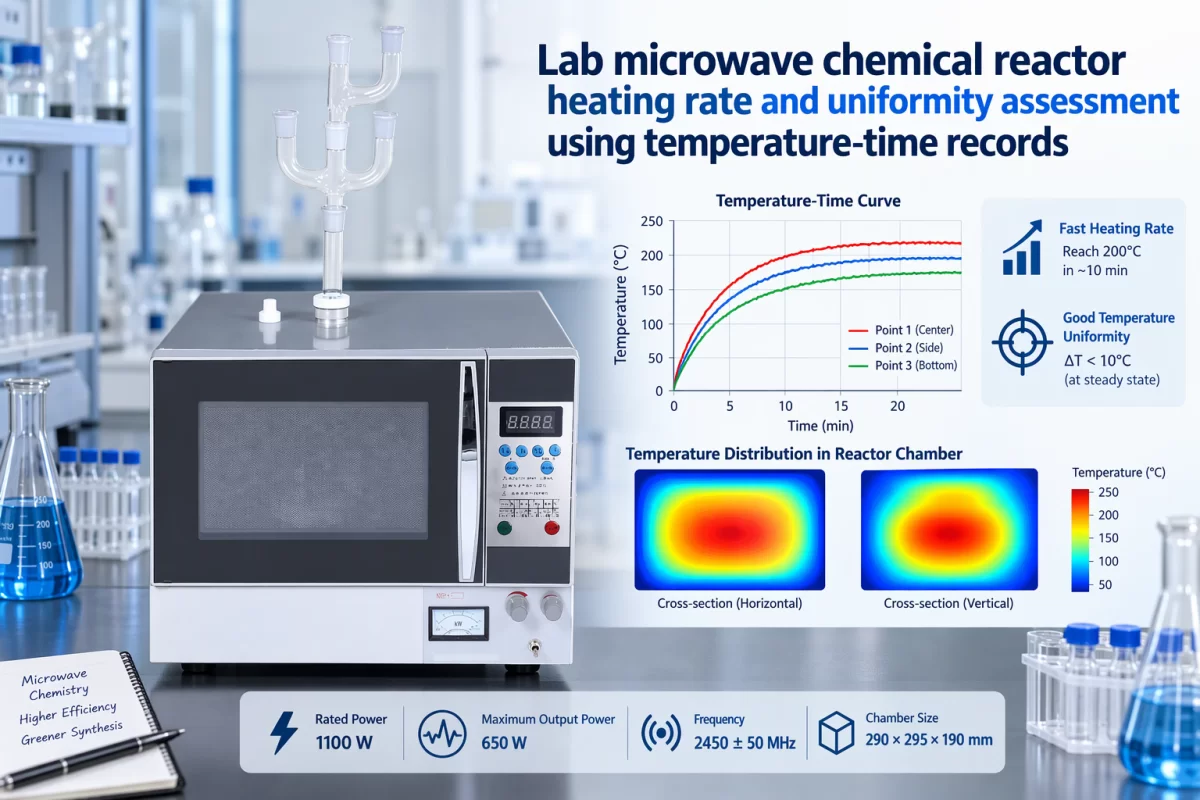
When considering a Microwave Synthesis Reactor for laboratory chemistry, request a temperature-versus-time record for a load that reasonably represents the planned work. The record should identify the starting temperature, target temperature, elapsed time, measurement location, and operating settings. A graph without these conditions offers limited value for equipment selection.
- Define the load: material composition, sample mass or volume, vessel material, and vessel dimensions.
- Define the interval: the exact starting and ending temperatures used to calculate the heating rate.
- Describe measurement: sensor type, placement, calibration information, and recording interval.
- Include control behavior: the approach to the setpoint, any overshoot, and the subsequent holding period.
An average heating rate can be expressed as the temperature rise divided by the elapsed time, commonly in °C/min. That average should be accompanied by the full trace: a single figure can conceal an initially rapid rise followed by slow stabilization.
Does a higher rated microwave output establish a faster reaction?
I would not use rated output alone to predict reaction speed. It describes an equipment rating, not the power absorbed by every sample or the chemistry's response. I recommend comparing measured heating curves and reaction outcomes under matched conditions, including conversion, selectivity, and total processing time.
Temperature uniformity needs spatial and time-based evidence
A stable temperature reading at one location does not establish that the entire reaction mixture is at the same temperature. Uniformity concerns differences across the load; stability concerns changes over time. Both matter, but they require different evidence.
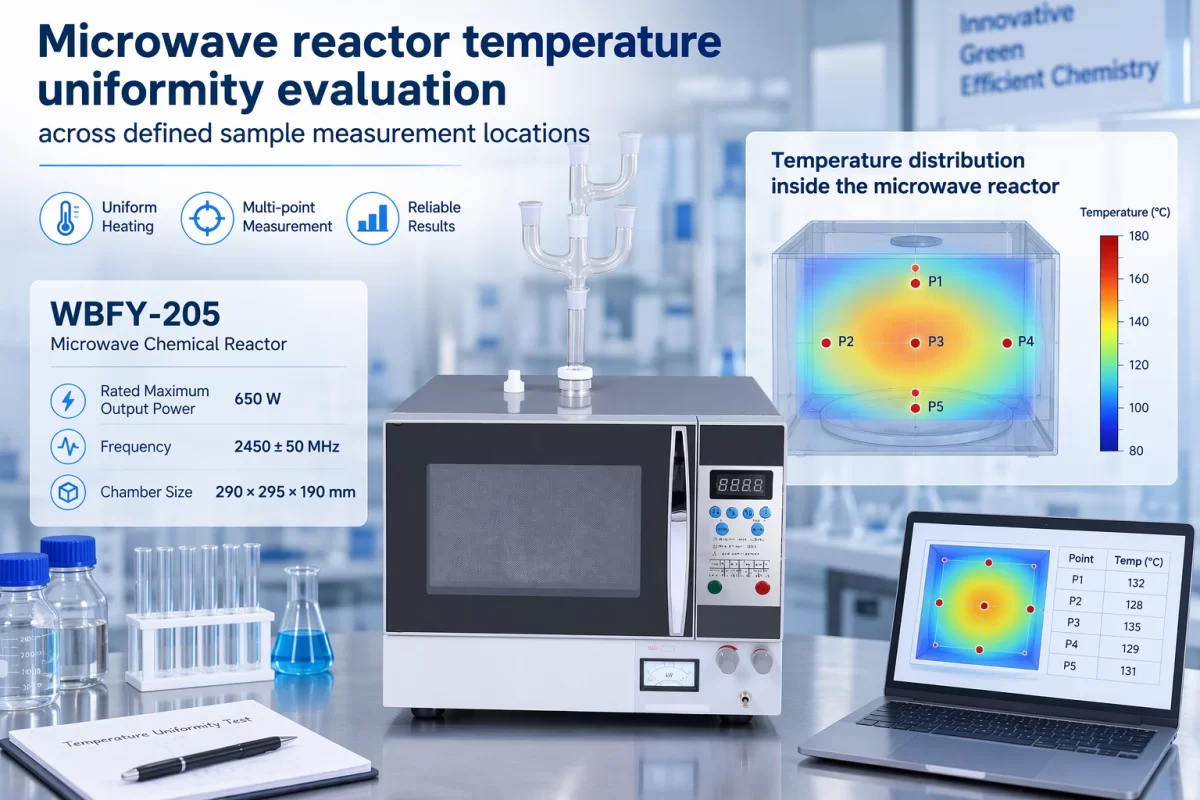
Ask for a measurement plan that identifies representative locations within the working load, including positions where gradients could develop. Measurements should be taken using a method suitable for the microwave environment. Probe installation and testing should follow the equipment manufacturer's safety instructions rather than improvised modifications.
A useful report describes the maximum and minimum measured temperatures at defined times, the resulting temperature spread, and the conditions during heat-up and holding. It should also distinguish a vessel-surface reading from a measurement of the reaction mixture. Surface temperature alone may not describe the internal thermal distribution.
Can one temperature reading demonstrate uniform heating?
I regard one reading as evidence for that measurement location only. For uniformity, I recommend a documented multi-location assessment or another validated spatial measurement method, with the vessel, load, and mixing conditions clearly described. The acceptable temperature spread should come from the process requirements, not from a generic claim.
WBFY-201 and WBFY-205: specifications that support selection
The following model-specific specifications help assess electrical requirements, chamber dimensions, and installation space. They are not measured heating-rate or uniformity results. Keep the model identity attached to every specification when comparing quotations and test reports.
| Parameter | Unit | WBFY-201 | WBFY-205 |
|---|---|---|---|
| Rated power consumption | W | 1100 | 1100 |
| Rated maximum output power | W | 750 | 650 |
| Maximum input current | A | 7.8 | 7.8 |
| Operating voltage | V | 220 | 220 |
| Microwave frequency | MHz | 2450 ± 50 | 2450 ± 50 |
| Chamber dimensions | mm | 290 × 295 × 190 | 290 × 295 × 190 |
| Overall dimensions | mm | 480 × 340 × 280 | 480 × 340 × 380 |
| Gross weight | kg | 20 | 35 |
On smaller screens, scroll horizontally to view all model columns.
Rated power consumption and rated maximum output power are different quantities. Neither provides a direct measurement of sample heating efficiency. Likewise, chamber dimensions describe the available enclosure space, not the permitted reaction volume. Vessel suitability and working batch size should be established for the proposed application.
Repeatability and process outcomes complete the comparison
A single successful demonstration is a starting point, not a complete acceptance test. Request repeated runs using the same preparation method, vessel placement, starting temperature, and operating procedure. Compare the time to target temperature, overshoot, holding behavior, and spatial temperature spread across the runs.
If microwave heating is being evaluated against a conventional method, use matched chemistry and comparable temperature histories where practical. Record preparation, heat-up, reaction holding, cooling, and handling separately. This avoids attributing every difference in total workflow time to the heating mechanism.
Thermal performance must also be compatible with safe operation. Before specifying a process, obtain the applicable instructions for vessel compatibility, solvent use, ventilation, and any proposed pressure or reflux arrangement. A temperature test does not establish suitability for every reaction environment.
What should an acceptance test prioritize for heat-sensitive chemistry?
I would prioritize temperature overshoot, spatial gradients, and repeatability alongside heat-up time. A rapid ramp is useful only when the material remains within its acceptable thermal conditions and the resulting chemistry meets the required quality criteria.
Build an evidence-led specification and quotation request
Start with the process requirements rather than a broad request for the fastest equipment. A concise application brief allows the supplier to propose a microwave chemical reactor and discuss a relevant demonstration without assuming that every reaction will accelerate.
- Describe the material, solvent system, vessel, and intended working batch.
- State the initial temperature, target temperature, holding duration, and acceptable overshoot.
- Define the allowable temperature spread and the evidence needed to assess it.
- Specify repeated-run expectations and the reaction-quality measures that matter.
- List installation requirements and the desired accessories or measurement configuration.
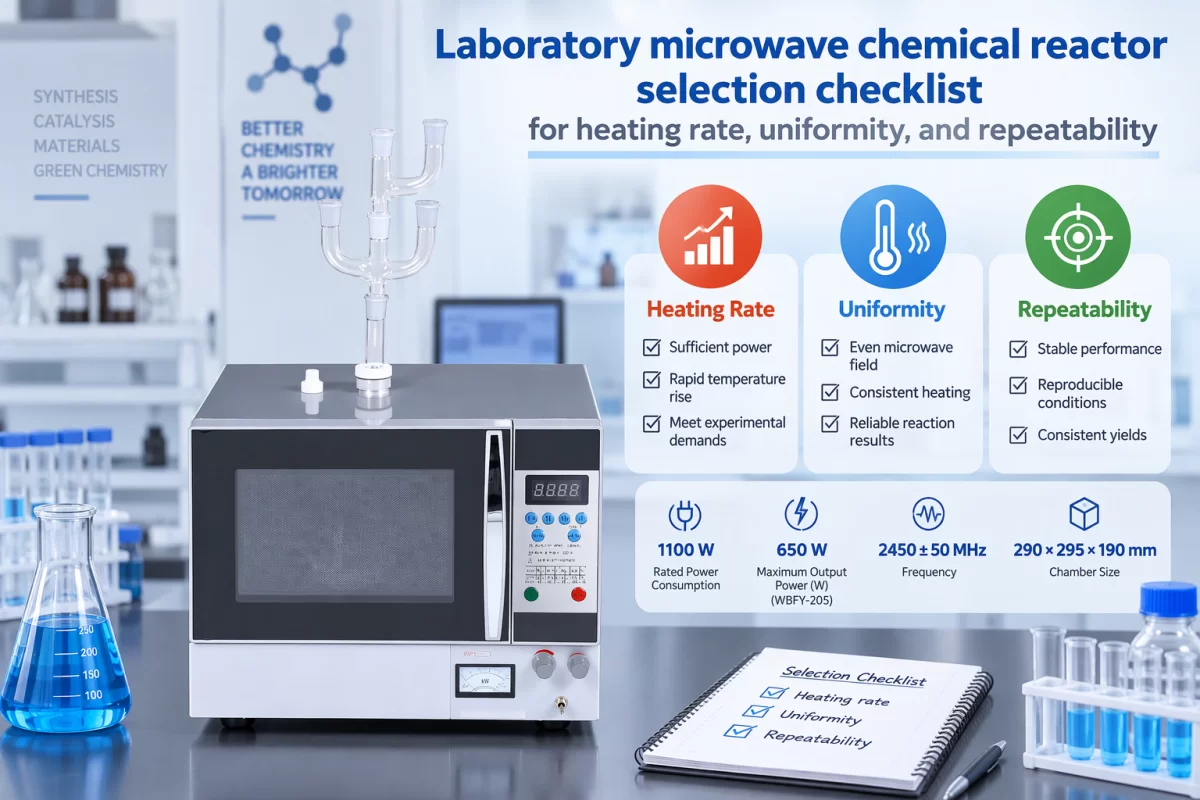
For additional purchasing context, the microwave reactor cost and application guide can accompany the technical discussion. Keep the quoted equipment scope and the agreed performance evidence together when comparing proposals.
Choose microwave heating with evidence, not an absolute ranking
A credible assessment of lab microwave chemical reactor heating rate and uniformity combines defined test conditions, complete temperature traces, spatial measurements, and repeated runs. Model specifications establish an equipment baseline; application-relevant testing establishes whether the thermal behavior suits the intended work.
Send the material details, working batch, target operating conditions, and configuration requirements to KD Instrument to discuss an appropriate microwave chemical reactor proposal and quotation. Make the desired evidence part of that discussion from the start.