Laboratory processing • Sample-led planning
Mini Spray Dryer Throughput for R&D: Plan Around Available Sample
Choosing a compact mini spray dryer for R&D powder production starts with a practical question: how much usable sample is available for each experiment? For research and small-batch trials, the best planning basis is the liquid allocation, its solids content, and the powder needed for analysis—not the evaporation rating alone. A smaller laboratory system can support this workflow, provided the experiment accounts for feed delivery, operating stability, collection, and cleaning.
Start with the sample budget, not the largest capacity
Before booking a spray drying trial, separate the total prepared sample from the amount actually available for drying. Analytical checks, transfer losses, retained reference material, and repeat experiments may all draw from the same batch. A nominally adequate preparation can become restrictive once several operating conditions are included.
Define the purpose of the first run. A feasibility screen may only need enough recovered material to assess whether a powder can be collected and characterized. A formulation comparison may require separate samples for moisture measurement, particle assessment, stability work, and repeat testing. The experimental objective should determine the sample allocation.
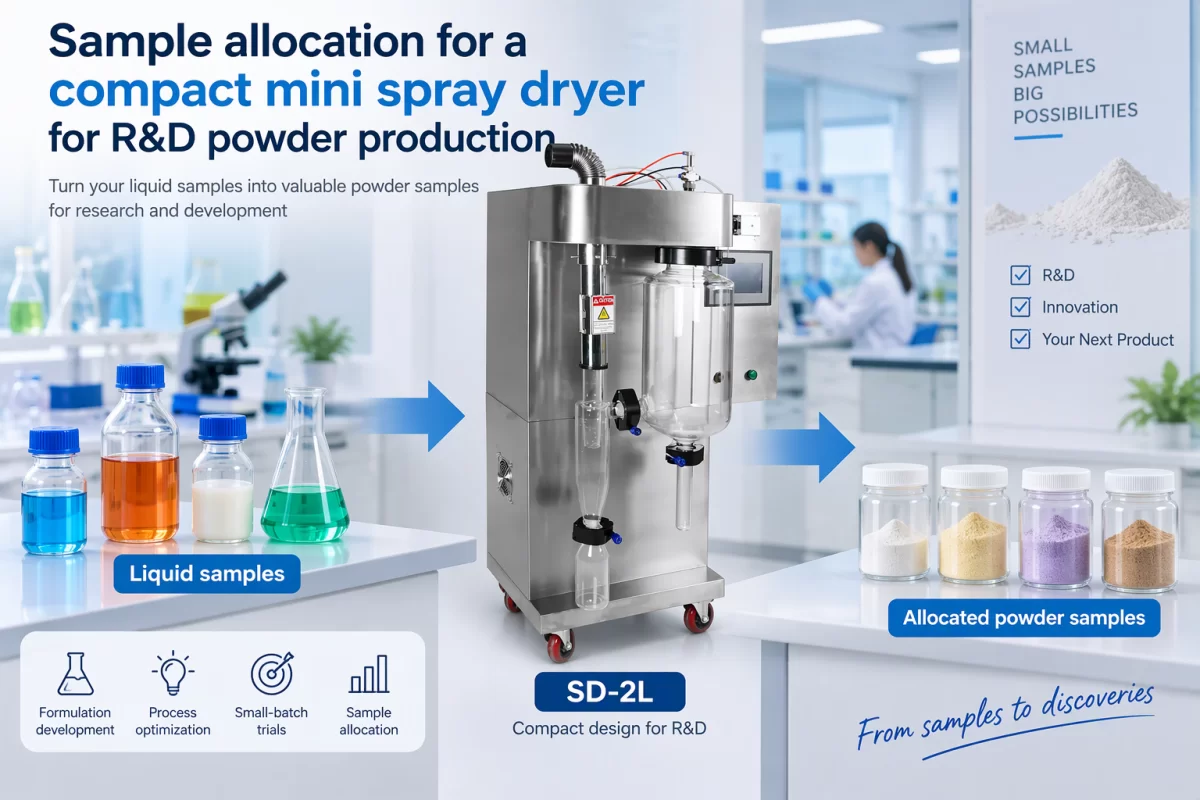
Is the minimum feed quantity enough for a complete research trial?
I treat the SD-2L minimum feed quantity of 50 mL as an equipment planning reference, not a promise of sufficient collected powder. The useful result depends on the solids in that liquid, material retained in the feed path, collection losses, and the analytical sample requirement. For a scarce formulation, I would first calculate the available dry solids and prioritize one informative condition rather than distribute the sample across too many short runs.
Mini spray dryer throughput: separate water removal from powder output
Three quantities need to remain distinct: liquid feed rate, evaporated water rate, and collected powder rate. They describe different parts of the process. A dilute feed may require substantial water removal while supplying relatively little dry matter. Collection losses can further reduce the amount recovered for testing.
An evaporation rating is not a powder production rating. Estimate powder availability from the feed’s dry solids, then evaluate actual collection performance during the trial.
For a first-pass material balance, multiply feed mass by the dry-solids mass fraction. If only a liquid volume is known, use a measured density to convert volume into mass. Do not assume every formulation has the density of water. Carrier solids, where used, should be included in the total dry-solids calculation.
A hypothetical sample calculation
Available dry solids = feed mass × dry-solids mass fraction
Suppose a trial has 500 g of feed containing 10% dry solids by mass. That feed contains 50 g of dry solids before process losses. This is a material-balance example, not an SD-2L output guarantee. Collected dry solids may be lower because some material remains in the equipment or is not recovered. If the collected powder contains residual moisture, its measured mass also includes that moisture.
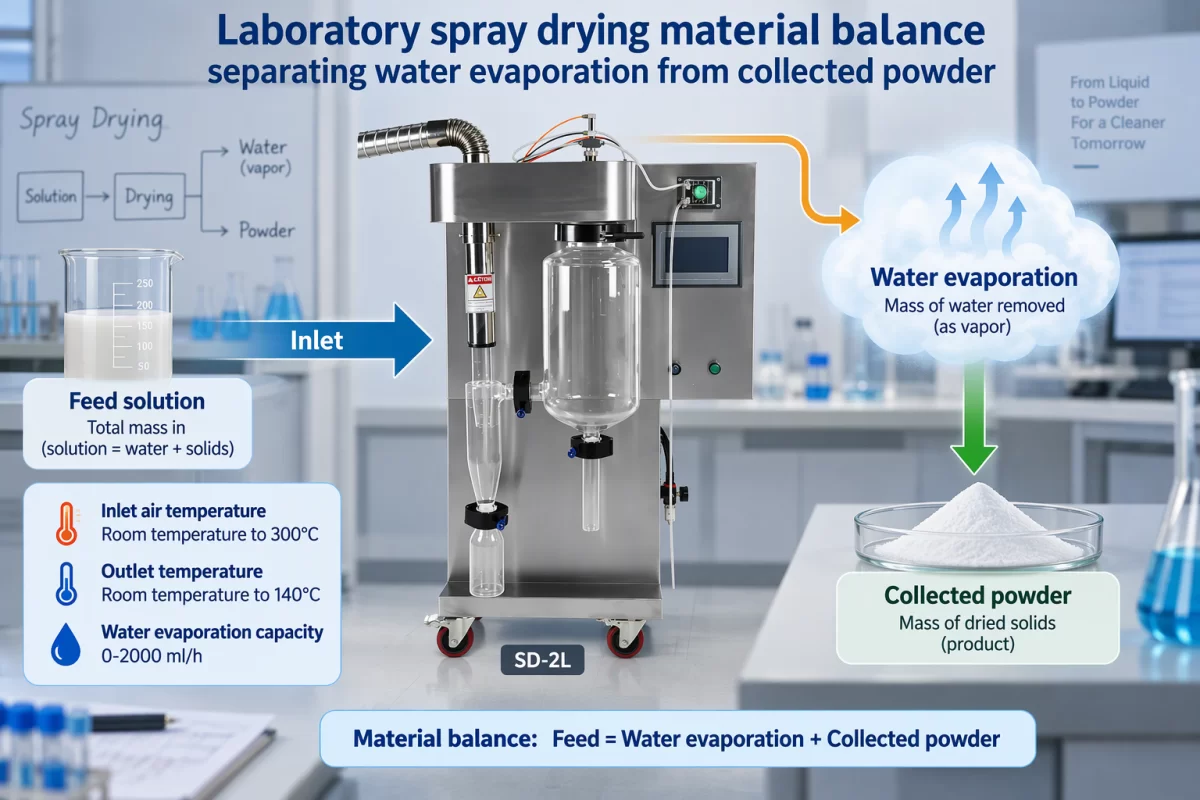
Does a 2,000 mL/h water evaporation rating mean 2 kg/h of powder?
No. I would use the SD-2L evaporated-water specification of 1,500–2,000 mL/h only as a water-removal reference. It does not establish a powder mass rate. Feed concentration, the selected feed rate, residual moisture, and collection behavior determine the practical powder result. Actual achievable operation must also be evaluated for the material and drying conditions.
SD-2L specifications for compact R&D trial planning
The SD-2L provides a small laboratory equipment option for sample-led trials. Its peristaltic-pump feed adjustment is relevant when establishing a workable feed rate for a formulation. The temperature ranges below describe equipment control ranges, not recommended drying recipes or verified suitability for every material.
| Parameter | SD-2L value | Planning relevance |
|---|---|---|
| Minimum feed quantity | 50 mL | Starting reference for sample allocation; not a powder-yield guarantee. |
| Maximum feed volume rate | 2,000 mL/h | Upper feed specification, not an automatic operating target. |
| Evaporated water | 1,500–2,000 mL/h | Water-removal specification; separate from collected powder output. |
| Feeding method | Peristaltic pump adjustment | Feed delivery setting to record during each trial. |
| Inlet air temperature control | 30–300 °C | Equipment control range; select conditions for the formulation. |
| Outlet temperature control | 30–150 °C | Equipment control range; record the observed operating temperature. |
| Nozzle diameter | 1.00 mm | Relevant to assessing feed compatibility and cleaning needs. |
| Compressed air working pressure | 2–3 bar | Air-system operating requirement for trial preparation. |
| Electric heater | 3.5 kW; AC 220 V, single-phase, grounding | Heater electrical specification, not total equipment power. |
| Equipment dimensions, L × W × H | 600 × 700 × 1,200 mm | Equipment envelope; allow additional access and service space. |
| Equipment weight | 130 kg | Consider delivery, positioning, and installation arrangements. |
Explore the Mini Spray Dryer for laboratory powder trials when discussing a sample-limited project. Selection should connect the equipment configuration with the feed composition, available batch, target operating conditions, and required analytical output.
Build the schedule around the complete experiment
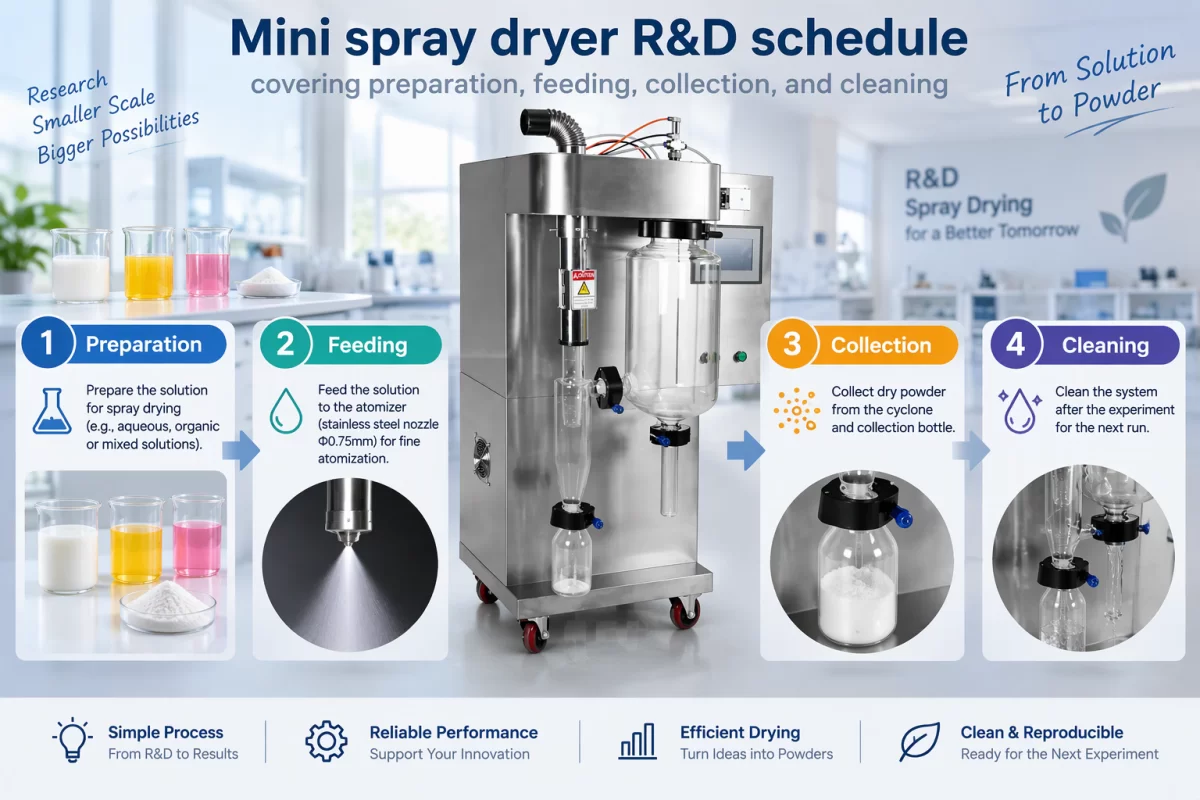
Feeding time is only one part of a laboratory booking. A practical schedule includes equipment preparation, warm-up, stabilization, sample feeding, powder collection, shutdown, and cleaning. The SD-2L’s stated average drying time of 1.0–1.5 seconds should not be used as the duration of a complete batch or the interval between experiments.
- Prepare and document the feed. Record sample mass or volume, density where needed, solids content, and the material available after analytical reservations.
- Establish a workable condition. Select initial settings based on the material, then observe feed delivery and drying behavior before committing the remaining sample.
- Calculate the feeding window. Divide allocated liquid volume by the chosen volumetric feed rate. Treat this as feeding time only, with consistent units.
- Collect and label each result. Record recovered mass, operating observations, and the condition associated with every powder sample.
- Allow for cleaning and repeats. Adjust subsequent bookings using measured experience with the formulation rather than a fixed capacity assumption.
How should a limited sample be divided across several conditions?
I would begin with the powder needed for each analytical package and work backward to the required feed solids. Next, I would reserve material for a repeat and allocate the remainder to a small number of meaningful conditions. A preliminary run can inform later allocations, especially when collection losses are not yet known.
Application context also matters when deciding what to measure. The overview of spray drying applications and examples can help frame the research objective, while material-specific trials remain necessary to establish a suitable process.
Budget for the configuration and the trial workload
Our company’s reference price: US$2,800–3,250.
This is a reference price for budget discussion, not a fixed quotation for a particular SD-2L configuration. The actual quotation depends on configuration and the inquiry outcome. Provide the material description, working batch size, intended operating conditions, and configuration requirements to obtain a corresponding equipment proposal and price.
Laboratory planning should also consider the practical workload: sample preparation, operator time, analysis, cleaning, and repeat experiments. For an R&D program, useful throughput is better expressed as completed, interpretable trials with sufficient collected material than as the largest liquid volume processed in an hour.
Choose a compact mini spray dryer around the research objective
A compact mini spray dryer for R&D powder production is most useful when equipment selection and experiment design share the same sample budget. Start with available dry solids, estimate the material required for analysis, and schedule the full workflow. Keep water evaporation, feed delivery, and recovered powder as separate measurements.
For research and small-batch trials, a well-planned sample can be more valuable than unused nominal capacity. Share the feed material, available quantity, target powder requirement, and trial conditions to discuss an appropriate mini spray drying solution.