Laboratory spray drying · Feed setup selection
Small-Scale Pharmaceutical Powder Trials: Selecting a Mini Spray Dryer Feed Setup
Selecting a mini spray dryer for small-scale pharmaceutical powder preparation starts with the liquid available for the experiment—not simply the largest hourly capacity. For formulation screening and exploratory powder trials, the feed setup must suit the sample volume, material behavior and intended collection plan. The SD-2L provides a compact equipment option to evaluate, with peristaltic pump adjustment and a specified minimum feed quantity of 50 mL.
Start with usable trial liquid, not nominal throughput
A prepared formulation volume is not automatically the volume available for atomization. Some liquid may be reserved for concentration measurements, stability checks or repeat testing. Additional liquid can remain in the feed vessel and tubing. Before selecting the setup, separate the total prepared volume from the quantity allocated to the drying run.
For a pharmaceutical research trial, record the feed composition, solids concentration, solvent system and whether the material is a solution, suspension or emulsion. These details help define the feeding requirements. Suspensions may require a plan to manage settling, while viscous formulations need attention to transfer through the proposed tubing and nozzle. Equipment selection should follow the actual formulation rather than assuming every liquid behaves like water.
Does a 50 mL minimum feed quantity guarantee enough powder for analysis?
I would treat 50 mL as the SD-2L’s specified minimum feed quantity, not as a guaranteed analytical sample size. Collected powder depends on the solids supplied and the losses experienced during the run. I recommend working backward from the powder needed for testing, then allowing for liquid retained in the feed path and material that is not collected.
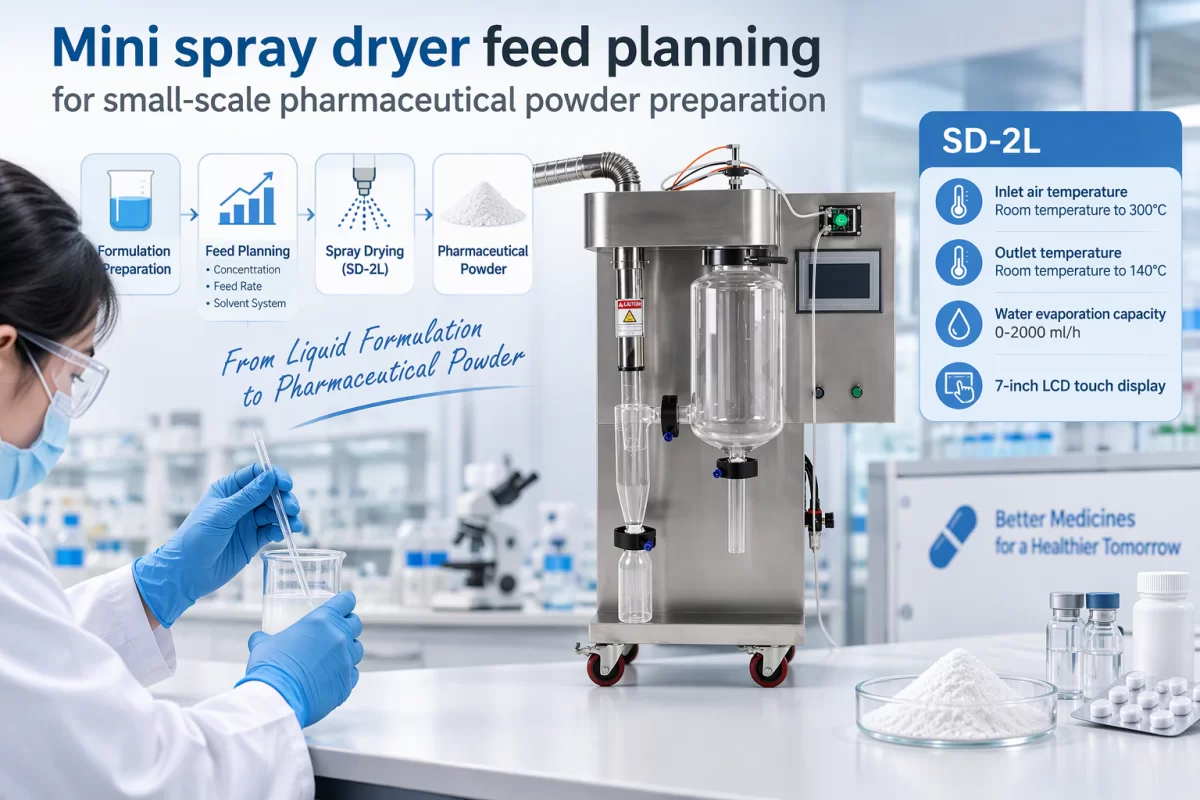
SD-2L feed-related specifications for laboratory trials
The following specifications apply to the SD-2L. They provide a starting point for discussing a small-scale feed setup, without treating maximum throughput as the required operating point for a limited-volume experiment.
| Parameter | SD-2L specification | Selection relevance |
|---|---|---|
| Feeding method | Peristaltic pump adjustment | Provides an adjustable liquid-feed approach. |
| Minimum feed quantity | 50 mL | A starting reference for available sample volume. |
| Maximum feed rate | 2,000 mL/h | An upper feed specification, not a batch-volume requirement. |
| Nozzle diameter | 1.00 mm | Relevant when assessing the proposed feed and atomization setup. |
| Compressed air working pressure | 2–3 bar | Relevant to planning the compressed-air arrangement. |
| Equipment dimensions, L × W × H | 600 × 700 × 1,200 mm | Supports laboratory placement planning; service access needs additional space. |
Volume and rate answer different questions: milliliters describe the available liquid quantity; milliliters per hour describe how quickly liquid is supplied. Neither value alone establishes the amount of usable powder a trial will produce.
For an equipment discussion, the Mini Spray Dryer product page is the relevant starting point. Specify the SD-2L when requesting a feed arrangement based on the values above.
Match peristaltic pump feeding to the formulation
With peristaltic pump adjustment, the feed path deserves as much attention as the dryer itself. Tubing material should be compatible with the formulation and cleaning procedure. The selected tubing arrangement, suction position and routing should also be considered when planning how much liquid will remain outside the drying chamber.
A practical setup keeps the feed vessel accessible, avoids unnecessary tubing length and allows the operator to observe liquid delivery. For a suspension, the protocol should address how composition will be maintained during withdrawal. Any mixing method must be appropriate for the material; it should not introduce avoidable foaming or change the formulation.
Should a limited-volume trial run at the maximum feed rate?
I would not choose the maximum rate solely to shorten the experiment. For a small sample, a faster feed can leave little time to observe behavior or separate startup material from the intended collection period. I recommend selecting the operating feed rate together with the drying conditions and recording actual liquid consumption over a timed interval.
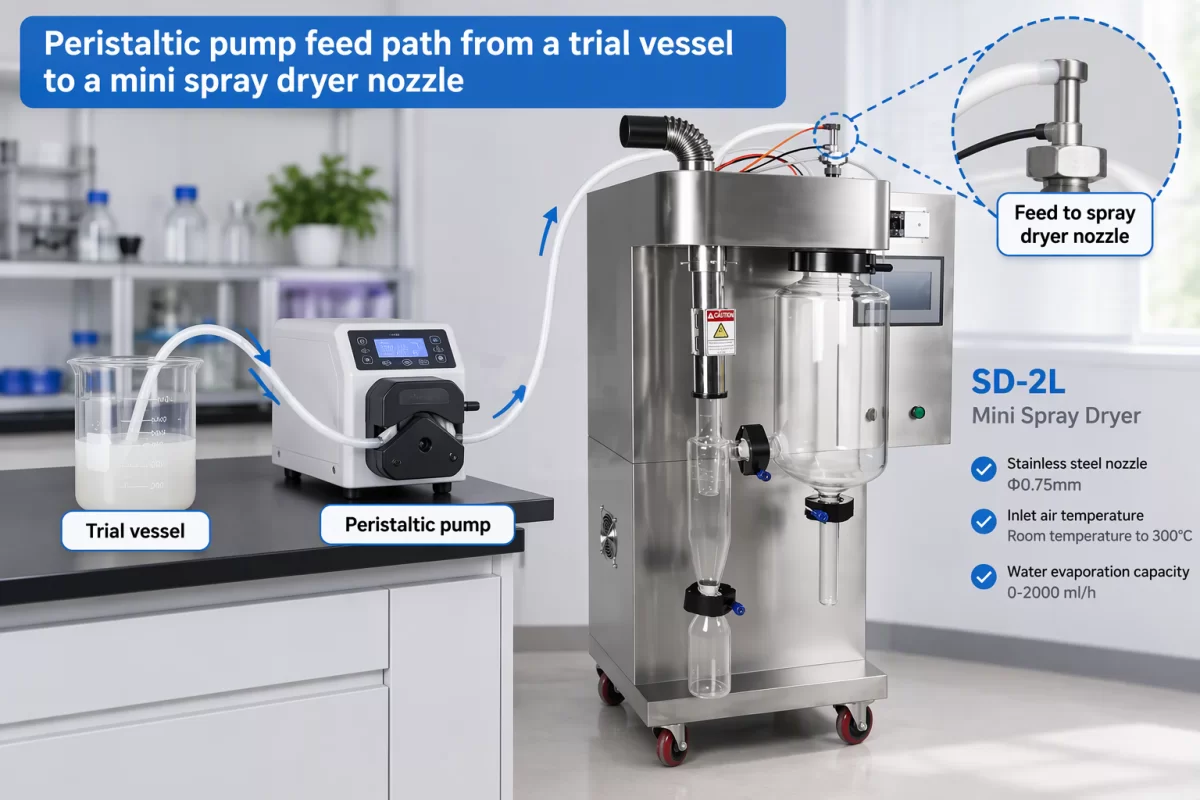
Build a feed-volume plan for pharmaceutical powder preparation
A useful first experiment should answer a defined research question: whether the formulation can be fed consistently, whether powder can be collected for the intended tests, or how a selected process change affects the sample. General examples of spray-drying applications provide broader context, but the feed plan should remain specific to the material under study.
- Define the analytical requirement. List the planned powder tests and the sample quantity needed for each, including repeat measurements where appropriate.
- Calculate the solids supplied. Use the measured feed concentration and allocated liquid quantity. Distinguish theoretical solids input from actual collected powder.
- Budget the complete liquid path. Include formulation reserved for analysis, tubing priming, vessel residue and any startup or shutdown liquid used by the protocol.
- Choose a collection strategy. Decide whether startup powder will be separated and identify the collection interval used for comparing trial conditions.
- Record actual consumption. Measure liquid depletion over time and document feed behavior, interruptions and collected powder mass.
For small-batch comparisons, consistency in feed preparation and handling can be as important as the chosen operating settings. Changing concentration, mixing practice and feed rate simultaneously makes it harder to interpret the result. Where possible, vary one planned factor at a time and keep a clear trial record.
Keep equipment selection within the research trial scope
Small-scale pharmaceutical powder preparation is an application to assess against the specific material and laboratory requirements. A feed specification does not establish suitability for every active ingredient, solvent or regulated manufacturing process. Solvent-containing, potent or hazardous feeds require an appropriate safety assessment and equipment arrangement before a drying trial is planned.
What information makes a feed-setup inquiry more useful?
I recommend supplying the available liquid volume, formulation type, solvent composition, solids concentration, viscosity information and desired powder quantity. Include whether the work is a single screening run or a series of repeat trials. These details allow the discussion to focus on the feed path and working batch rather than nominal capacity alone.
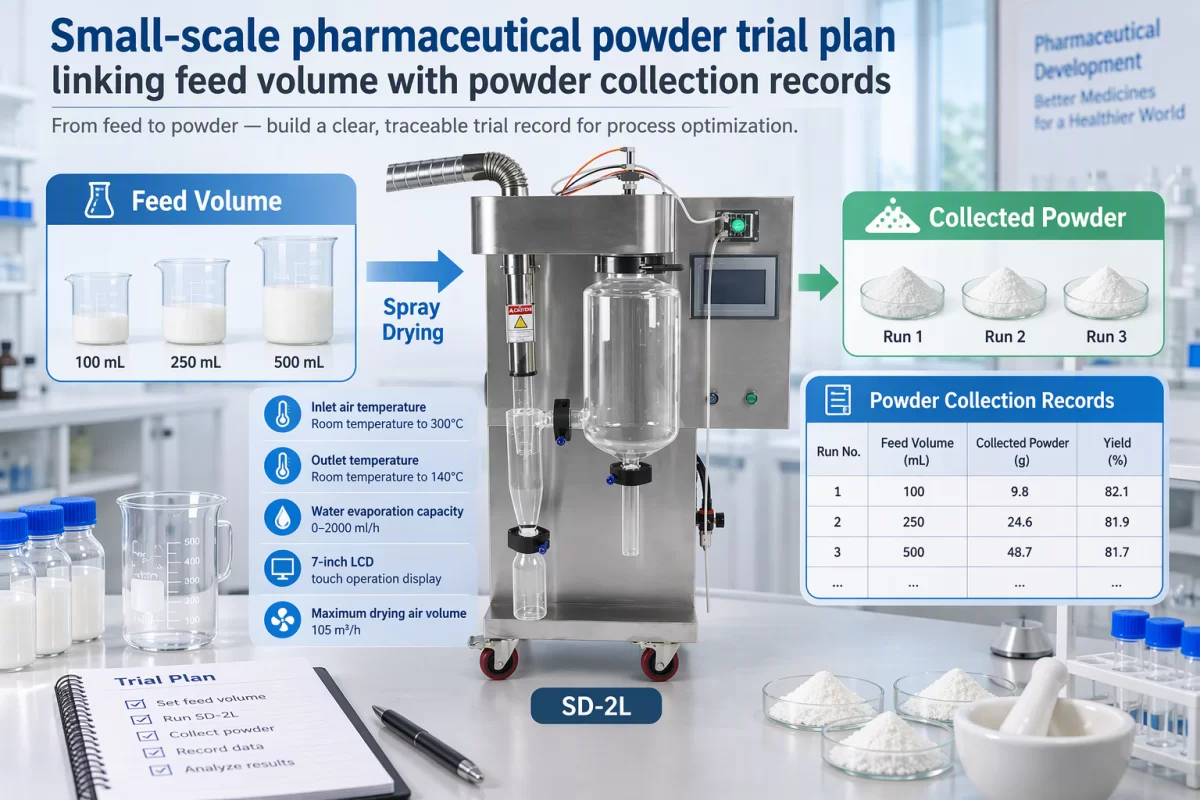
Select the mini spray dryer around the usable sample
A mini spray dryer for small-scale pharmaceutical powder preparation should be selected around the liquid that can actually support the trial. The SD-2L’s peristaltic pump adjustment, 50 mL minimum feed quantity and 2,000 mL/h maximum feed specification offer concrete starting points for that discussion. The next step is to connect those specifications to formulation behavior, feed-path hold-up and the powder needed for analysis.
Planning a research or small-batch trial? Share the material, available liquid quantity, target working conditions and configuration needs with KD Instrument to request a corresponding feed setup proposal and quotation.