Laboratory equipment • Selection guide
Which Vacuum Oven Features Matter Most for Heat-Sensitive Samples?
Choosing the best lab vacuum drying oven for heat-sensitive samples starts with the sample’s limits, not the oven’s maximum temperature. Temperature regulation, vacuum connections, usable chamber space, and process records all affect whether a drying method can be developed and repeated with confidence.
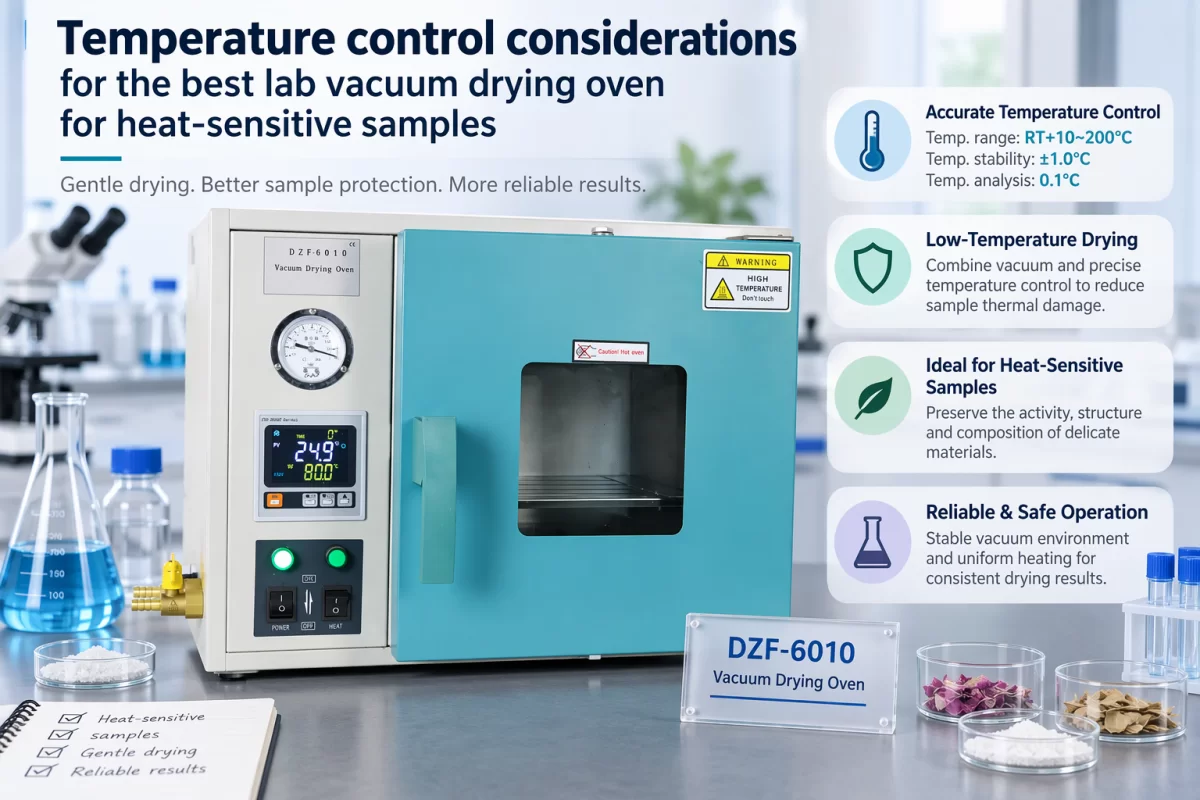
Temperature control: prioritize sample protection over heating limits
Reduced pressure can support evaporation at lower temperatures than would be needed at atmospheric pressure, but it does not make every material safe to heat. A sensitive compound may degrade during a long exposure, while a wet powder may change structure as solvent leaves. The useful selection question is therefore whether the oven can maintain the working conditions needed by the method.
The DZF-6010, DZF-6020, DZF-6050, and DZF-6090 specifications list temperature stability of ±1.0 °C. This is a control-related specification, not a guarantee of sample temperature, chamber-wide uniformity, or freedom from overshoot. For sensitive materials, evaluate the loaded chamber and consider independent temperature measurement at representative sample positions.
Temperature setting, stability, spatial uniformity, and actual sample temperature answer different questions. A precise-looking display should not replace a trial showing that the material remains within its acceptable thermal exposure throughout the cycle.
Vacuum interfaces: assess the entire drying system
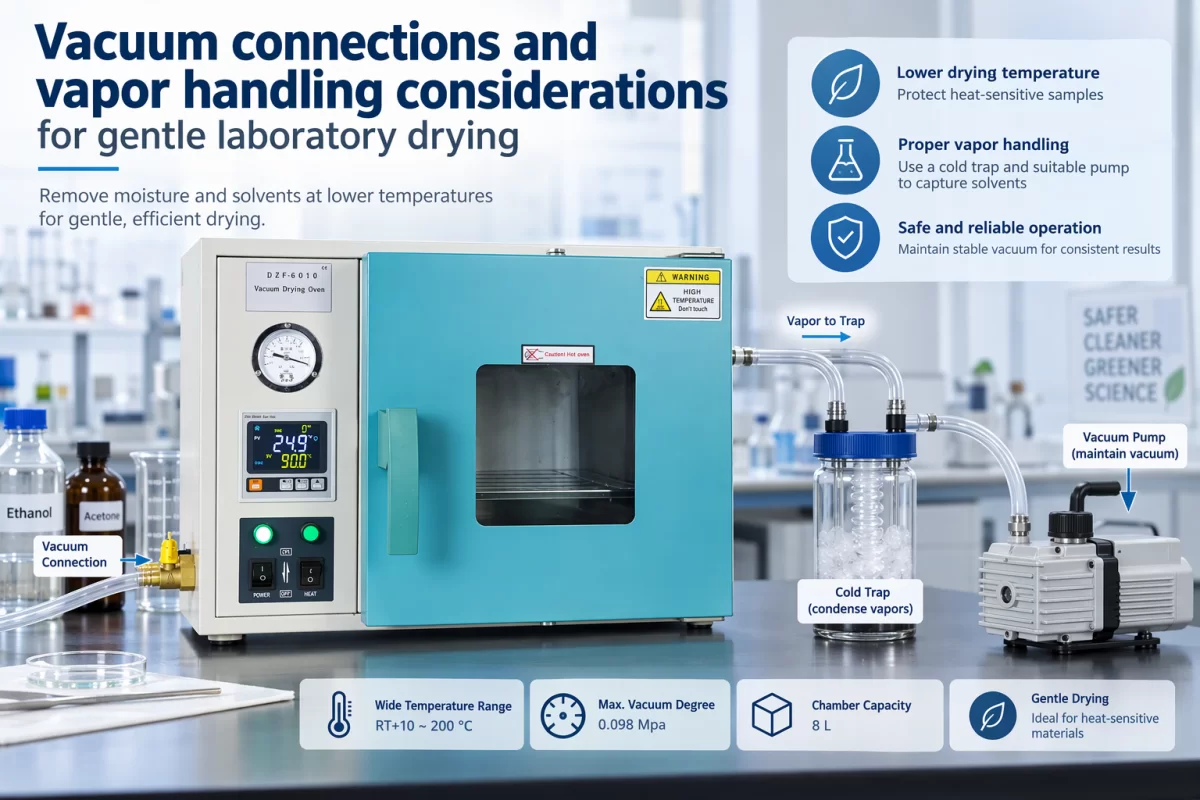
A vacuum oven is only one part of the vacuum path. The pump, connecting line, valves, seals, and vapor-handling equipment must work together. When comparing systems, request the connection type and size, hose compatibility, valve arrangement, pressure measurement method, and the scope of any supplied pump package.
The useful pressure is the pressure maintained during the loaded drying process, not merely a pump specification measured under different conditions. Vapor release, leaks, restrictive tubing, and pump suitability can affect that operating pressure. A gradual evacuation procedure may also be needed when a sample tends to foam, bump, or lose fine particles.
- For water-containing samples: assess the expected vapor load and the pump’s suitability for that duty.
- For solvent-containing samples: evaluate chemical compatibility, vapor collection, exhaust handling, and laboratory safety requirements.
- For fragile powders: develop controlled evacuation and venting steps to reduce sample disturbance.
Flammable or hazardous materials require an application-specific safety assessment. Neither vacuum operation nor a configuration label should be treated as blanket permission to process a particular solvent.
Chamber capacity: choose usable loading space, not just liters
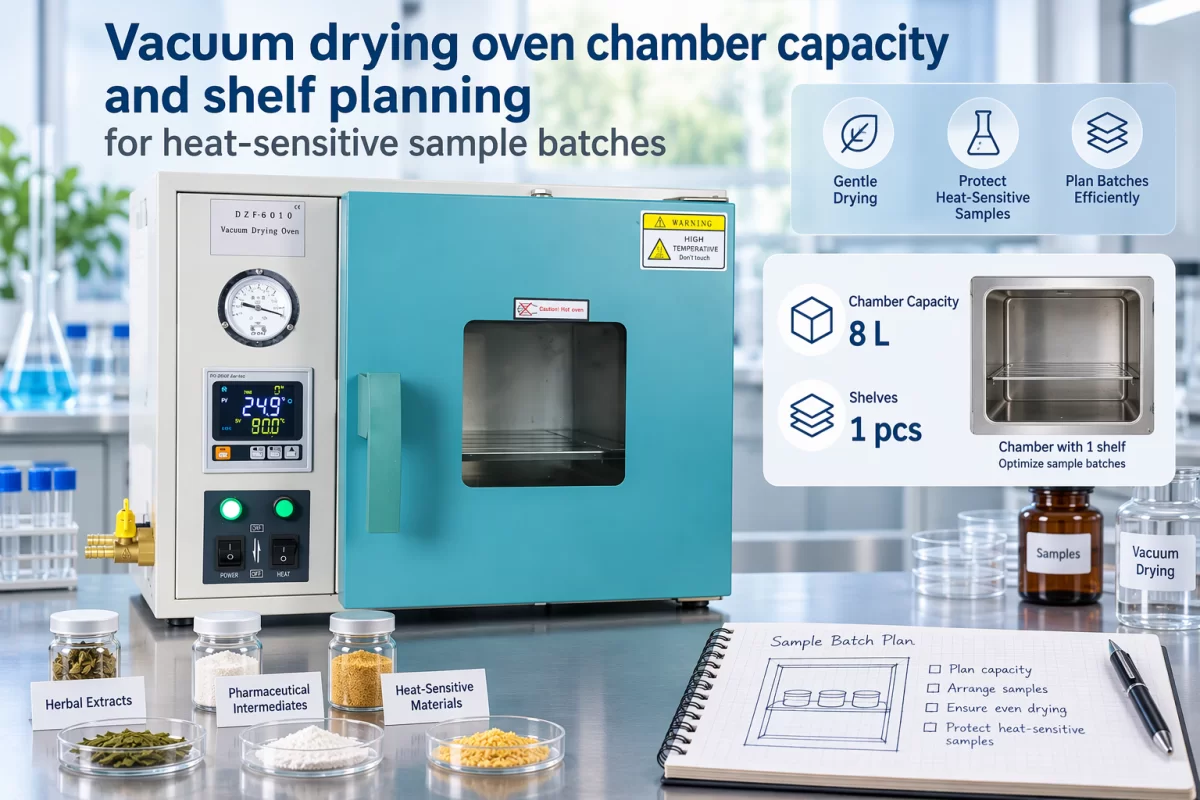
Chamber volume helps narrow the options, but vessel dimensions and loading depth are often more important. A shallow layer in a suitable tray may dry differently from the same mass in a deep container. Allow space for the chosen vessels, safe handling, and a repeatable loading arrangement.
The following DZF models provide several starting points for laboratory batch planning. Input power is the listed electrical input rating; it should not be interpreted as measured cycle energy consumption or a promise of drying speed.
| Model | Chamber capacity (L) | Internal W × D × H (mm) | Shelves (pcs) | Input power (W) |
|---|---|---|---|---|
| DZF-6010 | 8 | 200 × 200 × 200 | 1 | 400 |
| DZF-6020 | 25 | 300 × 300 × 270 | 1 | 700 |
| DZF-6050 | 55 | 400 × 400 × 345 | 2 | 1400 |
| DZF-6090 | 90 | 450 × 450 × 450 | 2 | 2000 |
For small method-development batches, the DZF-6010 is a candidate when the vessels fit its chamber. The DZF-6020 offers more space for a larger single-shelf arrangement. For work requiring two shelf levels, the DZF-6050 and DZF-6090 are candidates to evaluate. These are use-based selection suggestions, not claims that one model dries every material more effectively than another.
These four models list a 304 stainless steel liner. Material compatibility and cleaning procedures should still be assessed for the actual sample, solvent, and residues.
Timing and recording: separate cycle control from evidence
The DZF-6010, DZF-6020, DZF-6050, and DZF-6090 list a timing range of 1–9999 minutes. A timer can support a defined procedure, but elapsed time alone does not establish dryness or document what happened during the cycle.
If traceability matters, define the required records before selecting a configuration. Useful entries include sample identity, initial load, vessel arrangement, temperature settings, measured temperature, pressure history, start and finish times, and the final acceptance result. Depending on the laboratory workflow, records may be maintained manually or through a suitable independent acquisition system.
Built-in data logging, computer connectivity, export formats, and audit-trail functions should be specified as purchasing requirements rather than assumed from a digital display or timing function. For routine exploratory work, a documented manual method may be adequate; for a controlled workflow, recording capability can become a decisive selection criterion.
Which vacuum oven is best for each laboratory use?
- Small screening batches: prioritize vessel fit, manageable loading depth, and temperature behavior at the intended conditions.
- Repeated multi-vessel batches: prioritize shelf layout, consistent loading, and a validated cycle that covers representative sample positions.
- Solvent-removal work: prioritize compatible vacuum connections, pump selection, vapor management, and safety controls.
- Traceable laboratory workflows: prioritize the required measurement and recording arrangements alongside the oven itself.
The Lab Vacuum Drying Oven product page is a starting point for discussing a DZF solution. For a focused recommendation, provide the material, solvent or moisture content, batch size, vessel dimensions, target operating conditions, and recording needs.
Our company’s reference price: US$610. This is a general budgeting reference, not a model-specific quotation or a confirmed package price. The actual quotation depends on configuration and the inquiry result.
Choose the best fit for heat-sensitive sample drying
The best lab vacuum drying oven for heat-sensitive samples is the one that matches the material’s thermal limits, the required vacuum system, the batch layout, and the laboratory’s documentation needs. A larger chamber or a higher heating limit is not automatically a better choice.
Use the DZF model dimensions and capacities to build a shortlist, then establish the actual drying temperature, pressure, duration, and endpoint through sample validation. This application-first approach provides a more useful basis for purchasing than an unsupported “best oven” ranking.