Chemical Process Scale-Up in Jacketed Steel Reactors: Reviewing the Utility System
Selecting a stainless steel jacketed reactor for chemical process scale-up involves more than choosing a larger vessel. The heating and cooling system must support the intended batch, while the installation site must supply the necessary electrical service, circulation connections and heat-rejection capacity. A utility review connects those requirements before equipment is ordered.
Start with the process heat load, not vessel volume alone
A useful scale-up brief describes the initial material temperature, target process temperature, required heating time, cooling endpoint and expected reaction heat. Batch mass and heat capacity influence the sensible heat requirement. Reaction heat, vessel thermal mass, evaporation and losses can add further demands. These contributions should be considered separately rather than represented by a single nominal vessel capacity.
For geometrically similar vessels, volume grows faster than surface area. Consequently, increasing batch size does not automatically preserve the heat-up or cool-down time achieved in a smaller reactor. Available jacket area, the driving temperature difference and the overall heat-transfer coefficient all matter. This review concerns the thermal circuit and facility utilities, rather than an agitator scale-up calculation.
The Stainless Steel Jacketed Reactor product page is a relevant starting point for discussing the vessel. Material grade, seals, connections and thermal-system configuration should be selected for the chemicals and operating conditions of the intended process.
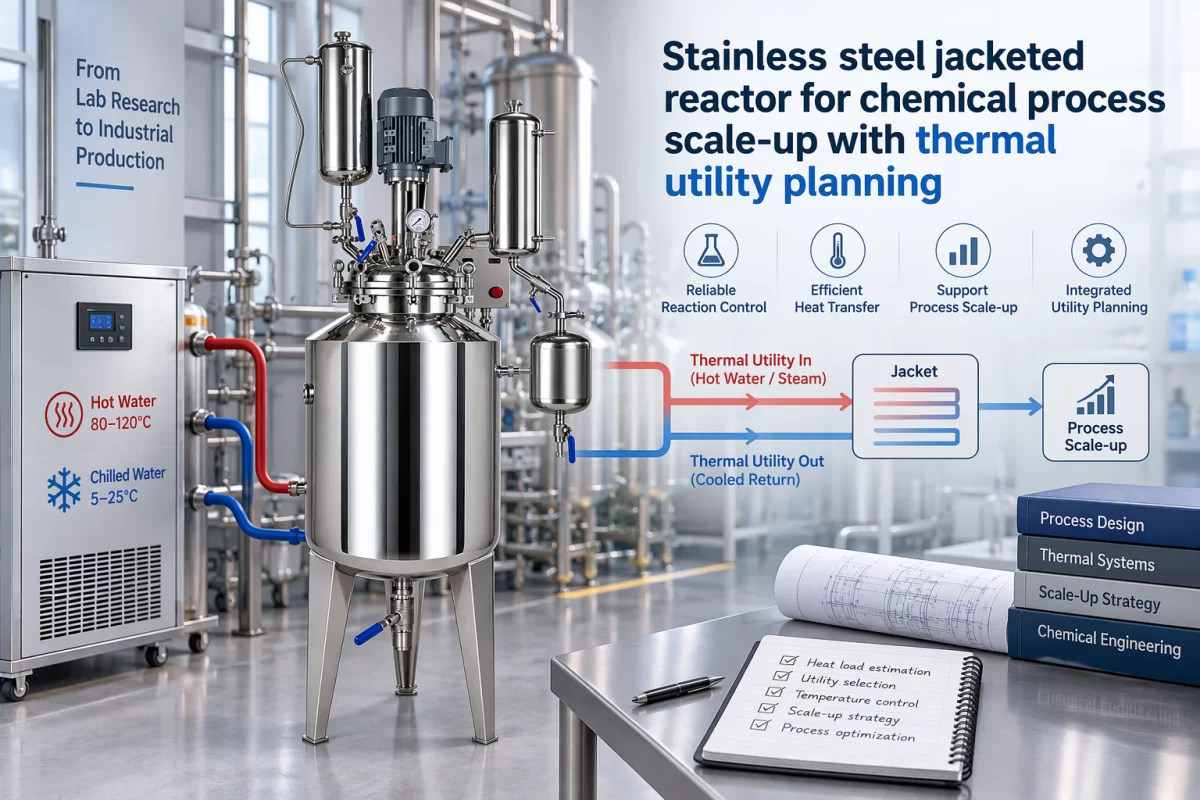
Does a larger jacketed reactor require only a larger heater?
My recommendation is to review the complete heat-transfer path. A higher heater rating will not necessarily shorten a batch if jacket flow, transfer area or the allowable temperature difference becomes the limiting factor. I would assess heating duty, cooling duty and circulation performance together.
Match circulation heating to the operating sequence
Circulation heating transfers energy through a fluid loop connected to the jacket. The utility specification should identify the heat-transfer fluid, its usable temperature range, compatibility with wetted circuit components and behavior at the lowest startup temperature. Fluid viscosity affects pumping requirements, while thermal expansion influences reservoir and expansion-management needs.
Heater selection should distinguish between warming the batch and holding it at temperature. A system that maintains a stable hold may still take too long to reach that condition. Include the thermal fluid inventory and connecting pipework in the startup assessment, and specify the desired ramp rather than relying only on the final setpoint.
- Temperature measurement: Decide whether control uses the vessel sensor, the circulating fluid sensor or a coordinated control arrangement.
- Flow protection: Define the response to insufficient circulation before heater operation is permitted.
- Thermal limits: Establish allowable product, jacket-fluid and component temperatures separately.
- Pipework: Account for hose length, fittings, insulation and access for maintenance.
For temperature-sensitive chemistry, a large jacket-to-product temperature difference can create undesirable local conditions at the vessel wall. Heating power and control strategy therefore need to be evaluated alongside product stability, not simply against the fastest possible warm-up.
Cooling capacity for chemical process scale-up
Cooling deserves its own duty calculation. Removing stored sensible heat after a heating step differs from managing heat released during reagent addition or reaction. For an exothermic process, the time-dependent heat-release profile can be more important than the batch-average load. Feed conditions and the safe response to a loss of cooling belong in the process risk review.
A chiller should be assessed at the required operating temperature and actual ambient conditions. Its nominal capacity alone does not establish the available cooling duty at every setpoint. The coolant flow, return temperature, fluid properties and pressure drop across the assembled circuit also affect performance.
When a refrigerated loop is appropriate, a low-temperature cooling liquid circulating pump is a relevant equipment category to evaluate. Selection should follow the process cooling duty and required flow; it should not be based on an assumed match between vessel size and pump size.
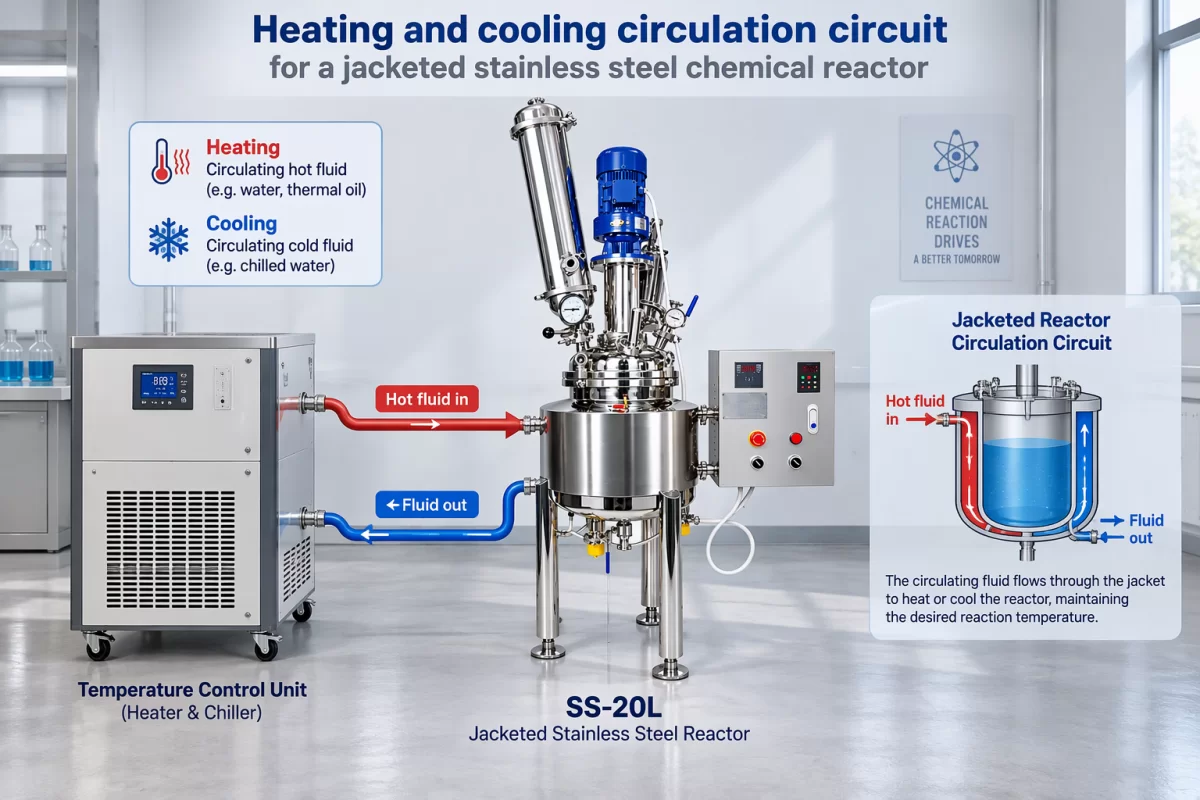
Can a cooling unit be selected from its lowest temperature alone?
I would not use the minimum temperature as the sole selection criterion. The more useful check is whether the unit can remove the required heat at the actual operating setpoint while maintaining suitable circulation. I would also include heat rejection to the room or facility water system in that review.
A documented SS-5L configuration for utility discussions
The SS-5L provides a specific small-scale reference for planning connections and instrumentation. The following details apply to that model, rather than serving as a universal specification for larger reactors.
| Item | Documented specification | Unit |
|---|---|---|
| Model | SS-5L | — |
| Reactor volume | 5 | L |
| Reactor material | 316 stainless steel | Grade |
| Frame and pipe material | 304 stainless steel | Grade |
| Heating method | Circulation heating | — |
| Electrical supply | 220 V / 60 Hz | V / Hz |
| Temperature display | PT100 sensor with digital display | — |
| Interface connection | Threaded union | — |
The reactor electrical supply should not be treated as the electrical requirement for the entire installation. External heating, cooling and auxiliary equipment need their own load assessment. Likewise, stainless steel grade alone does not establish chemical compatibility for every solvent, acid, salt or cleaning procedure.
Review the site utility system before installation
A capable thermal unit can still be constrained by the facility around it. Review available power, circuit protection, protective earthing and local installation requirements with qualified personnel. Check whether the room can accommodate the heat discharged by an air-cooled unit, or whether a water-cooled arrangement requires a dedicated facility-water connection.
- Heat rejection and ventilation: Include the external unit’s rejected heat, service clearances and solvent-handling requirements.
- Cooling water: Record available supply temperature, flow, pressure and water-quality conditions where applicable.
- Condensation control: Assess insulation and moisture management for lines operating below the room’s dew point.
- Auxiliary services: Evaluate condenser cooling, vacuum or inert-gas needs when those functions are part of the selected process configuration.
- Access and containment: Plan drain routes, spill management, hose routing and space for inspection.
If the condenser shares a coolant source with the jacket, both demands should be evaluated under the operating steps when they occur together. Independent temperature requirements may call for separate circuits. Utility interruption responses should also be defined before commissioning, including safe handling of reagent feeds and residual reaction heat.
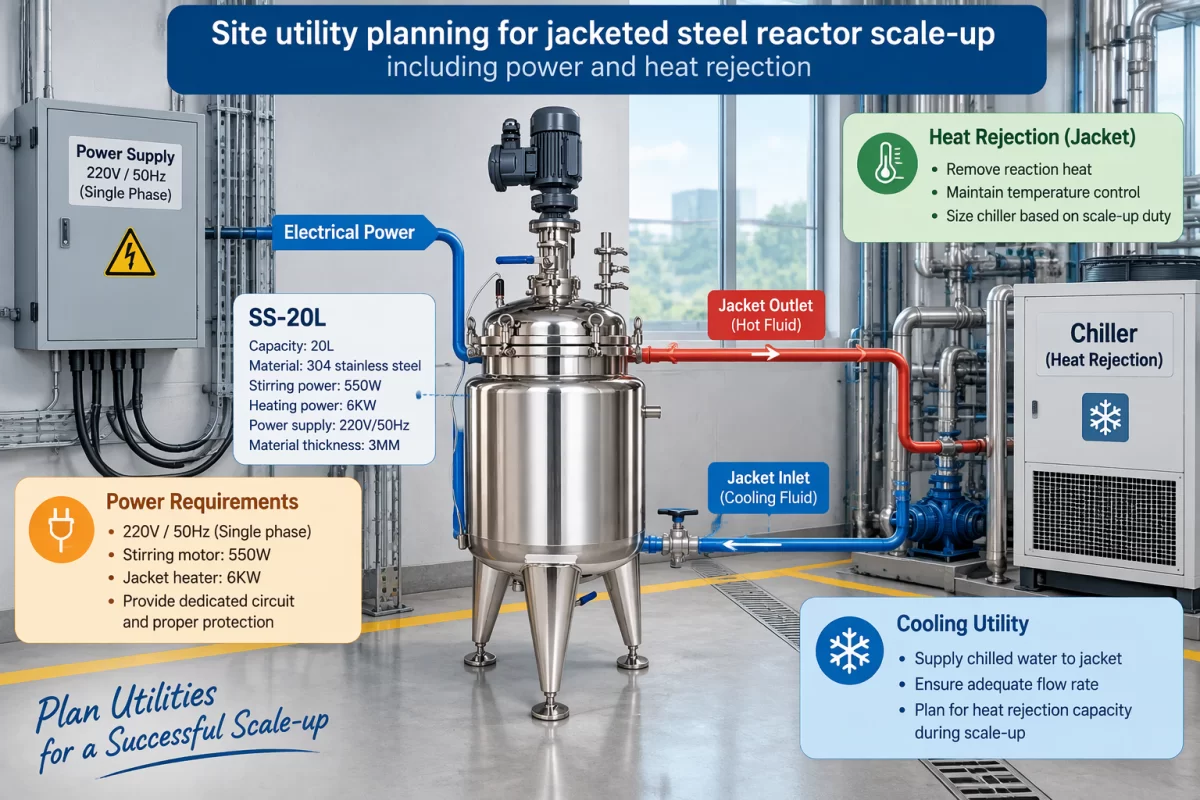
What information makes a reactor utility quotation more useful?
I recommend providing the chemical system, working batch size, temperature sequence, expected reaction heat and preferred cycle time, together with available site utilities. This gives the supplier a practical basis for proposing materials, thermal equipment and connections suited to the intended operation.
Reference pricing and configuration planning
Our company’s reference price:US$2,042
This is a reference figure, not a quotation for the SS-5L configuration or a complete installed utility package. The actual quotation depends on the selected configuration and the results of the inquiry.
Define the purchasing scope clearly: vessel, circulation heater, cooling unit, connecting lines, insulation, controls and installation services should be identified individually where required. A useful cost comparison follows the same process duty and supply scope, rather than comparing vessel prices without considering the supporting utilities.
Specify the reactor and utilities as a coordinated system
A stainless steel jacketed reactor for chemical process scale-up should be selected around the intended thermal duty and site conditions. Heating capacity, cooling performance, circulation flow, instrumentation and facility services work together; vessel volume alone cannot define the package.
Stainless steel jacketed reactor solutions can be considered for this application, with materials and configuration selected for the operating conditions. Send the material details, working batch volume, temperature profile and utility availability to request a corresponding reactor proposal and quotation.
A well-defined utility brief makes the equipment discussion more focused and gives commissioning a clearer set of performance objectives.