Choosing a Mini Rotary Evaporator for Solvent Recovery in a Small Lab
Finding the best lab mini rotary evaporator for solvent recovery starts with matching the equipment to the work—not choosing the largest flask or chasing an unsupported ranking. For small solvent batches, the useful questions concern solvent behavior, working volume, collection capacity, and the vacuum and cooling equipment available in the laboratory.
What makes a mini rotary evaporator the best fit?
A rotary evaporator combines flask rotation, bath heating, reduced pressure, and condensation to separate volatile solvent from a less volatile sample. Rotation spreads the liquid over the flask surface, while reduced pressure allows boiling at a lower temperature than at atmospheric pressure. The condenser then turns solvent vapor into liquid for collection.
For a small laboratory, “best” means a setup that can handle the normal batch with manageable glassware, controlled evaporation, and enough space for the complete system. A small evaporator is not automatically a small installation: the bath, condenser, receiving flask, vacuum pump, cooling source, and tubing all need room.
Match flask capacity to the working batch
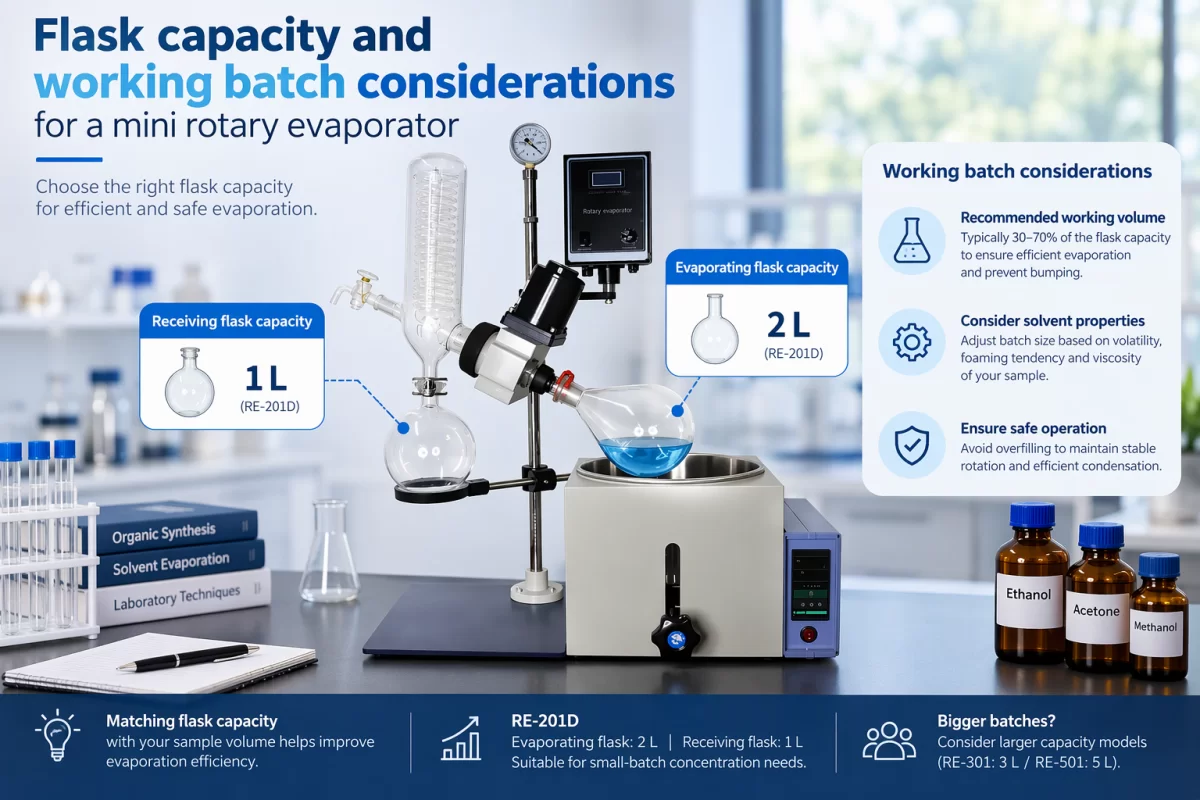
Begin with the volume of solution loaded for one run, rather than the total solvent processed in a week. Also consider foaming, solids, viscosity, and the expected amount of solvent collected. Nominal flask capacity is not the same as a recommended operating fill: the liquid needs room to move during rotation, and headspace helps manage splashing and bumping.
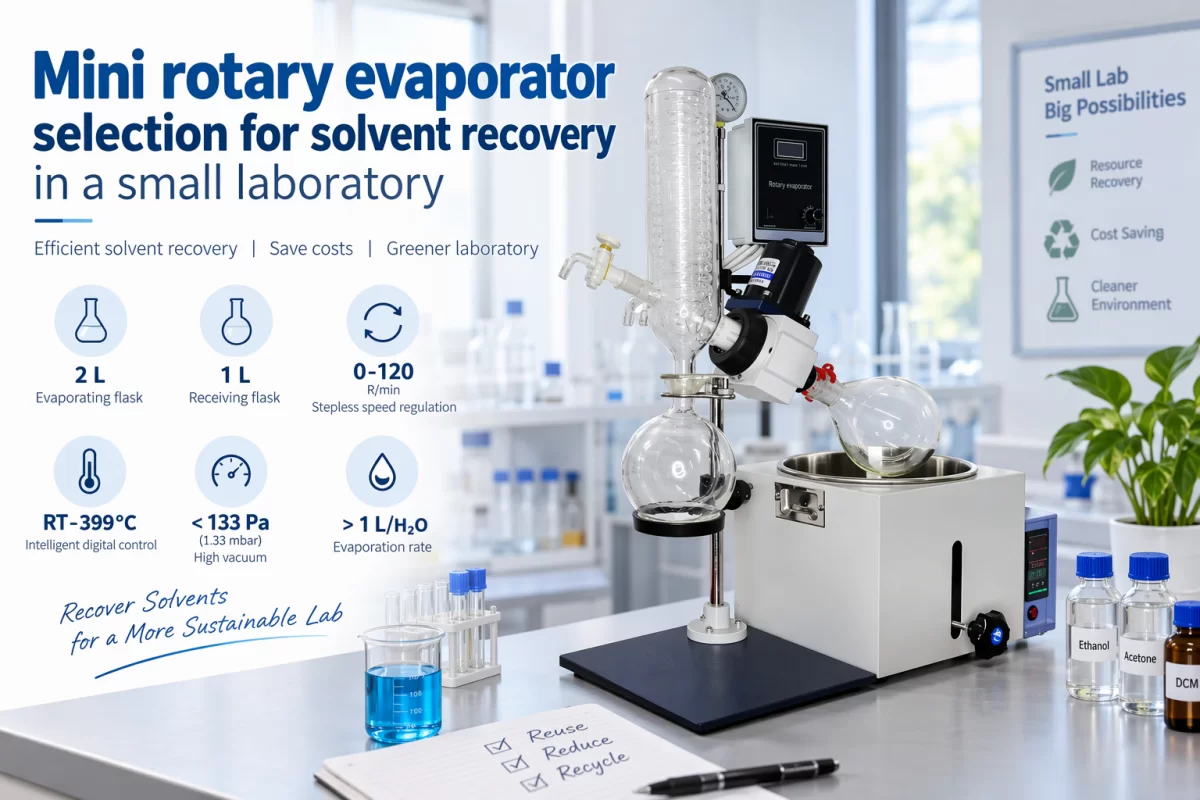
The RE-201D, RE-301, and RE-501 offer different evaporating and receiving flask capacities. The following comparison keeps each capacity tied to its corresponding model.
| Model | Evaporating flask (L) | Receiving flask (L) |
|---|---|---|
| RE-201D | 2 | 1 |
| RE-301 | 3 | 2 |
| RE-501 | 5 | 3 |
For a laboratory considering the smaller end of this range, the 2L rotary evaporator product page is a relevant starting point for a product inquiry. Describe the actual liquid charge and expected distillate volume so the proposed glassware and accessories can be matched to the workflow.
Receiving capacity deserves separate attention. The RE-201D has a 1 L receiving flask, so collection planning should account for the solvent expected during each run and a safe procedure for stopping and emptying the receiver. Increasing the evaporating flask size without considering collection capacity can create unnecessary interruptions.
Choose operating conditions around the solvent
Solvent identity determines much of the selection process. A volatile solvent and a higher-boiling solvent can require different pressure and cooling conditions, even when their batch volumes are identical. For mixtures, the vapor composition may also change as evaporation proceeds, making a single fixed operating condition less suitable throughout the run.
- Volatile solvents: Evaluate condenser cooling and pressure control together. Rapid vapor generation can exceed the cooling system’s ability to condense the solvent.
- Higher-boiling solvents: Consider whether the available vacuum and permissible sample temperature support the intended separation. More bath heat is not always an acceptable solution.
- Foaming or solids-containing samples: Allow suitable headspace and use a controlled startup procedure to reduce carryover into the vapor path.
- Solvent intended for reuse: Define acceptable purity and test the collected liquid as needed. Condensation alone does not demonstrate that the recovered solvent meets a reuse specification.
For flammable or hazardous solvents, equipment selection must also follow the laboratory’s risk assessment, ventilation requirements, and local safety rules. Do not assume that a compact laboratory unit has explosion-protection features or any particular certification.
Check vacuum, cooling, and the real installation size
The evaporator is only one part of the solvent recovery system. Vacuum equipment should be chemically compatible with the vapor it may encounter, while pressure control should allow a gradual approach to boiling. Appropriate vapor trapping or other pump protection may be needed for the application.
Cooling should be selected for both the required coolant temperature and the heat load during condensation. A low-temperature cooling liquid circulating pump is a relevant option to evaluate when a dedicated coolant supply is needed. Match its operating capabilities to the solvent and intended evaporation conditions rather than selecting it by name alone.
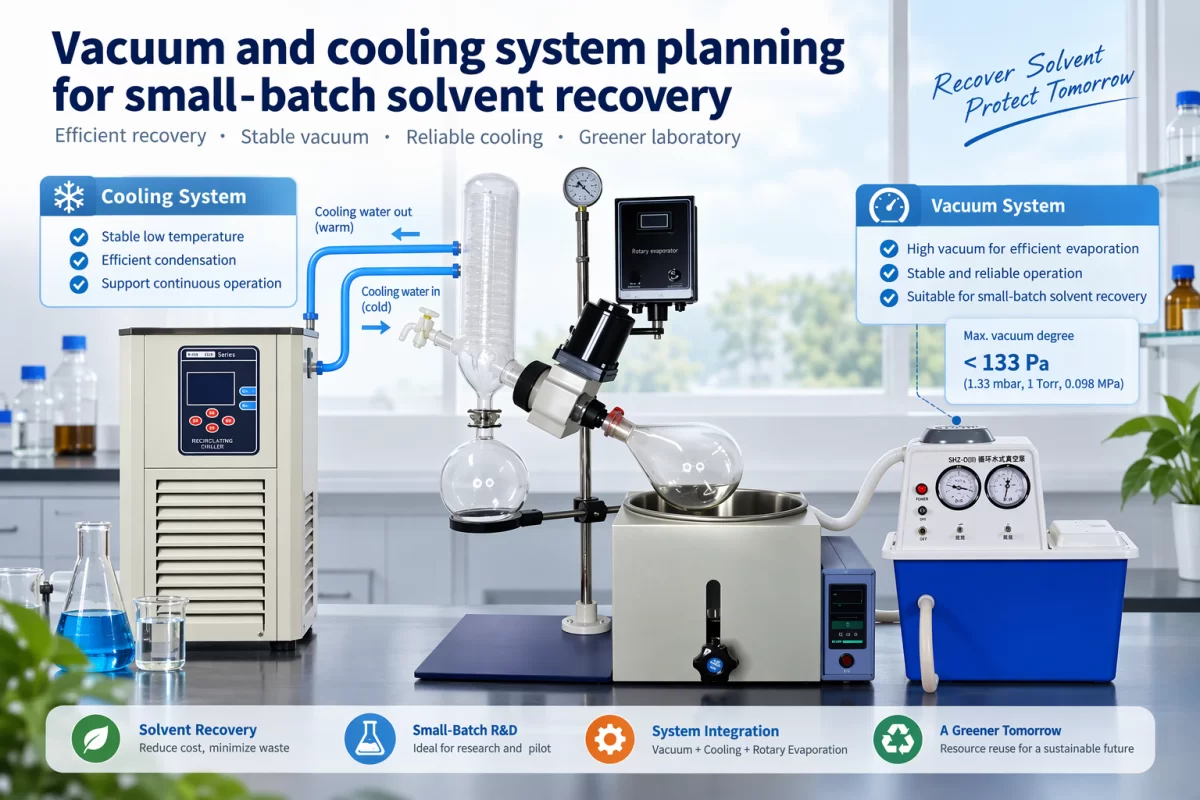
Before purchase, measure the usable installation area and overhead clearance. Include room to remove flasks, access the bath, route hoses without sharp bends, and service the pump or cooling unit. Check electrical requirements, coolant connections, drainage arrangements, and the intended ventilation location as part of the same plan.
Budget for the complete solvent recovery workflow
Compare quotations by their included components. An evaporator-only offer and a package containing cooling and vacuum equipment are not equivalent purchases. Glassware, hoses, pressure control, pump protection, and replacement parts can also affect the practical cost of putting the system into service.
Our company’s catalog reference price: US$1,242. This is a general reference across the supplied company price listings, not a model-specific price for the RE-201D or a complete mini rotary evaporator package. The actual quotation depends on the selected configuration and inquiry results.
For a useful quotation, request an itemized configuration showing the evaporator, glassware, cooling equipment, vacuum equipment, and accessories included. This keeps the purchasing decision focused on the complete application rather than an isolated headline price.
The best mini rotary evaporator is the one matched to the task
The best lab mini rotary evaporator for solvent recovery is not defined by a universal ranking. It is the system that accommodates the routine working batch, supports suitable conditions for the solvent, provides adequate collection capacity, and fits the laboratory with its required accessories.
The RE-201D is a model to consider when a 2 L evaporating flask and 1 L receiving flask align with the intended workflow. The RE-301 and RE-501 provide larger flask-capacity options when the application calls for them. Share the material, batch volume, target operating conditions, and accessory requirements with KD Instrument to request a corresponding equipment proposal and quotation.
Start with the solvent and working batch. Then choose the flask, vacuum supply, cooling system, and installation space as one coordinated solution.