Laboratory equipment · System selection
Laboratory Rotovaps for Recovery and Concentration: Choosing a Complete System
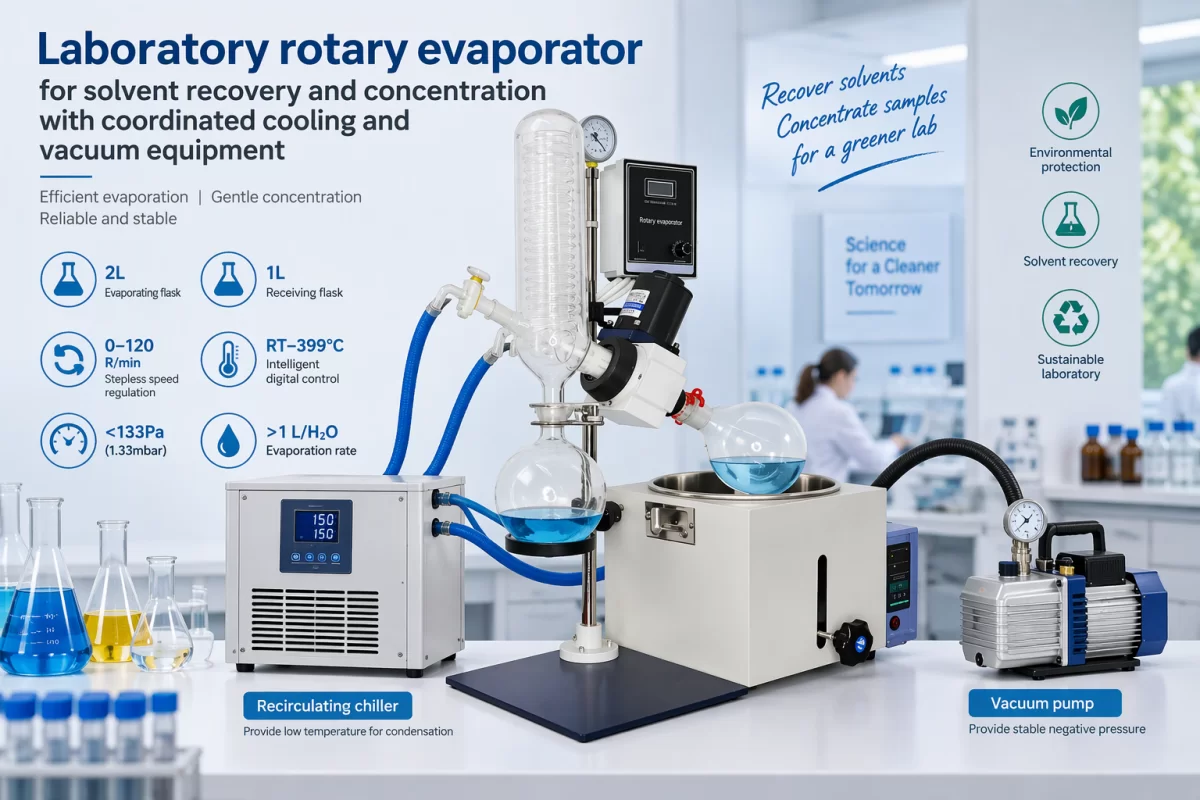
Choosing a laboratory rotary evaporator for solvent recovery and concentration means selecting more than a rotating flask and a heating bath. The evaporator, condenser cooling circuit, and vacuum system must work together under the intended solvent conditions and batch workload.
A useful purchasing decision starts with the material, the volume processed in each run, and the utilities available in the laboratory. Those details help define a complete system rather than a collection of accessories that may not suit the same operating conditions.
Select the rotovap, cooling, and vacuum as one system
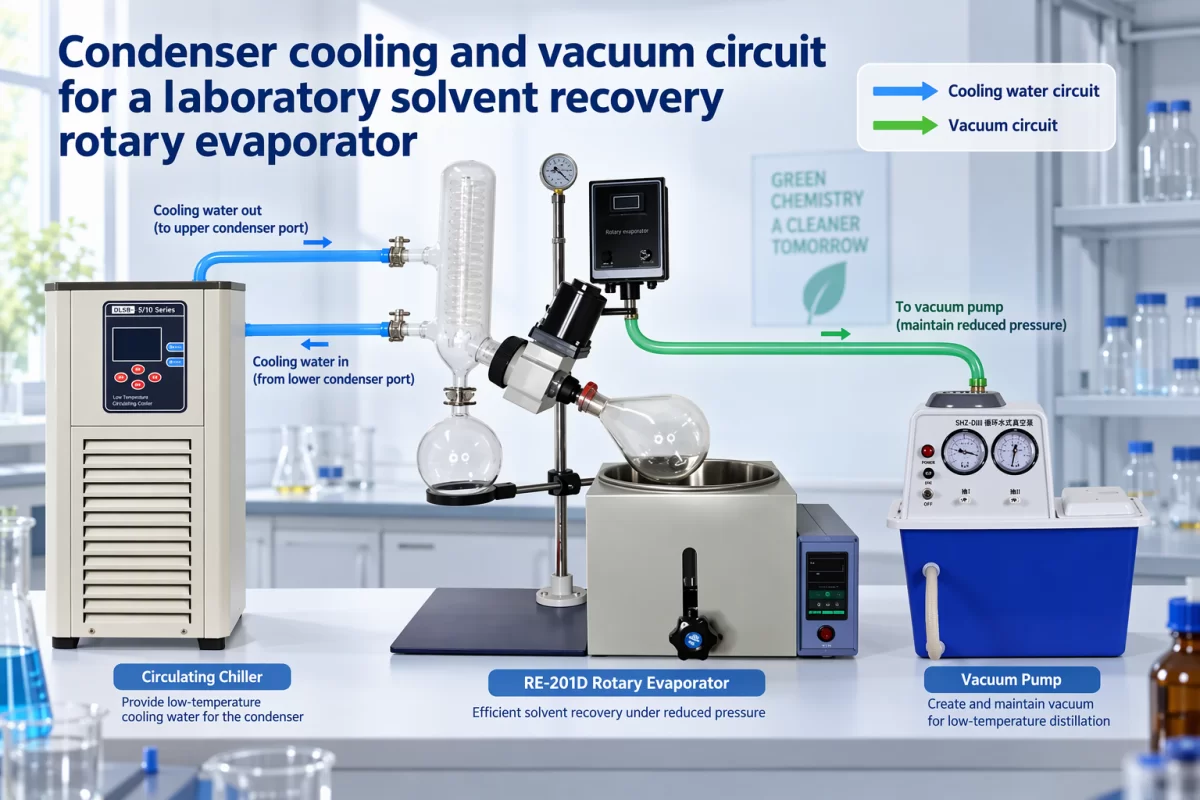
The main unit provides flask rotation, bath heating, and the glassware path for evaporation and collection. Cooling removes heat from solvent vapor at the condenser. The vacuum system establishes reduced pressure and must handle the remaining gas and vapor load. Each part affects the others: increasing evaporation without sufficient condensation can send more solvent vapor toward the pump.
For a new installation, the rotary evaporator with chiller and vacuum pump is a relevant starting point for discussing a coordinated equipment package. Define the required flask size, cooling duty, pump suitability, control approach, and connection accessories together when requesting a proposal.
Is a larger evaporating flask enough to increase usable throughput?
I would not select capacity on flask volume alone. A larger flask can accommodate a different workload, but usable throughput also depends on heat input, solvent behavior, condenser performance, and vacuum stability. I recommend reviewing the complete vapor-handling path before moving to a larger model.
Start with solvent properties and operating conditions
Identify the solvent or solvent mixture before selecting supporting equipment. Boiling behavior under reduced pressure, chemical compatibility, and the material’s temperature sensitivity influence the operating window. A solvent mixture may change composition during evaporation, so a setting suitable at the start of a run may not remain suitable near the end.
For volatile solvents, evaluate whether the cooling circuit can maintain effective condensation at the intended pressure and vapor load. For less volatile solvents, assess the combination of bath heating, achievable operating pressure, and acceptable product temperature. Avoid treating the lowest pump pressure or the highest bath setting as the normal process target.
- Solvent identity: Include mixture composition and any corrosive or otherwise challenging components.
- Material behavior: Describe foaming, viscosity changes, solids, and sensitivity to heat.
- Operating objective: State the amount of solvent to remove and the desired final material condition.
- Safety conditions: Assess ventilation, vapor discharge, solvent handling, and any hazardous-area requirements before installation.
Glassware, seals, tubing, and pump wetted components should be evaluated for the actual chemicals involved. Flammable-solvent service also requires an appropriate laboratory risk assessment; suitability should not be assumed from the general description “rotary evaporator.”
Match laboratory rotovap capacity to the working batch
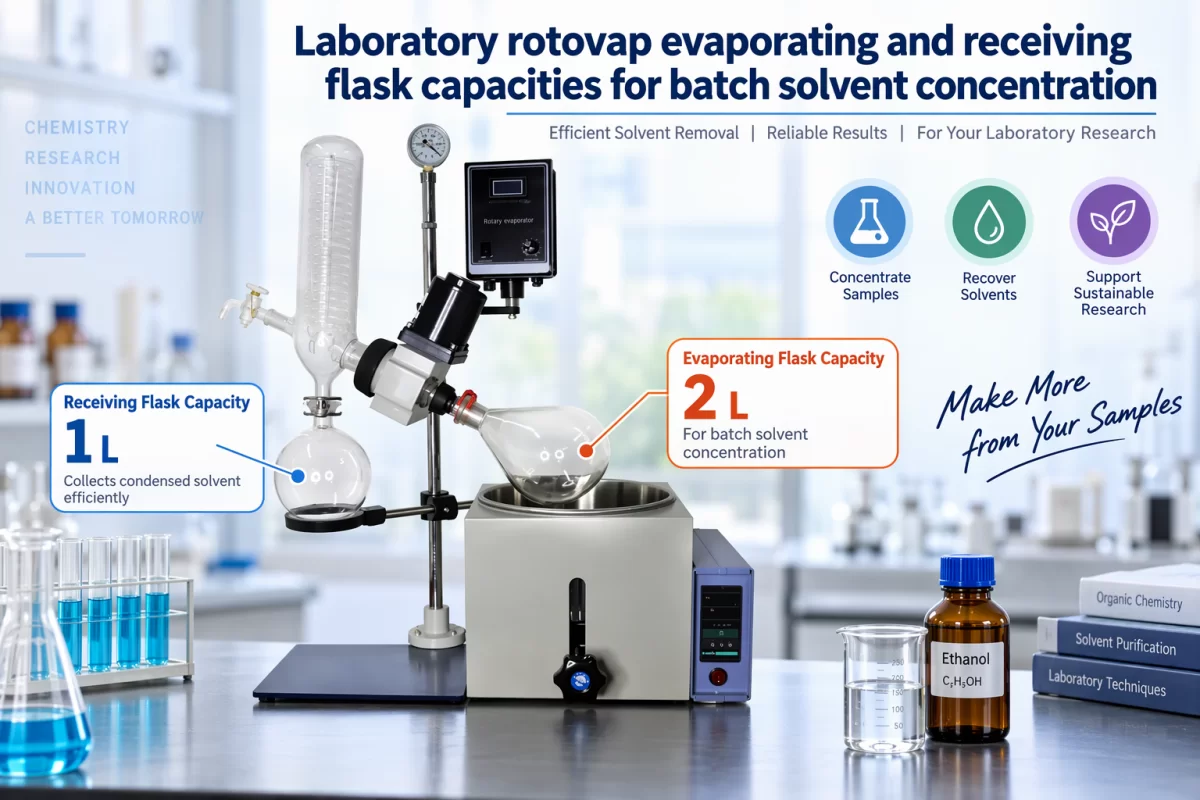
Evaporating-flask capacity is a useful first screening parameter, but it is not the same as a recommended liquid charge. Working volume must leave adequate space for rotation, vapor formation, and the material’s foaming behavior. Receiving-flask capacity also matters because the expected condensate volume determines collection and emptying arrangements.
The following model-specific flask capacities provide a practical comparison across smaller laboratory units and larger configurations.
| Model | Evaporating flask (L) | Receiving flask (L) |
|---|---|---|
| RE-201D | 2 | 1 |
| RE-301 | 3 | 2 |
| RE-501 | 5 | 3 |
| R1005 | 5 | 3 |
| R1010 | 10 | 5 |
| R1020 | 20 | 10 |
| R1050 | 50 | 20 |
Listed flask capacities describe the vessels, not validated working-charge volumes or guaranteed evaporation rates.
For smaller laboratory workloads, explore the 2L rotary evaporator product page as a starting point for a compact setup. Compare the proposed equipment against actual batch requirements rather than assuming that every run should approach the flask’s full capacity.
How should evaporating and receiving flask sizes be compared?
I start with both the initial liquid charge and the expected amount of collected solvent. I then consider foaming, handling, and the planned collection procedure. A suitable evaporating flask does not automatically make the receiving flask large enough for the entire run.
Coordinate condenser cooling with vacuum control
Cooling capacity at the intended operating temperature
A chiller should be selected for its available cooling capacity at the intended coolant temperature, not simply its minimum temperature setting. The required duty depends on the solvent vapor load and operating conditions. Coolant flow, hose routing, fluid compatibility, and ambient laboratory conditions also deserve attention.
The low-temperature cooling liquid circulating pump page provides a relevant option to discuss when planning condenser circulation. Include the intended coolant conditions and process workload in the inquiry so the cooling equipment can be evaluated alongside the evaporator.
Vacuum performance under process load
Choose the pump for solvent compatibility, pumping capability at the intended operating pressure, and appropriate vapor management. Stable, adjustable pressure can be more useful than an unnecessarily deep vacuum. Gradual pressure changes help manage sudden boiling, while suitable condensation and vapor trapping can reduce solvent exposure at the pump.
Can an existing chiller and vacuum pump be reused?
I would consider reuse when the equipment suits the solvent, process load, and required connections. I would compare the chiller’s performance at the operating temperature and the pump’s capability under load, then review controls, tubing, and vapor protection as part of the same system.
Plan installation conditions and a complete-system budget
Allow space for the evaporator, glassware handling, lift movement, chiller ventilation, and vacuum equipment. Check the proposed electrical supply requirements and assess whether the laboratory has suitable cooling circulation, ventilation, and a practical condensate-handling area. Short, appropriately sized connections can help avoid unnecessary flow restrictions and difficult routing.
A quotation should identify what is included: the main unit, bath, glassware, cooling equipment, vacuum pump, pressure controls, tubing, connectors, and any proposed protective accessories. This makes it easier to compare complete configurations and recognize which existing laboratory components can remain in service.
Company reference price
Our company’s reference price is US$1,480. This is a budgeting reference, not a fixed price for every model or a guaranteed complete-system package price. The actual quotation depends on the selected configuration and the inquiry result.
For a useful system proposal, provide the solvent composition, initial working batch, expected solvent removal, acceptable material temperature, desired run schedule, and available utilities. Also list any existing chiller or pump equipment and specify whether the inquiry covers a standalone evaporator or a coordinated package.
Build a coordinated solution
Choose a complete solvent recovery and concentration system
The right laboratory rotary evaporator for solvent recovery and concentration is the one whose main unit, cooling circuit, and vacuum equipment fit the same process requirements. Begin with solvent properties and the working batch, compare model-specific flask capacities, and then evaluate supporting equipment and installation conditions together.
Share the material, workload, target operating conditions, and configuration needs with KD Instrument to request a corresponding rotary evaporator solution and quotation. A clearly defined system scope provides a stronger basis for purchasing than flask capacity or an accessory specification considered in isolation.