Mini Rotovap Prices for Pharma Solvents: Compare Essential Accessories
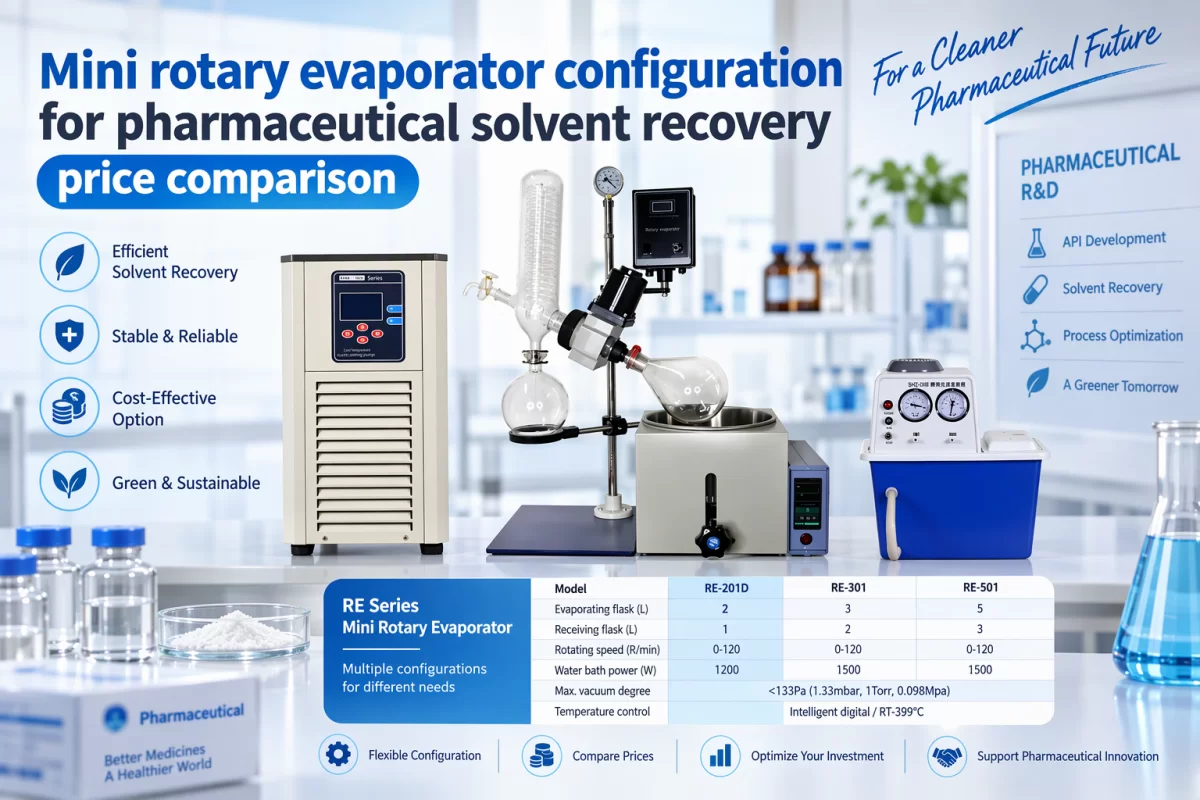
Finding the best price mini rotary evaporator for pharmaceutical solvent recovery starts with comparing complete working configurations, not just the evaporator body. Cooling equipment, vacuum control, and solvent receiving accessories can change both the purchase scope and the practicality of everyday operation.
A useful quotation should match the solvent, actual working batch, and utilities already available in the laboratory. This guide explains how to compare those requirements without treating a low advertised equipment price as a complete recovery-system budget.
Mini rotovap prices: compare the same equipment scope
A rotary evaporator rotates a flask while heating the liquid and operating under reduced pressure. Vapor passes into a condenser, and condensed solvent collects in a receiving flask. Each part of that sequence depends on compatible supporting equipment. An evaporator-only quotation and a package with a chiller, vacuum pump, and control accessories are therefore different purchasing propositions.
Company reference price
US$1,480 is our company reference price across the supplied price listings. It is not a model-specific quotation for the mini rotovap or a guaranteed price for a complete solvent recovery package. The actual quotation depends on configuration and the inquiry result.
For a meaningful comparison, request separate line items for the evaporator, cooling source, vacuum equipment, receiving glassware, connection tubing, and any additional vapor protection. Also ask whether delivery, installation support, and consumable spares are included or charged separately. A clearly defined scope is more useful than an unexplained package total.
Does the lowest evaporator price provide the best value for pharma solvent recovery?
My answer is: not necessarily. I would first compare what each quotation includes and whether the cooling and vacuum equipment suit the solvent. A lower equipment-only price may leave essential accessories outside the budget, while an existing compatible laboratory utility may make an evaporator-only purchase sensible.
Match flask capacity to the working batch
Nominal evaporating flask capacity is not the same as an approved liquid charge. Working volume must leave space for rotation, vapor formation, and possible foaming or bumping. Solvent mixtures, concentrated residues, and foaming samples can require different loading and operating approaches even when the flask size is unchanged.
The following model-specific capacities provide a starting point for discussing laboratory-scale requirements. They do not establish pharmaceutical-solvent throughput or a validated batch size.
| Model | Evaporating flask (L) | Receiving flask (L) |
|---|---|---|
| RE-201D | 2 | 1 |
| RE-301 | 3 | 2 |
| RE-501 | 5 | 3 |
For a compact-product inquiry, the 2L Rotary Evaporator product page is a relevant starting point. Include the solvent composition and intended liquid charge when requesting a corresponding configuration. Increasing flask size alone does not resolve an undersized condenser, inadequate cooling supply, or poorly controlled vacuum.
Cooling accessories: solvent behavior drives the choice
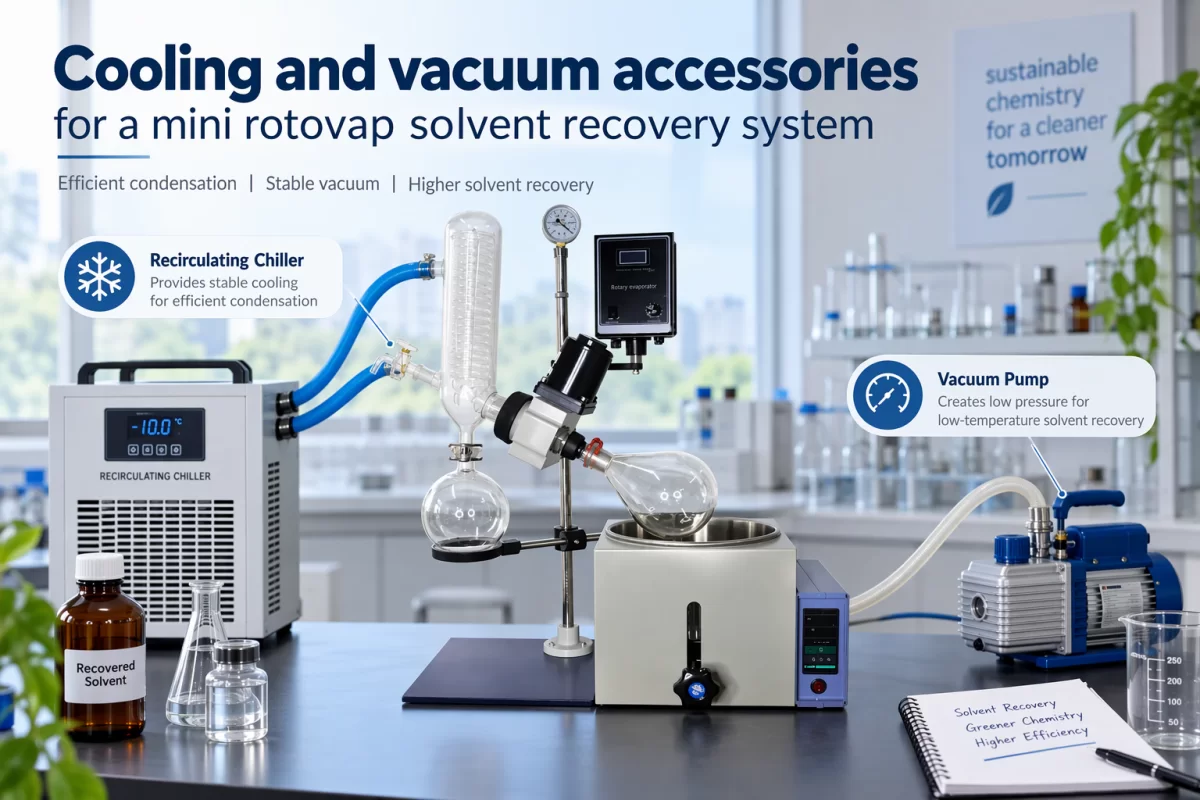
The condenser must remove heat from the vapor stream to collect solvent effectively. A recirculating cooling system adds equipment to the quotation, but it also provides a dedicated coolant supply rather than relying solely on changing site-water conditions. Whether that addition is necessary depends on the solvent, vapor load, desired operating pressure, and existing utilities.
For volatile solvents such as acetone or dichloromethane, assess condensation requirements carefully at the proposed operating pressure. For ethanol-containing batches, account for composition changes during evaporation. Water-rich mixtures may need a different balance of heating, pressure, and condensation capacity. These examples are selection considerations, not guaranteed operating settings for a particular model.
Ask for cooling capacity at the intended coolant temperature, rather than comparing chillers only by their lowest advertised temperature. Flow, connection compatibility, coolant suitability, and the expected heat load also matter. A low-temperature cooling liquid circulating pump is a relevant accessory category to discuss when dedicated condenser cooling is required.
Can existing laboratory cooling equipment reduce the initial purchase cost?
I would consider reusing it only after checking its capacity at the required temperature, available flow, and connection compatibility. Shared cooling equipment also needs enough capacity for simultaneous users. An existing unit can reduce new equipment purchases, but its suitability should be assessed under the intended workload.
Vacuum accessories: compare control and solvent compatibility
A vacuum pump should be selected for the actual vapor exposure and required operating conditions, not simply the deepest ultimate vacuum. Wetted materials, pumping capacity under load, maintenance needs, and exhaust handling all affect suitability for solvent recovery. Tubing and fittings must also be compatible with the solvent and vacuum service.
Vacuum regulation can help operators approach boiling conditions gradually instead of applying an abrupt pressure reduction. This is especially relevant when samples foam or bump. A pressure measurement device and suitable control arrangement can add cost, but they address a different need from pumping capacity alone.
Consider whether a vapor trap is appropriate to reduce solvent reaching the pump, and define how pump exhaust will be handled under laboratory safety procedures. Flammable-solvent work requires a site-specific risk assessment and suitable equipment; a product name or general laboratory application does not establish hazardous-area suitability or pharmaceutical compliance.
Receiving accessories: plan collection and batch separation
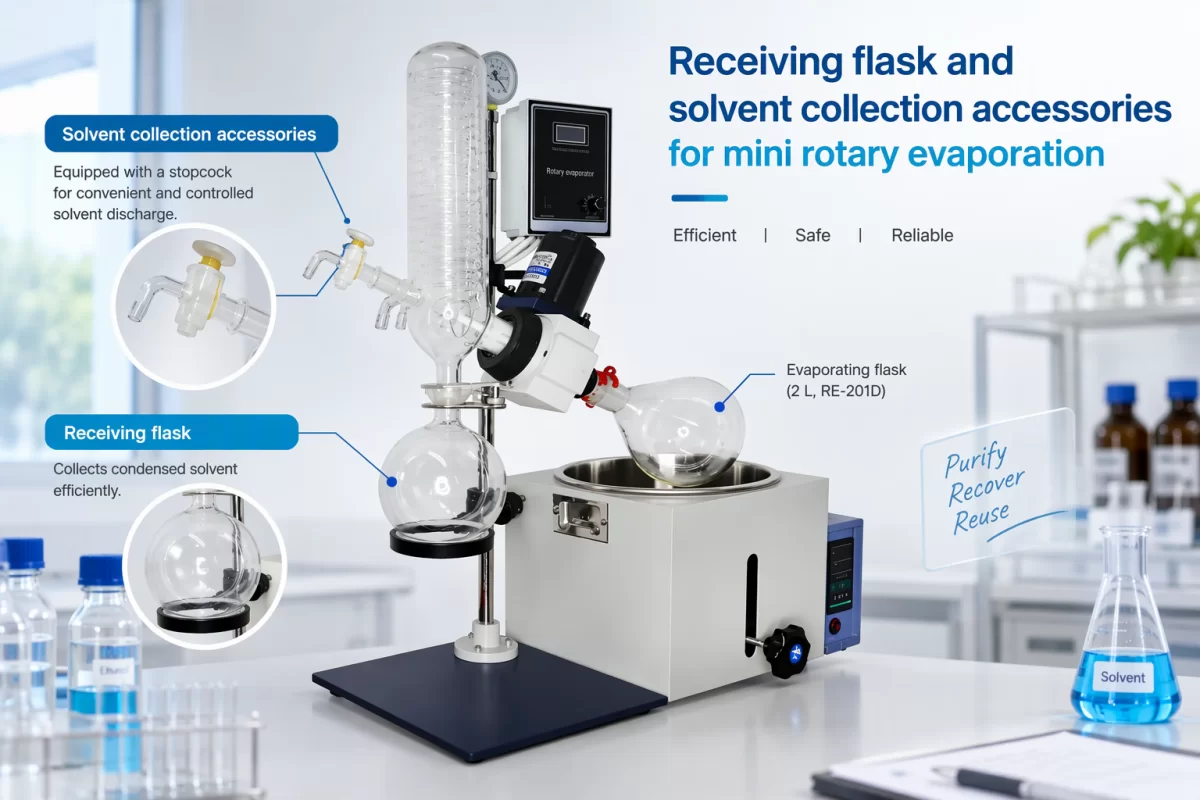
The receiving flask affects how much condensate can be collected before the operator must stop and manage the collected solvent. For the RE-201D, the listed receiving flask capacity is 1 L. That nominal capacity should not be treated as permission to fill the receiver completely or as a guarantee of uninterrupted recovery from any particular feed charge.
Discuss spare receivers, compatible joints, clamps, seals, and a bump trap where appropriate. Their value depends on the workflow: occasional small batches may need a simple collection arrangement, while repeated batches can make spare glassware and clearly defined changeover procedures useful. Additional glassware also introduces more surfaces to clean and more connections to inspect.
Is recovered solvent automatically suitable for reuse in pharmaceutical processing?
No. I would treat recovery and release for reuse as separate decisions. Reuse depends on the process specification, possible carryover, solvent composition, and appropriate testing. Rotary evaporation alone does not establish pharmaceutical-grade purity or satisfy a validated quality-control procedure.
What to include in a mini rotary evaporator inquiry
A practical inquiry gives the supplier enough process information to price a compatible system rather than an unspecified collection of components.
- Solvent and material: solvent names, mixture composition, dissolved material, and known foaming or precipitation behavior.
- Batch requirements: intended working charge, expected condensate volume, batch frequency, and desired processing schedule.
- Process limits: allowable material temperature, proposed pressure conditions, and the required concentration endpoint.
- Available utilities: existing cooling equipment, vacuum equipment, electrical supply, and ventilation arrangements.
- Accessory scope: dedicated chiller, pump, vacuum control, vapor protection, spare receivers, tubing, and consumable parts.
- Quality requirements: cleaning procedures, documentation needs, and the site's solvent-reuse acceptance criteria.
Ask for an itemized quotation with an identified model and accessory configuration. This makes it easier to compare an existing-utilities option against a dedicated system and to understand which additions address genuine process needs.
Choose the best-price mini rotovap for the actual process
The best price mini rotary evaporator for pharmaceutical solvent recovery is the configuration that fits the batch and supporting utilities without omitting necessary cooling, vacuum, or collection equipment. Use nominal flask capacity to begin the discussion, then evaluate the solvent, condensation load, pressure control, and receiving workflow together.
Send the solvent composition, working batch, available utilities, and accessory requirements with the inquiry. A configuration-specific quotation provides a clearer purchasing basis than a reference price alone and helps keep the equipment scope aligned with laboratory needs.