Pilot chemistry · Process development
Rotary Evaporator Scale-Up for Pilot Chemistry: Keeping Process Records Comparable
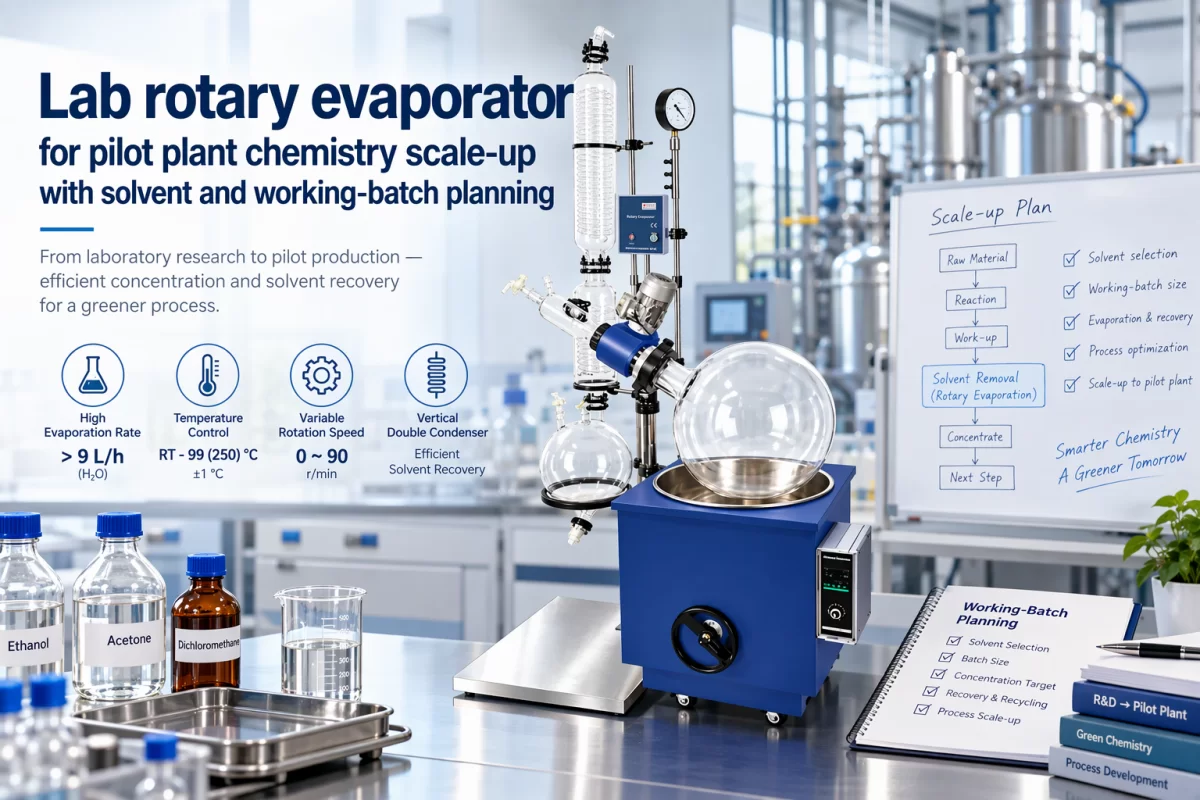
Choosing a lab rotary evaporator for pilot plant chemistry scale-up requires more than matching a larger flask to a larger batch. A useful laboratory-to-pilot comparison preserves the same record fields for solvent composition, actual charge, operating conditions, supporting equipment, and endpoint. Those records help distinguish a genuine process change from a difference in how the run was measured.
The selection principle: nominal flask capacity describes the vessel, not a guaranteed working charge, solvent-removal rate, or scale-up factor.
Start with the solvent and working batch—not the flask label
Rotary evaporation is commonly used to remove solvent under reduced pressure while rotation spreads liquid over the flask surface. When the process moves toward pilot chemistry, the relationship between heat input, vapor generation, condensation, and vacuum becomes an important part of equipment selection. A larger vessel does not establish that these supporting conditions have increased proportionally.
Define the feed before choosing the equipment: identify the solvent or solvent mixture, dissolved material, starting concentration, actual batch mass or volume, and intended final condition. Note any tendency toward foaming, bumping, precipitation, or increasing viscosity. These observations should remain in the record even when the equipment model changes.
Keep nominal flask capacity separate from working charge. The usable charge depends on the material, operating procedure, and equipment instructions; it should not be inferred directly from the flask nameplate. Likewise, receiver capacity belongs in the collection plan rather than being treated as proof that an entire batch can be processed without interruption.
Does a larger evaporating flask guarantee proportionally faster solvent removal?
My answer is no. I would compare actual removal rate under documented conditions, including solvent composition, charge, bath temperature, absolute pressure, rotation speed, and coolant conditions. Flask volume alone cannot show whether heating, condensation, or vacuum is limiting the run.
Use one record template for laboratory and pilot evaporation
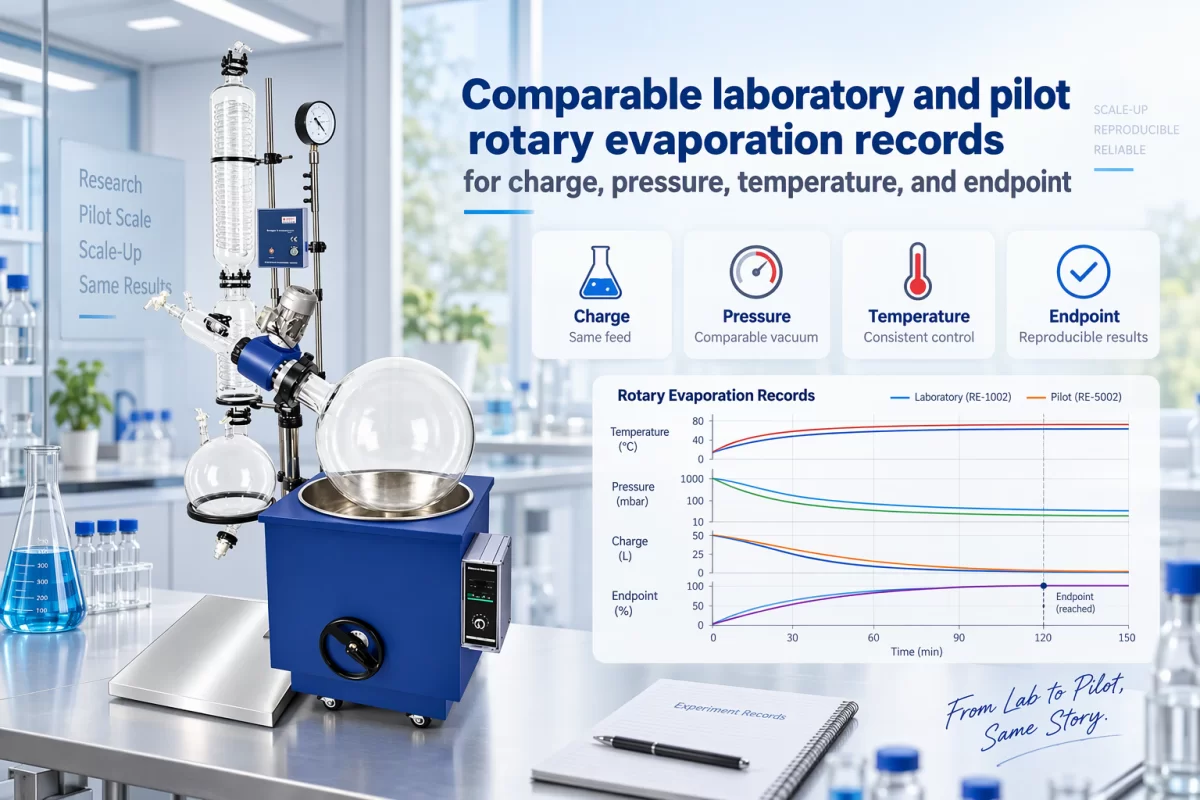
Comparable records do not require identical operating settings. They require consistent field names, units, measurement locations, and definitions. A pilot run may need a different pressure profile or collection procedure, but that change should be visible beside the laboratory baseline.
| Record field | Units or identification | Comparison requirement |
|---|---|---|
| Feed and solvent | Identity; composition basis | Use the same basis for mixture composition and concentration. |
| Actual charge | kg or L | Record charge separately from nominal flask capacity. |
| Heating conditions | °C; bath medium | Separate setpoint from measured temperature. |
| Vacuum conditions | mbar absolute or Pa absolute | Identify gauge location and record the pressure profile. |
| Rotation and cooling | rpm; °C; L/min where measured | Record rotation settings and coolant inlet/outlet conditions. |
| Time and collection | min; kg or L recovered | Use defined start and stop events; log receiver changes. |
| Endpoint and outcome | Defined test; analytical units | Apply the same endpoint criterion and sampling method. |
Distinguish warm-up time, stable evaporation time, sampling pauses, and unloading time. Otherwise, a rate calculated from the full cycle may be compared incorrectly with one calculated only during steady collection. For rate calculations, state whether the result is recovered mass per hour or recovered volume per hour; volume comparisons also need a consistent measurement temperature.
A mass balance can include feed, collected distillate, final concentrate, samples, and measurable hold-up. Recording these streams helps prevent solvent recovery from being confused with product recovery. The endpoint should be a defined process or analytical criterion, not simply the moment when collection appears to slow.
Rotary evaporator capacities for a staged scale-up review
The following model-specific flask capacities provide a starting point for comparing laboratory and larger-volume equipment. They describe the listed vessels, not approved working fill levels or solvent-specific throughput.
| Model | Evaporating / rotating flask (L) | Receiving / recovery flask (L) |
|---|---|---|
| RE-201D | 2 | 1 |
| RE-301 | 3 | 2 |
| RE-501 | 5 | 3 |
| R1005 | 5 | 3 |
| R1010 | 10 | 5 |
| R1020 | 20 | 10 |
| R1050 | 50 | 20 |
Two models with the same nominal flask capacity should not automatically be treated as equivalent systems. Compare the complete proposed configuration against the process requirements, including the condenser arrangement, vacuum equipment, heating system, utilities, and handling procedure.
For a larger-volume purchasing discussion, the Rotary Evaporator 50L for Sale product page is a relevant starting point. An inquiry should include the actual working batch and solvent-removal objective so the proposed equipment can be assessed as a system rather than selected solely by capacity.
Which batch information is most useful when selecting a pilot rotary evaporator?
I would begin with solvent identity and composition, actual charge, starting concentration, target endpoint, and required cycle time. I would then add foaming or solids behavior and the available cooling, vacuum, electrical supply, and installation space. Together, these details make the selection discussion more meaningful than a capacity request alone.
Match vacuum and cooling to the pilot chemistry duty
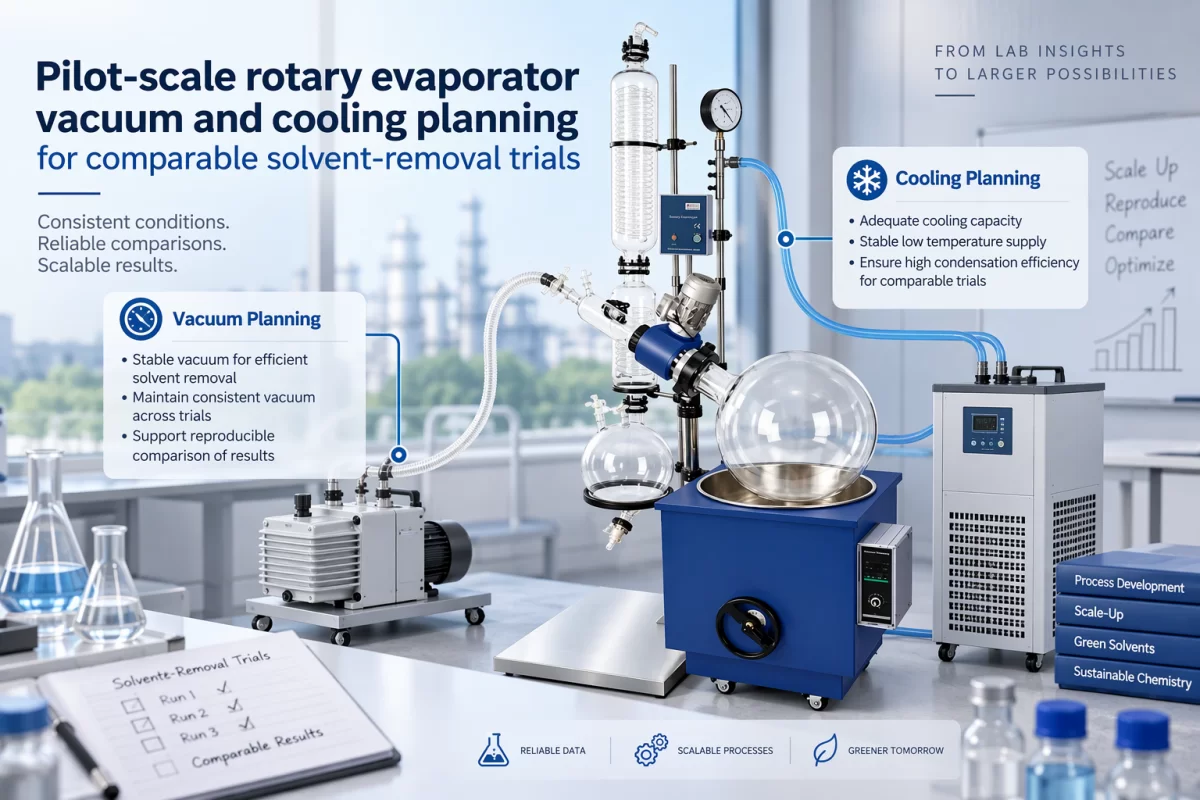
The vacuum pump and condenser should be considered alongside the evaporator. Record the pressure measured during operation, not only a pump specification. Hose dimensions, connections, leakage, vapor load, and gauge position can affect how an operating pressure reading should be interpreted.
Cooling selection should account for the intended solvent, coolant temperature, circulation, and vapor load. A coolant setpoint by itself does not describe heat-removal capability. The low-temperature cooling liquid circulating pump page provides a relevant route for discussing supporting cooling equipment without assuming that every evaporator requires the same cooling arrangement.
For flammable solvents or hazardous materials, assess ventilation, material compatibility, vapor handling, and applicable site requirements before operation. Do not assume that a standard configuration is suitable for a hazardous location. Also plan safe glassware handling, receiver emptying, access for maintenance, and cleaning between batches.
How can a slower pilot run be interpreted without blaming vessel size?
I would review the pressure and coolant trends beside the collection history, then compare heating conditions, charge behavior, and interruptions with the laboratory run. That sequence can help identify a supporting-equipment or procedure constraint before changing the evaporator size. Any conclusion should be checked through a controlled follow-up trial.
Build the trial plan and purchasing brief together
Begin with a documented laboratory baseline, then define the pilot trial’s acceptance criteria before running it. Compare endpoint quality, recovery, cycle time, and operating stability. Where practical, change one major operating factor at a time so the result can be interpreted rather than attributed to several simultaneous changes.
- Describe the duty: solvent mixture, actual batch, concentration range, and target endpoint.
- Describe the site: available power, cooling, vacuum equipment, ventilation, and installation space.
- Define the configuration: evaporator model, collection arrangement, supporting equipment, and required handling features.
- Define the evidence: comparable run records, analytical results, and an agreed basis for calculating recovery and rate.
Company reference price: US$1,480. This is a reference price from our company's supplied price list, not a quotation for a particular 50 L system or a complete pilot installation. The actual quotation depends on the selected configuration and inquiry results.
A useful quotation request therefore identifies both the equipment and the intended process. Include whether cooling and vacuum equipment are required in the supply scope, together with the working batch, target conditions, and expected operating schedule.
Comparable records make scale-up decisions more useful
A lab rotary evaporator for pilot plant chemistry scale-up should be selected around solvent behavior, actual batch size, and supporting conditions. Nominal flask capacities help organize the options, but documented operating conditions and consistent endpoint definitions are what make laboratory and pilot results comparable.
For a process-focused equipment proposal, provide the solvent or mixture, working charge, target endpoint, cycle-time objective, available utilities, and configuration needs. That brief supports a more relevant rotary evaporator recommendation and quotation—and a clearer plan for evaluating the first pilot run.