Rotary Evaporators for Pharmaceutical Solvent Recovery: Planning Condensation
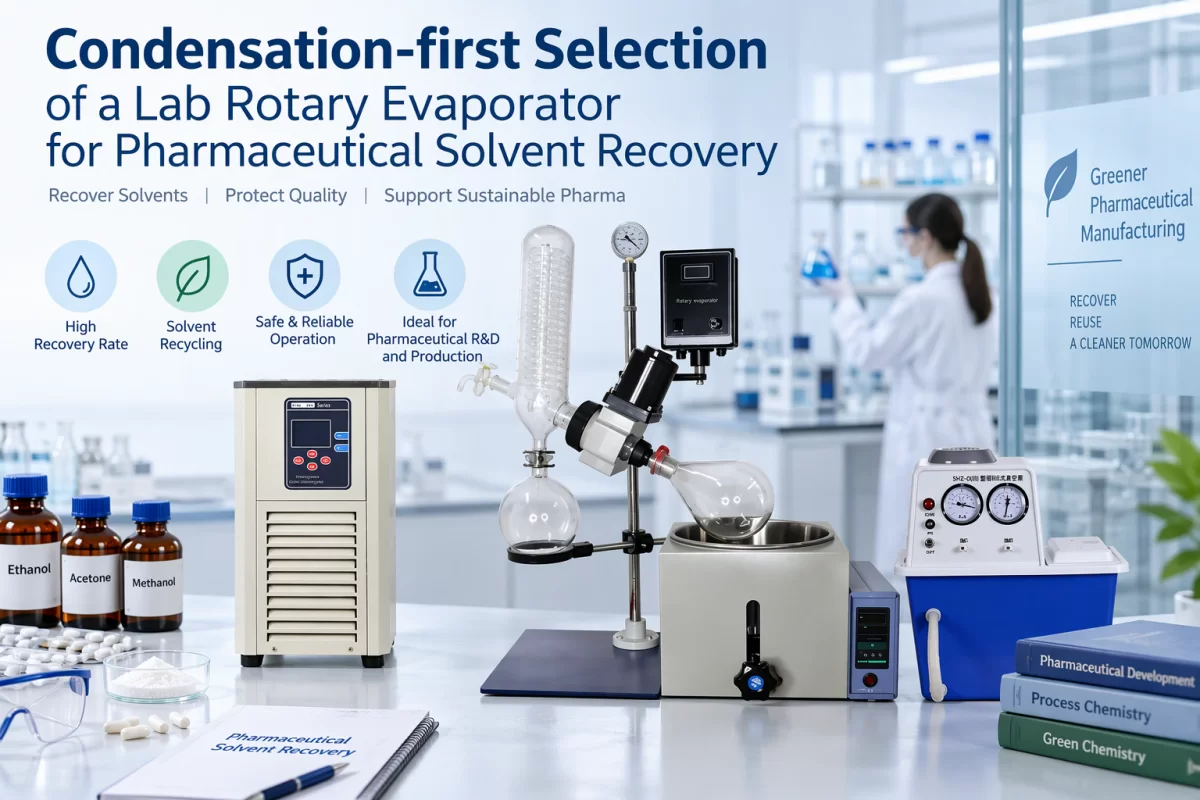
The search for the best lab rotary evaporator for pharmaceutical solvent recovery should begin at the condenser, not with the largest flask or the highest bath setting. Solvent vapor must be cooled and collected at a rate that matches evaporation. If the cooling system cannot handle that vapor load, additional heating can increase vapor carryover instead of useful solvent recovery.
For pharmaceutical research and process-development laboratories, a suitable selection balances solvent behavior, working batch, receiver capacity, vacuum control, and available utilities. This is a laboratory equipment selection discussion—not a claim that a standard rotary evaporator constitutes a validated pharmaceutical production line.
Start with the solvent and the condensation duty
A rotary evaporator creates a rotating liquid film and uses reduced pressure to support solvent evaporation at a lower boiling temperature. The condenser then removes heat from the vapor so that liquid can collect in the receiver. These stages must work together: evaporation capacity alone does not establish recoverable throughput.
Begin with the solvent identity, mixture composition, approximate quantity to remove, and acceptable product temperature. Ethanol, acetone, ethyl acetate, and water-containing mixtures do not share one universal operating recipe. Their boiling behavior under vacuum and the cooling required for collection differ. Mixed solvents can also change composition during a run, so a setting that works at the beginning may need adjustment later.
Condensation duty depends on the mass of solvent evaporated per unit time, its latent heat, and any additional sensible cooling. A chiller's lowest attainable temperature is therefore only part of the selection. Cooling capacity at the intended operating temperature, coolant circulation, and the condenser's heat-transfer capability also matter.
Does a colder condenser always produce better solvent recovery?
I would evaluate cooling temperature together with capacity and flow. A colder coolant can help capture volatile solvent, but insufficient refrigeration capacity or poor circulation can still limit collection. Excessive cooling can also create freezing problems with some mixtures. I recommend choosing a practical operating point based on the actual solvent and monitoring its stability under load.
Match flask size to the working batch and receiver plan
Nominal evaporating-flask capacity is not the same as a recommended liquid charge. Working fill must leave room for film formation, foaming, and changes in liquid behavior. A batch that fits inside a flask can still be unsuitable if it bumps, entrains product, or generates vapor faster than the condenser can collect it.
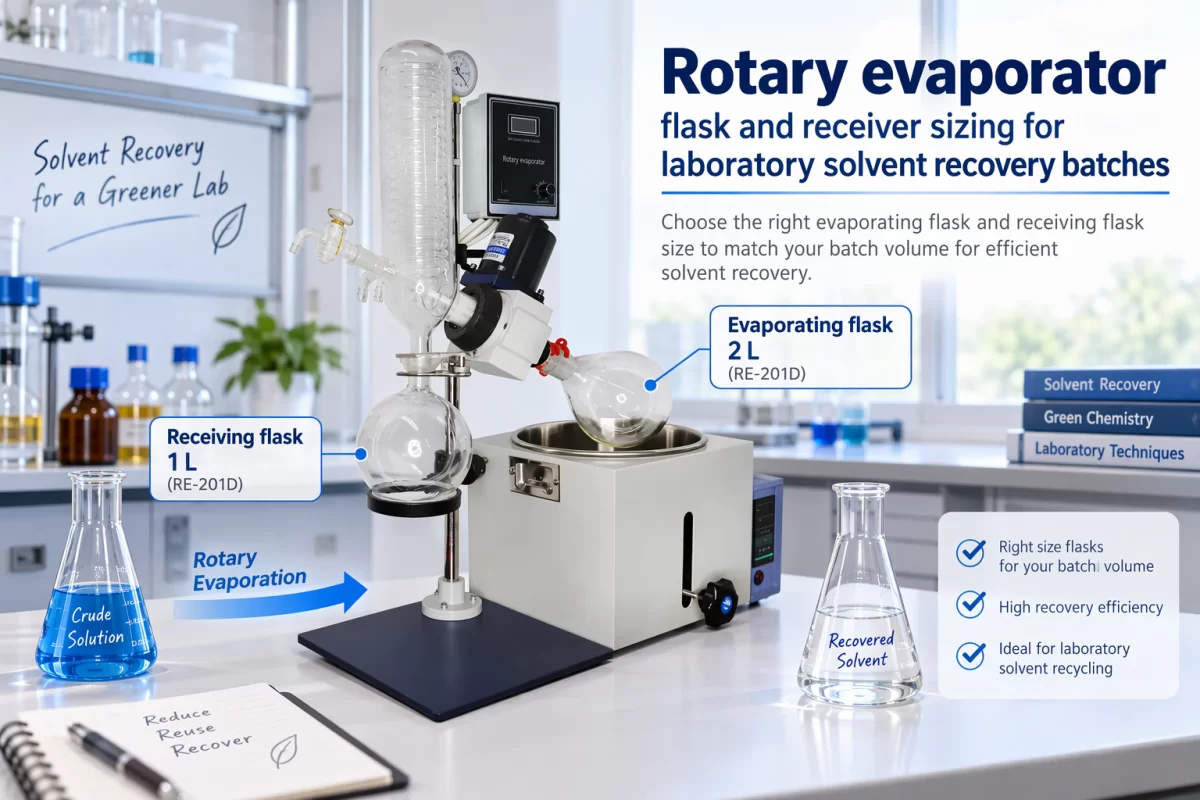
The following model capacities provide starting points for comparing laboratory equipment. They describe the evaporating and receiving vessels, not a guaranteed working batch or solvent-specific recovery rate.
| Model | Evaporating flask / bottle (L) | Receiving flask / recovery bottle (L) |
|---|---|---|
| RE-201D | 2 | 1 |
| RE-301 | 3 | 2 |
| RE-501 | 5 | 3 |
| R1005 | 5 | 3 |
| R1010 | 10 | 5 |
| R1020 | 20 | 10 |
| R1050 | 50 | 20 |
For smaller development batches, the 2L rotary evaporator product page is a relevant starting point for an equipment inquiry. Describe the intended liquid charge and solvent-removal task so that the proposed equipment and accessories can be matched to the application.
Receiver planning deserves equal attention. Estimate the liquid expected to condense, allow operating headroom, and define how collection will be interrupted or transferred safely. A larger evaporating vessel does not eliminate receiver-handling requirements, and moving to a larger batch also requires reassessing cooling demand and vapor transport.
Is the largest flask the best choice for pharmaceutical laboratory solvent recovery?
I would choose around the routine working batch rather than the largest available vessel. Small development runs may be easier to handle with compact glassware, while larger batches need an appropriately sized receiver and supporting utilities. Flask size should solve a real batch-handling need; it should not substitute for condensation planning.
Build a coordinated cooling and vacuum system
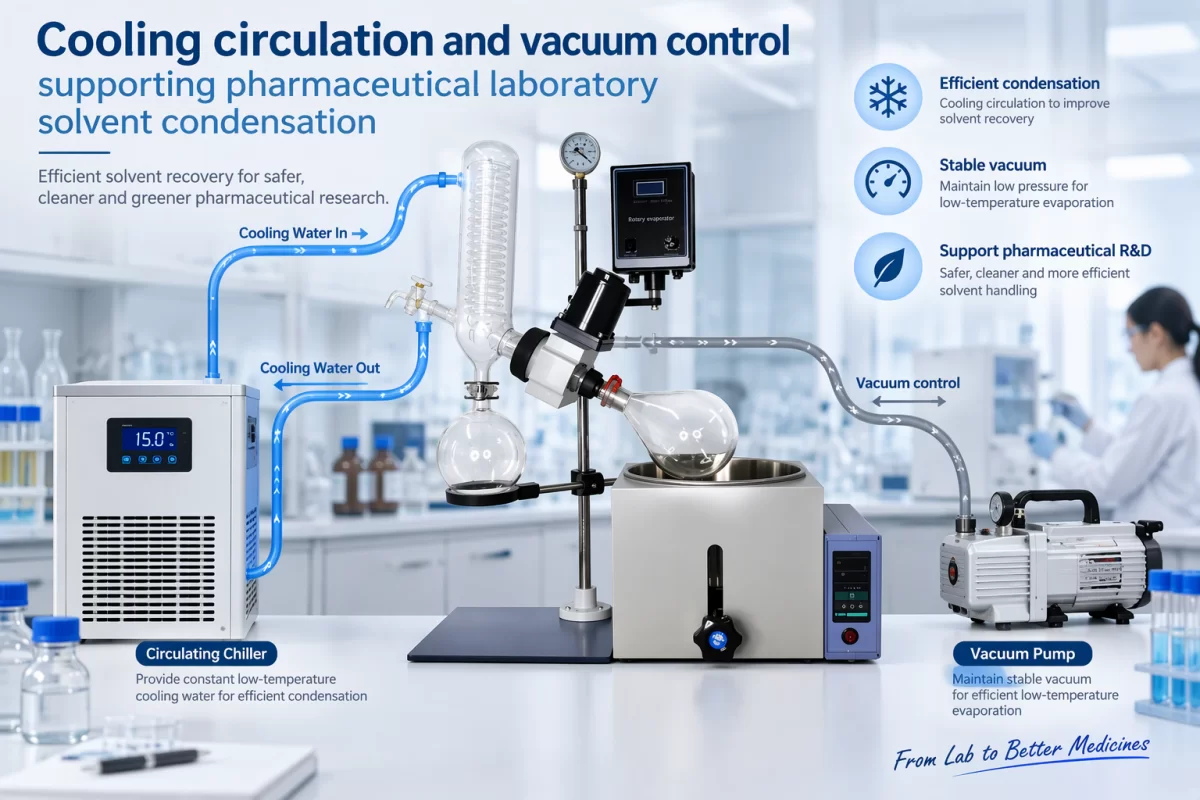
Once the solvent and batch are defined, review the condenser, cooling source, vacuum pump, and controller as one system. The low-temperature cooling liquid circulating pump page provides a relevant route for discussing condenser cooling equipment. Specify the required coolant operating temperature and estimated heat load, rather than selecting by equipment name alone.
- Cooling circuit: Assess coolant compatibility, usable flow, hose routing, connection sizes, and cooling capacity at the intended temperature. Restricted hoses or an unsuitable coolant can reduce practical heat transfer.
- Vacuum control: Select a controllable pressure range that supports the solvent's boiling behavior and product-temperature limit. Lower pressure is not automatically better if it causes unstable boiling or excessive vapor generation.
- Pump protection: Review chemical compatibility and determine whether an additional cold trap is appropriate. Route pump exhaust to a suitable laboratory extraction system.
- Operating environment: Check electrical supply, ventilation, installation clearance, glassware handling, and the risk assessment for flammable or hazardous solvents. Do not assume ordinary equipment is suitable for a classified hazardous area.
What makes the best lab rotary evaporator for pharmaceutical solvent recovery?
“Best” is an application-fit question, not an unsupported ranking. Compare candidates against a defined solvent-recovery task: stable boiling, manageable product temperature, effective collection, acceptable handling, and compatible supporting equipment. During a trial, record the initial charge, solvent composition, bath temperature, operating pressure, coolant conditions, collected volume, and run duration.
Track both recovery and material quality. A rapid run is not necessarily a useful one if product reaches the receiver through entrainment or the recovered solvent is unsuitable for its intended reuse. Collection volume alone does not establish solvent purity. Pharmaceutical workflows may require analytical testing, traceability, documented cleaning procedures, and qualification appropriate to the intended use.
Can recovered solvent be reused directly in pharmaceutical work?
I would not treat condensation as proof of reuse suitability. The recovered liquid may contain water, other solvents, or carried-over impurities. I recommend establishing a reuse specification and testing the collected solvent against it. Equipment selection supports the recovery step, but quality decisions belong within the laboratory's approved procedures.
Reference pricing and a useful equipment inquiry
Evaluate the complete purchasing scope, including the rotary evaporator, glassware, condenser arrangement, cooling equipment, vacuum pump, controls, and any required trapping or connection accessories. A standalone evaporator price should not be treated as the cost of a complete solvent-recovery installation.
For a useful proposal, provide the solvent or mixture, routine working batch, approximate solvent-removal quantity, product-temperature limit, desired processing time, existing cooling and vacuum equipment, electrical supply, and installation constraints. Include documentation and cleaning requirements where they affect the intended application.
Choose for reliable condensation, not headline capacity
The best lab rotary evaporator for pharmaceutical solvent recovery is the one whose evaporation, condensation, collection, and supporting utilities fit the actual laboratory task. Begin with the solvent, define the working batch, and check whether the cooling system can sustain the expected vapor load. Then compare vessel capacities and the complete equipment configuration.
Start the selection discussion with the material and target operating conditions. A condensation-first approach helps turn a rotary evaporator inquiry into a practical, application-focused solvent-recovery proposal.