What capacity rotary evaporator for pilot plant chemistry?
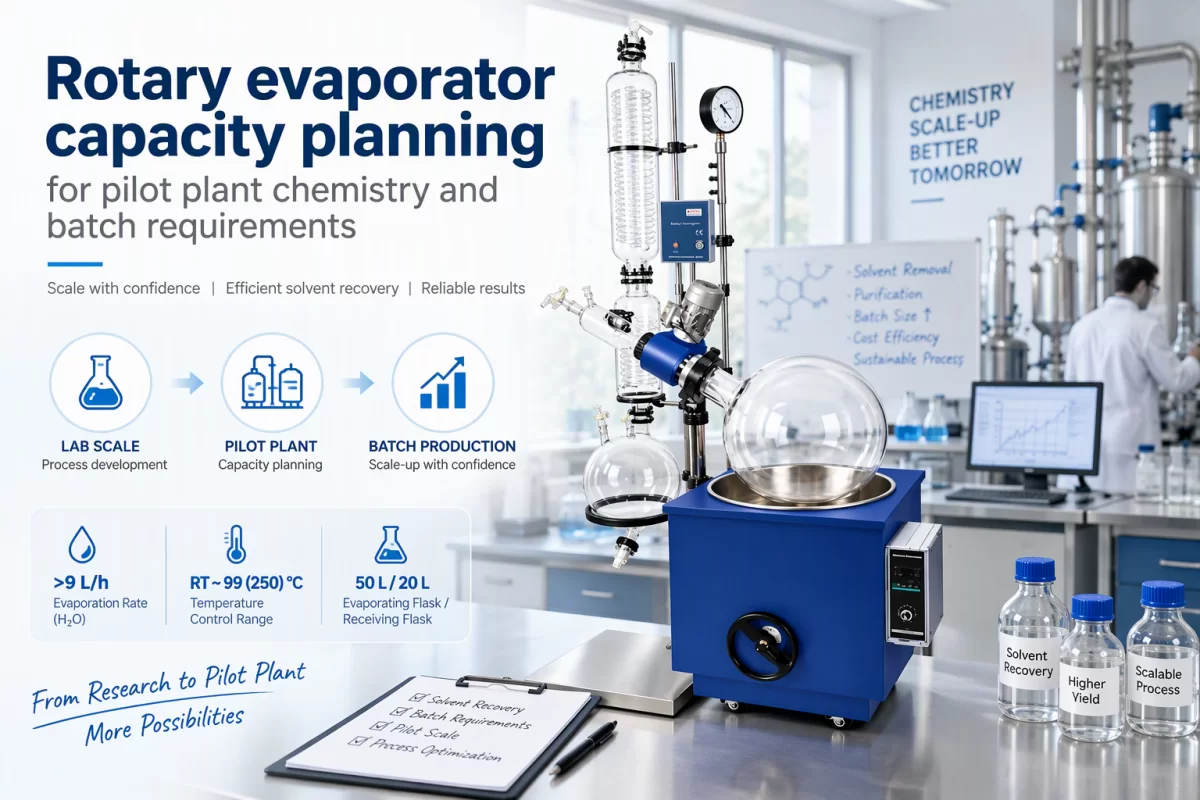
Choosing a rotary evaporator for pilot plant chemistry starts with the process, not simply the largest available flask. The supplied product listings include 10 L, 20 L and 50 L options, giving a useful starting point for comparing equipment as chemistry moves beyond small laboratory trials. However, a listed capacity does not, by itself, establish the permitted working charge or the solvent removal rate.
Define capacity before comparing pilot-scale evaporators
“Capacity” can describe several different things: the advertised equipment size, the liquid charged for one run, the volume collected in the receiving vessel, or the solvent removed over a production period. These quantities should not be treated as interchangeable. A purchasing specification should identify each separately so that the selected rotary evaporator addresses the actual pilot process.
Start by recording the incoming solution volume, the solvent composition and the required final concentration. Also note whether the feed is likely to foam, contains suspended solids, or becomes more viscous as solvent is removed. These observations help frame a technical discussion; they do not replace model-specific operating instructions or process testing.
Compare the listed 10 L, 20 L and 50 L options
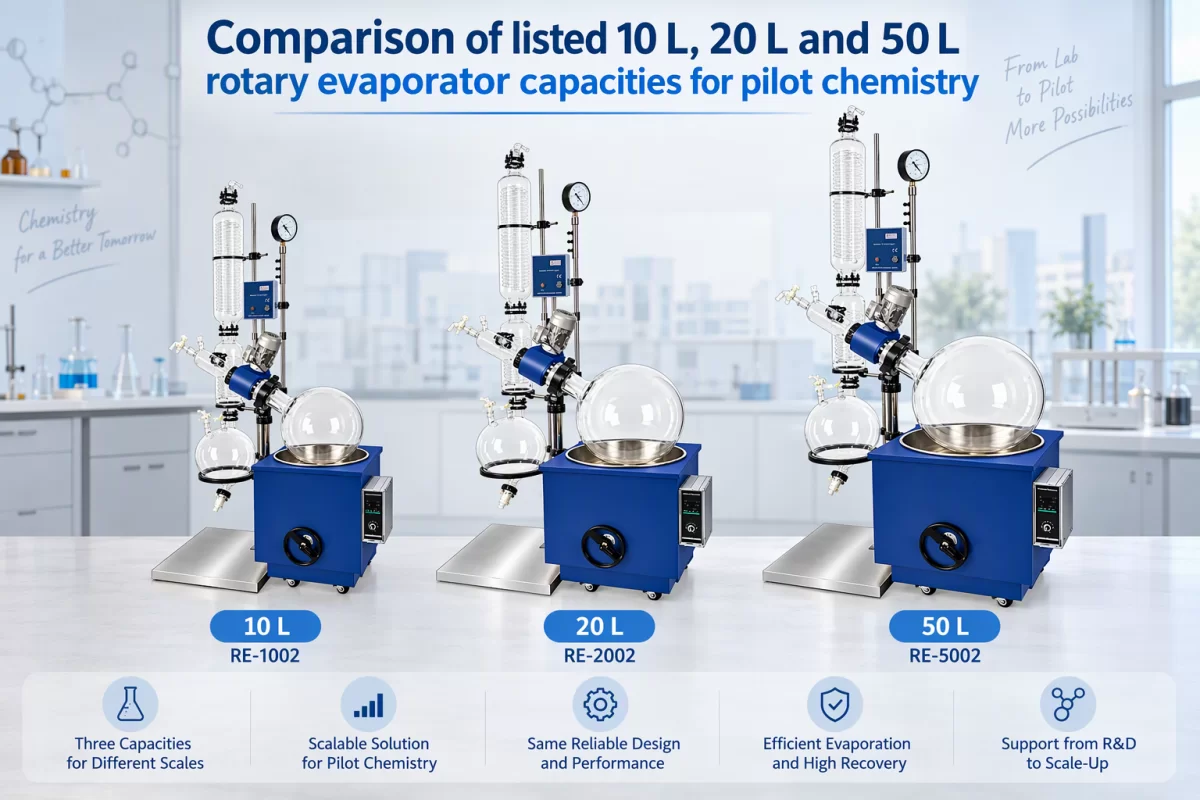
The supplied commercial listings identify RE1002 as a 10 L rotary evaporator, RE-2002 as a 20 L option and RE-5002 as a 50 L option. These capacity labels support a preliminary comparison. They do not establish heating power, condenser area, ultimate vacuum, operating temperature or evaporation performance, so those details should be confirmed for the exact quotation.
| Listed model | Advertised capacity (L) | Pilot chemistry selection focus |
|---|---|---|
| RE1002 | 10 L | Evaluate where the validated working charge and run schedule can accommodate the intended development batches. |
| RE-2002 | 20 L | Compare when a smaller shortlisted unit would require more batch divisions than the process schedule allows. |
| RE-5002 | 50 L | Assess for larger pilot campaigns, with particular attention to utilities, installation space and glassware handling. |
These are screening considerations, not guaranteed application limits. Allowable working charge and throughput require model-specific confirmation.
A 20 L option is worth comparing between the listed 10 L and 50 L sizes, but it is not automatically the correct pilot plant choice. A smaller unit may suit frequent formulation changes and separate experimental batches. A larger unit may be worth assessing when repeated batch splitting becomes impractical. Neither decision should rely on the capacity label alone.
Consider upstream operation as well. The solution transferred from a reactor may differ substantially from its original reaction charge after additions, sampling or workup. The overview of glass reactors in pilot plant workflows provides relevant context for planning this interface.
Match capacity with cooling, vacuum and the operating schedule
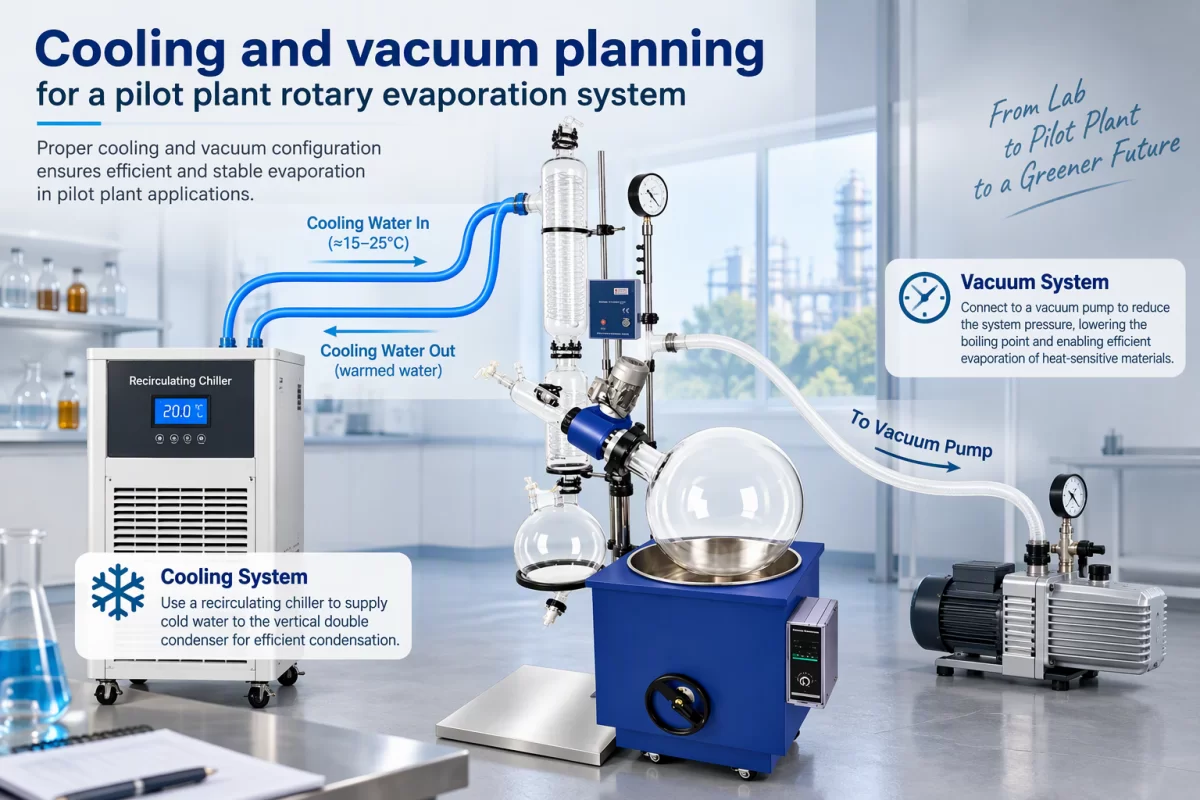
Rotary evaporator selection is a system decision. Increasing the listed size does not prove that the complete installation can achieve the required processing schedule. Ask the supplier to review the evaporator, condenser, cooling source and vacuum equipment together against the proposed solvent and operating conditions.
Cooling equipment should be selected for the condensation duty rather than merely paired by product name. The low-temperature cooling liquid circulating pump page is a relevant starting point for discussing a cooling source. Its suitability still needs to be checked for the proposed evaporator and process.
Include setup, filling, collection, cleaning and changeover in the operating schedule. A process with many separate formulations may have different equipment priorities from a campaign using one repeated recipe. Where concentration feeds a crystallization step, coordinate the endpoint and transfer conditions with the downstream crystallization reactor rather than evaluating evaporation in isolation.
Reference pricing and a configuration-specific quotation
The supplied company price table covers multiple equipment sizes, bundles and supporting items. A portfolio reference price can help initiate a purchasing discussion, but it should not be presented as the price of every 10 L, 20 L or 50 L rotary evaporator.
This reference is the lower-middle entry after sorting the supplied price entries from low to high, using the lower endpoint for entries expressed as ranges. It is not a model-specific offer. The actual quotation is subject to the selected configuration and inquiry results.
Request an itemized quotation that identifies the evaporator model, glassware, condenser arrangement, receiving vessel, heating bath, cooling equipment and vacuum equipment. Confirm what is included rather than assuming that a standalone unit and a bundle contain the same components.
Checks before approving a pilot chemistry purchase
- Validate the charge: obtain the permitted working volume and review the proposed feed behavior.
- Confirm technical limits: request documented temperature, rotation and vacuum specifications for the quoted configuration.
- Review utilities: check electrical requirements, cooling provision, vacuum connections and installation space.
- Assess safe operation: review solvent hazards, ventilation, glassware handling and site-specific requirements with qualified personnel.
- Check documentation: request relevant certificates and manuals; do not transfer claims from another listing to the selected model.
- Agree on acceptance criteria: define a representative process trial and the observations needed to confirm suitability.
These checks turn a capacity comparison into a defensible equipment specification. They also help prevent an apparently suitable size from being purchased with an incomplete utility package or an unverified performance expectation.
Choose pilot plant capacity around the chemistry
The answer to “What capacity rotary evaporator for pilot plant chemistry?” depends on the validated working charge and the complete process schedule. The listed RE1002 10 L, RE-2002 20 L and RE-5002 50 L options provide a practical comparison range, not a universal sizing rule.
Begin with the batch and solvent requirements, compare the available sizes, and confirm cooling, vacuum, handling and documentation before purchase. For a configuration-specific recommendation and quotation, prepare those process details for KD Instrument. As Alice, I recommend choosing the capacity that meets the demonstrated process need rather than treating the largest listed volume as the default.