Chemistry pilot plant purchasing guide
Which Rotary Evaporator Should a Chemistry Pilot Plant Buy?
Deciding which laboratory rotary evaporator to buy for pilot plant chemistry starts with the process, not the largest flask available. The right shortlist connects working batch volume, solvent behavior, product temperature limits, and the cooling and vacuum services already available on site.
A 20 L rotary evaporator is worth evaluating when smaller equipment creates excessive batch splitting, but its suitability depends on the permitted working charge and the complete system around it. This guide compares documented flask sizes and installation dimensions, then turns those details into a practical purchasing checklist.
Start with working batch size—not nominal flask capacity
Record the liquid volume entering evaporation, the amount of solvent to be removed, and the required final concentration. Also describe whether the feed foams, contains suspended solids, or becomes viscous as solvent leaves. These characteristics affect usable working volume and handling, so nominal flask capacity should not be treated as an approved fill volume.
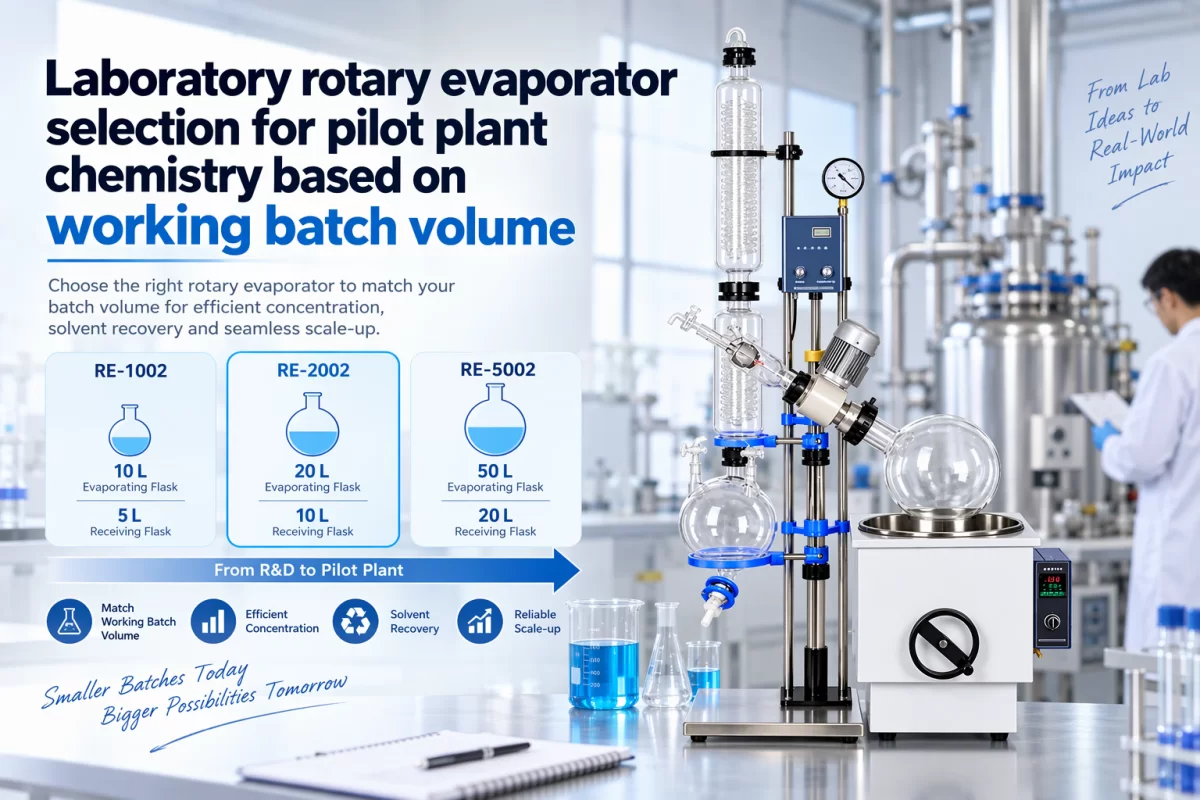
The following models provide a capacity-based starting point. Evaporating and receiving vessels serve different purposes: the first holds the process charge, while the second collects condensed solvent.
| Model | Evaporating / rotating flask (L) | Receiving / recovery flask (L) |
|---|---|---|
| RE-201D | 2 | 1 |
| RE-301 | 3 | 2 |
| RE-501 | 5 | 3 |
| R1005 | 5 | 3 |
| R1010 | 10 | 5 |
| R1020 | 20 | 10 |
| R1050 | 50 | 20 |
Does a 20 L rotating flask accommodate a 20 L working batch?
I would not plan a purchase on that assumption. The nominal vessel volume is not the operating charge. I would define the intended feed volume, foaming tendency, and concentration endpoint, then select a working charge that leaves appropriate space for rotation and vapor disengagement.
For small development runs, the 2–5 L models belong on the initial shortlist. Compare the R1010 and R1020 when repeated small runs disrupt the pilot schedule. Evaluate the R1050 when larger campaigns justify its handling and installation requirements. These are screening choices, not guarantees of batch throughput.
For a project considering this capacity class, the 20L Rotovap product page is a useful starting point for a configuration inquiry. Request a named model and an itemized equipment scope before placing an order.
Match the pilot plant rotary evaporator to the solvent
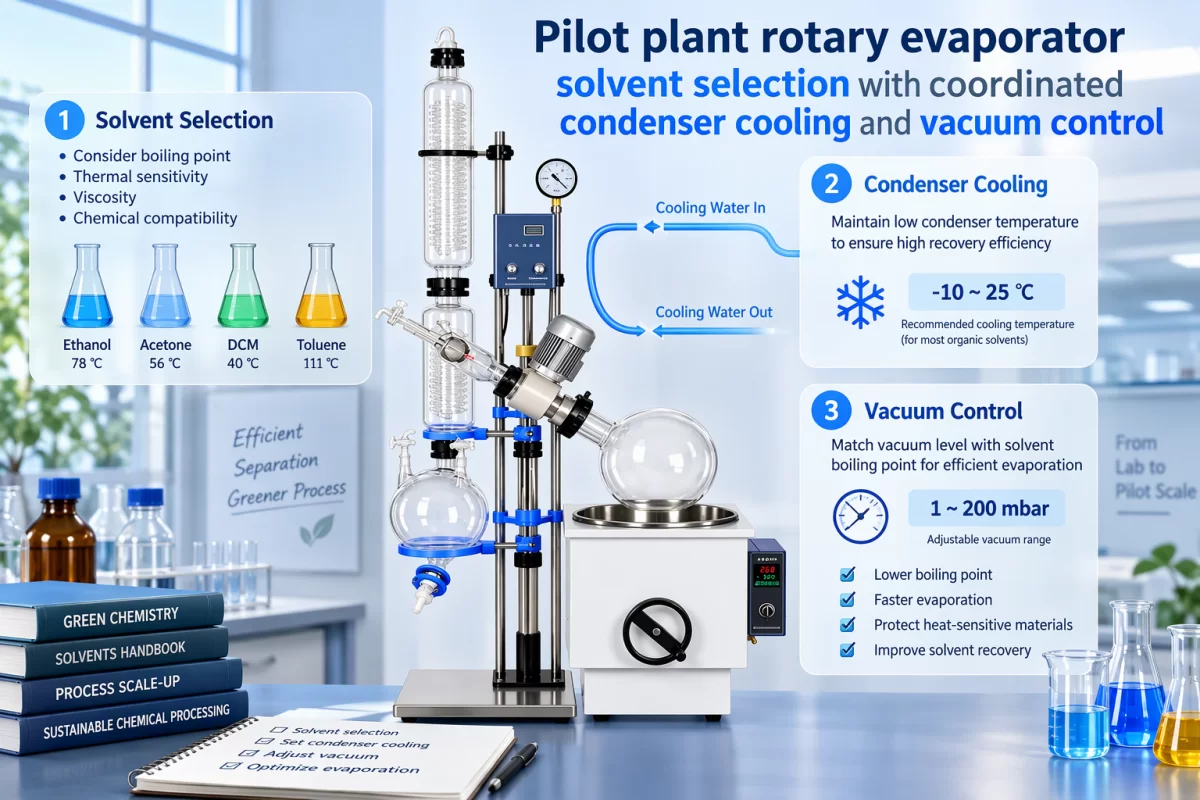
A solvent list is more useful than a generic request for “high vacuum.” Provide solvent identities, mixture composition, anticipated concentration changes, and the maximum acceptable product temperature. Reduced pressure can lower boiling temperature, but a workable operating point still depends on condensation, vacuum control, and the material being processed.
- Volatile solvents: assess whether the cooling system can condense the expected vapor load at the intended operating pressure. Include pump exhaust management in the process review.
- Higher-boiling solvents: evaluate the relationship between achievable operating pressure, heating conditions, and product stability. A larger flask alone does not resolve this requirement.
- Mixed solvents: anticipate changing boiling behavior during concentration. Define the endpoint and whether collected solvent fractions need separate handling.
- Flammable or aggressive materials: assess ventilation, ignition risks, wetted-material compatibility, and any applicable hazardous-area requirements before choosing equipment.
Specify compatibility requirements for glassware, seals, hoses, valves, the receiver, and the vacuum pump. Any required compliance documentation should identify the offered configuration; a capacity label is not evidence of a safety certification.
Can water evaporation data predict solvent removal time?
I would use a representative process trial rather than transfer a water-based result directly to another solvent. Solvent properties, operating pressure, cooling conditions, feed composition, and the endpoint all influence removal time. For purchasing, I would request a test plan tied to the actual process conditions.
Compare utilities and installation space before ordering
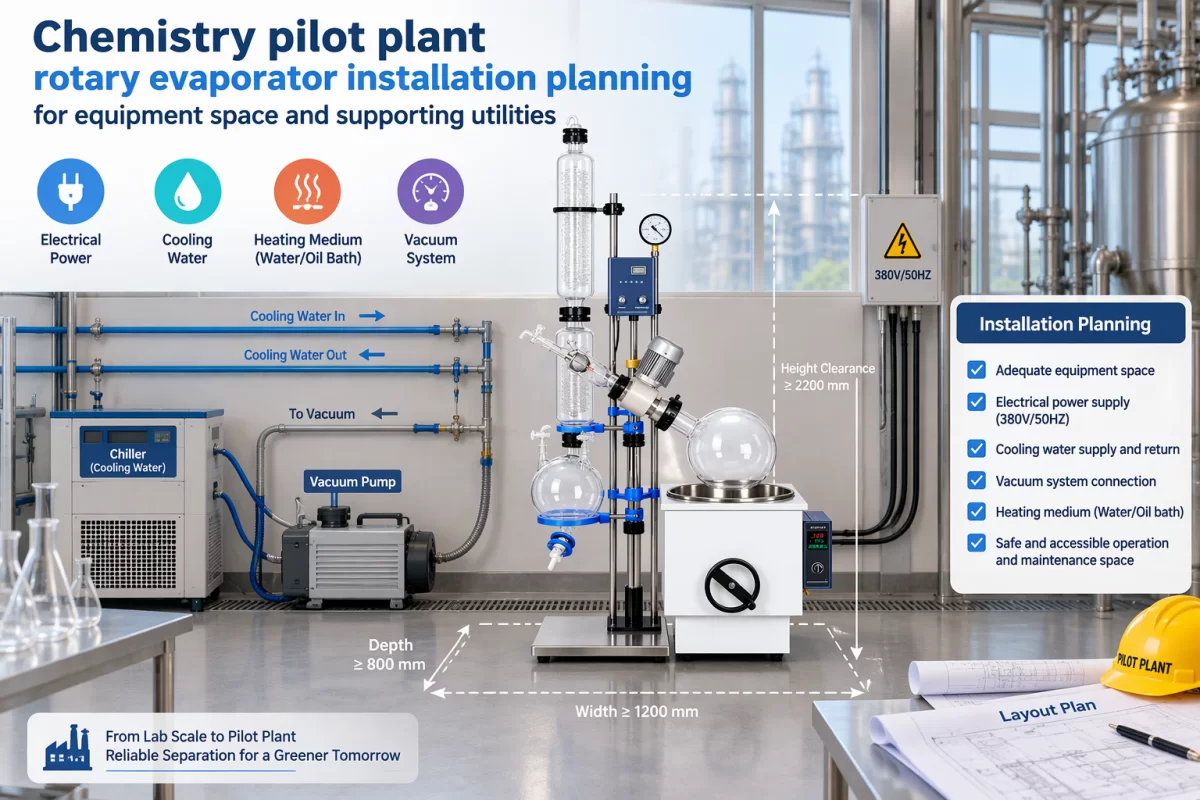
Purchase the evaporator as part of an operating system. The quotation should identify the heating bath, condenser arrangement, vacuum equipment, cooling equipment, connecting hoses, controls, and accessories included. Do not assume that a standalone evaporator price includes a pump or chiller.
For the site survey, record available voltage, frequency, phase, circuit capacity, coolant services, ventilation, and drainage. Ask for the electrical requirements of every offered component, rather than budgeting only for the evaporator itself. Chiller suitability should be evaluated at the required coolant temperature and process load, not simply by reservoir size.
| Model | Outline dimensions (mm) | Space-planning priority |
|---|---|---|
| R1005 | 660 × 400 × 1020 | Allow access for flask changes and receiver handling. |
| R1010 | 920 × 550 × 1700 | Check overhead clearance and service access. |
| R1020 | 1250 × 600 × 2100 | Plan the equipment position and glassware handling route. |
| R1050 | 1320 × 770 × 2340 | Review room height, delivery access, and handling arrangements. |
Outline dimensions are not service-clearance requirements. Reserve additional room for hoses, ancillary equipment, maintenance, and safe operation. If evaporation follows reaction work, coordinate transfers with the upstream equipment; this overview of glass reactors for pilot plants provides relevant context for the wider process layout.
Which matters more: a larger flask or stronger supporting utilities?
I would first identify the limiting step. If cooling cannot handle the vapor load, or vacuum performance deteriorates during operation, extra flask volume may not improve the schedule. I would compare complete systems against the required batch cycle, including charging, concentration, discharge, and cleaning.
Use a reference price without confusing equipment scopes
Our company’s reference price:US$1,480
This is a reference across our supplied price list, not a quotation for a particular model or a complete pilot plant package. The actual quotation depends on configuration and the inquiry result.
For a meaningful budget comparison, request separate line items for the evaporator, pump, chiller, controls, accessories, spare glassware, and delivery services. Compare equivalent scopes. A lower equipment price does not necessarily mean a lower installed project cost.
A purchasing checklist for pilot plant chemistry
Prepare a concise process brief before requesting a proposal. The following information helps turn a broad capacity request into a useful equipment recommendation:
- Batch definition: state incoming liquid volume, expected solvent removal, final concentration, and batches per shift.
- Material behavior: list solvents, solids content, foaming tendency, viscosity changes, and cleaning requirements.
- Operating limits: define maximum product temperature, target pressure conditions, and acceptable processing time.
- Vessel selection: compare nominal flask capacities against the intended working charge and receiver-emptying plan.
- Cooling and vacuum: request a matched proposal describing operating duties, controls, compatibility, and exhaust handling.
- Site readiness: provide electrical services, ventilation arrangements, room dimensions, and delivery access.
- Safety and acceptance: specify applicable documentation and agree on a representative commissioning or process test.
- Commercial scope: obtain a model-specific quotation with included components, spare parts, service terms, and delivery details.
Which laboratory rotary evaporator should a pilot plant buy?
Choose the model whose working charge, solvent-handling conditions, and supporting utilities fit the process. Keep smaller models on the shortlist for development work, compare 10 L and 20 L options when batch splitting becomes a scheduling issue, and evaluate 50 L equipment when campaign requirements justify the additional installation and handling demands.
A 20 L rotary evaporator is a practical candidate to discuss—not an automatic answer for every chemistry pilot plant. Submit the solvent list, intended working batch, temperature limits, production schedule, and available utilities to obtain a corresponding configuration proposal and quotation.