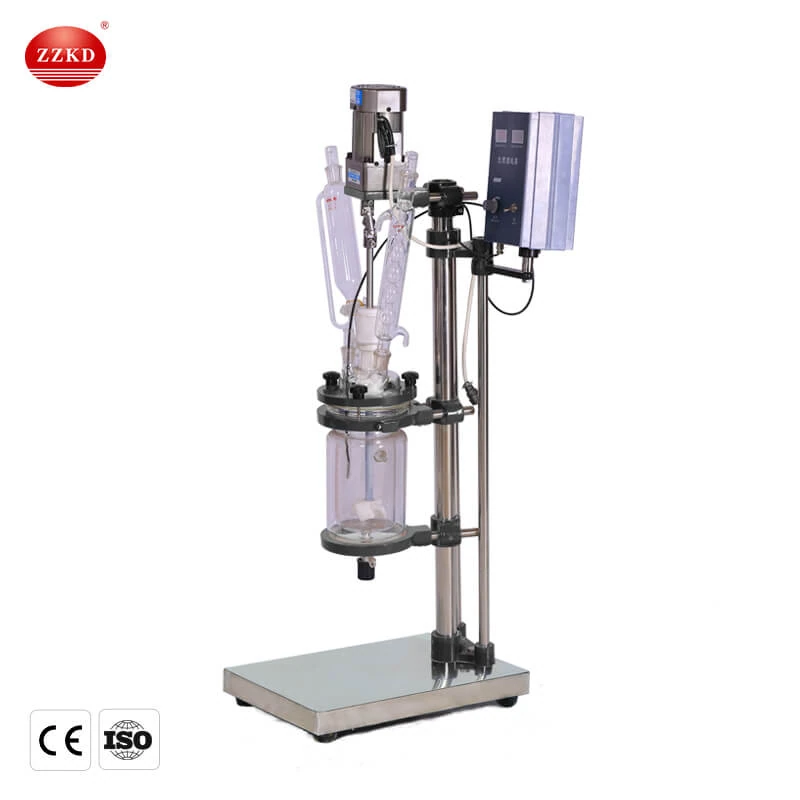
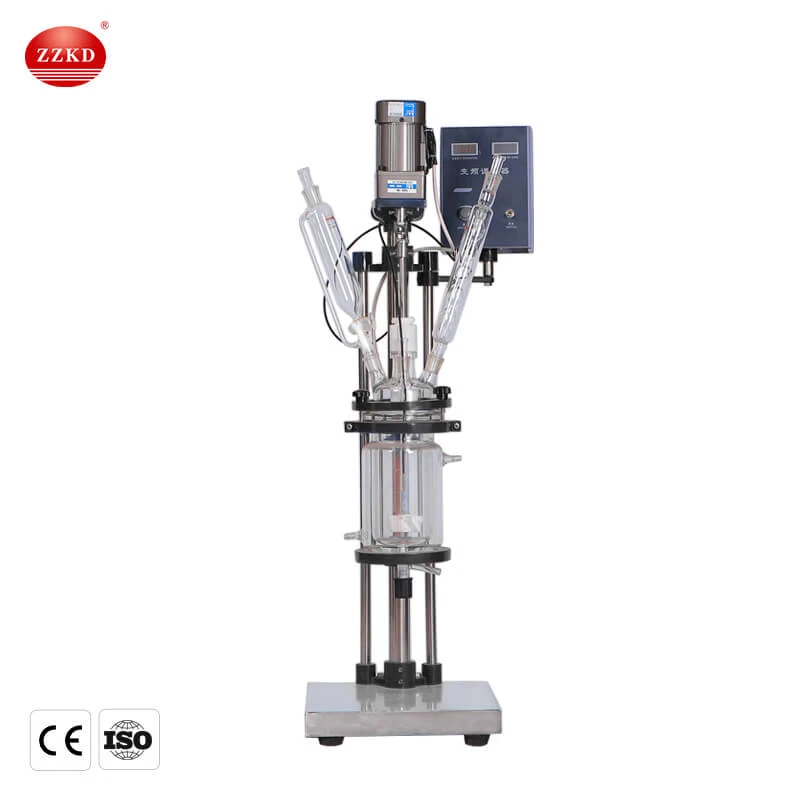
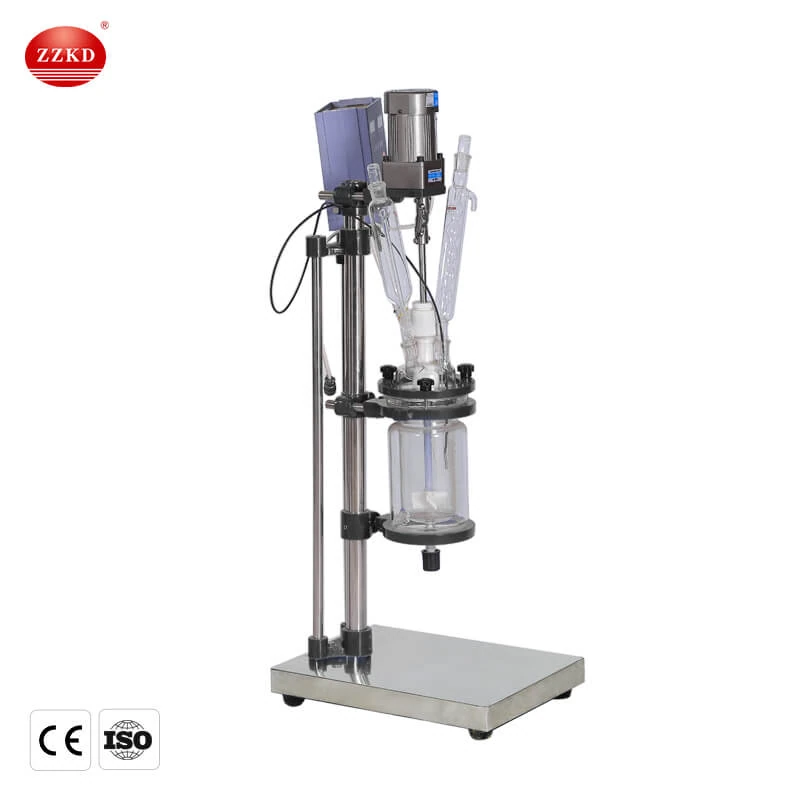
Overview
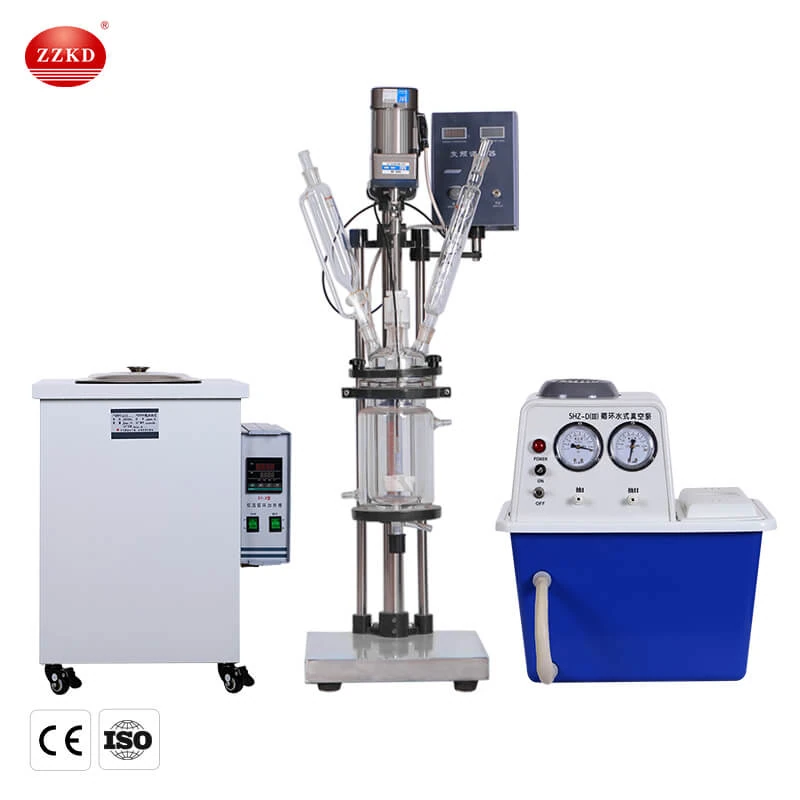
The small glass jacketed reactor is a glass reactor developed on the basis of the long-term production and use of the single-layer glass reactor, which can more conveniently control the temperature of the reactants. Use a constant temperature oil bath or a low-temperature circulating pump to circulate heat and cool the reactants through the interlayer of the small glass jacketed reactor, so that the temperature control of the reactants in the small glass jacketed reactor can reach a very high level, which is very important for experiments or production. Efficiency and quality have been significantly improved.
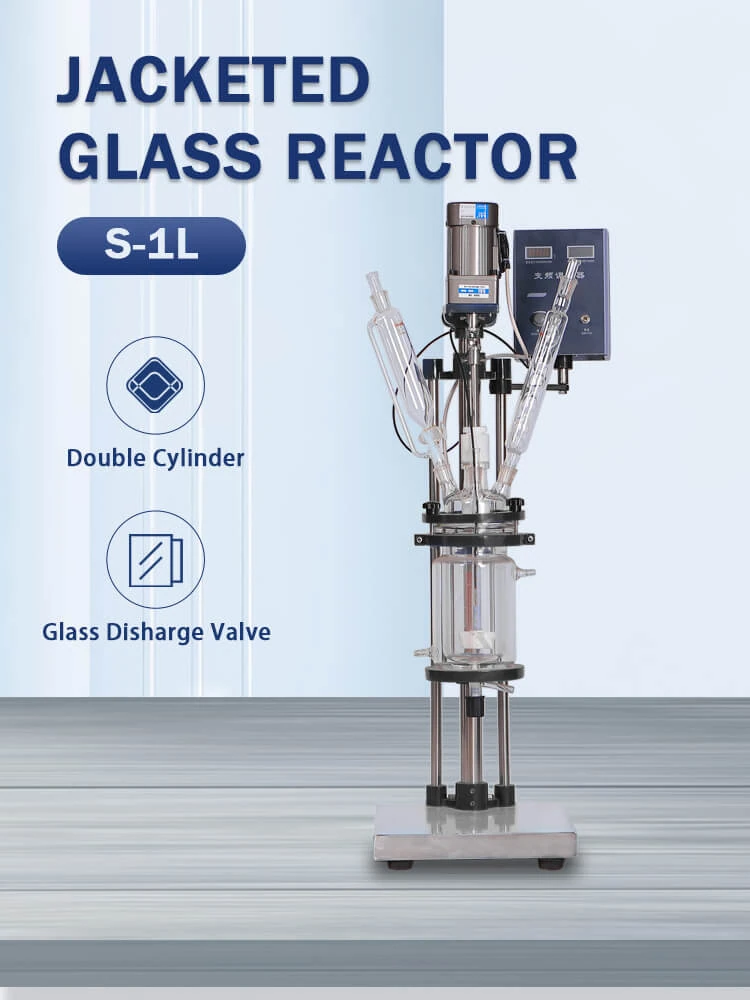
The small glass jacketed reactor integrates the functions of stirring, reaction, evaporation, liquid separation, extraction, heating and cooling, and can realize the function of rectification after adding a rectification column. It is an ideal reaction equipment for modern chemical industry, new materials, organic synthesis, biopharmaceuticals, precious metal purification and other occasions. The materials are reacted in the reactor, and the evaporation and reflux of the reaction solution can be controlled. After the reaction, the materials can be discharged from the outlet at the bottom of the reactor, which is very convenient to operate. It is an ideal equipment for modern chemical small sample, medium sample experiment, biopharmaceutical and new material synthesis.
Small jacket reactors are generally classified according to the jacket heating form, and can be divided into: electric heating rod heating, steam heating, heat transfer oil circulation heating reactor.
① The electric heating reactor heats the heat conduction oil through the electric heating rod, and uses the heat conduction oil as the medium to transfer heat to the material in the kettle body.
② The steam heating reaction kettle is heated by filling the jacket with steam, and a boiler needs to be added. The hardware investment is slightly larger, but the energy consumption is smaller than that of the electric heating jacket reaction kettle.
③ Heat conduction oil circulation heating reactor mainly realizes heat transfer or cooling of heat conduction oil circulation through the coil tube in the jacket.
The structure of the jacket: on the outside of the kettle body, jackets of various shapes are installed by means of welding or flange connection to form a closed space with the outer surface of the kettle body, and a heat-carrying fluid is introduced into this space for heating or Cool the material and maintain the temperature of the material within the specified range. This structure is called a jacket.
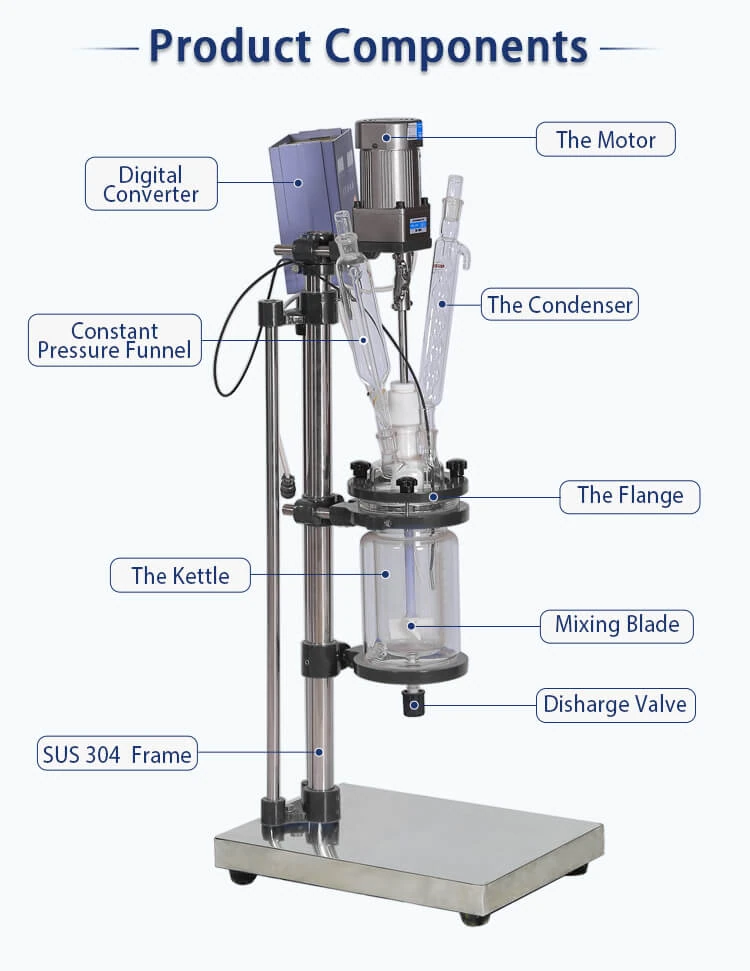
How to use small glass jacketed reactor:
1. Pay attention to check the power supply voltage used, and pay attention to keep it consistent with the specifications provided on the nameplate of the machine, otherwise there will be problems in use. After plugging in the power plug, it is necessary to turn on the power switch on the frequency converter at this time. As for its speed, you can use the speed control button to determine the speed.
2. When the machine is running, when the flow of materials or the speed of the motor gathers at a certain point, resonance will occur. At this time, attention should be paid to changing the speed of the motor, so as to avoid the continuation of the resonance happened. To avoid such a situation, when the small glass jacketed reactor is in use, we must pay attention not to leave the control of the operator.
3. After the stirring rod is installed and before use, it must be rotated by hand. At this time, the problem of concentricity should be observed. If there is a problem with concentricity, the heavy clamp should be loosened at this time, and then do clip is being processed, then turn on the power.
4. In the process of use, pay attention to the sealing of the kettle. If the performance of the sealing is gradually declining, it is necessary to check the rotating bearing in the agitator.
Of course, during the use of the small glass jacketed reactor, there will be some temporary use problems. At this time, it is necessary to stop the machine for inspection in time.
Features of small glass jacketed reactor:
1. It is sealed with PTFE material and special rubber composite sealing ring, which can resist various solvents and maintain high vacuum, which is very convenient to use.
2. Condenser to ensure high recovery rate.
3. Standardized connection method, easy to disassemble.
4. Equipped with a discharge switch, it is very fast to recover the solvent.
5. Equipped with a vacuum gauge, the working vacuum can be selected for low boiling point materials.
6. Reasonable structure and exquisite materials. The whole machine is made of stainless steel, aluminum alloy and new synthetic materials, which have the advantages of anti-corrosion, anti-rust and resistance to various solvents.

Features
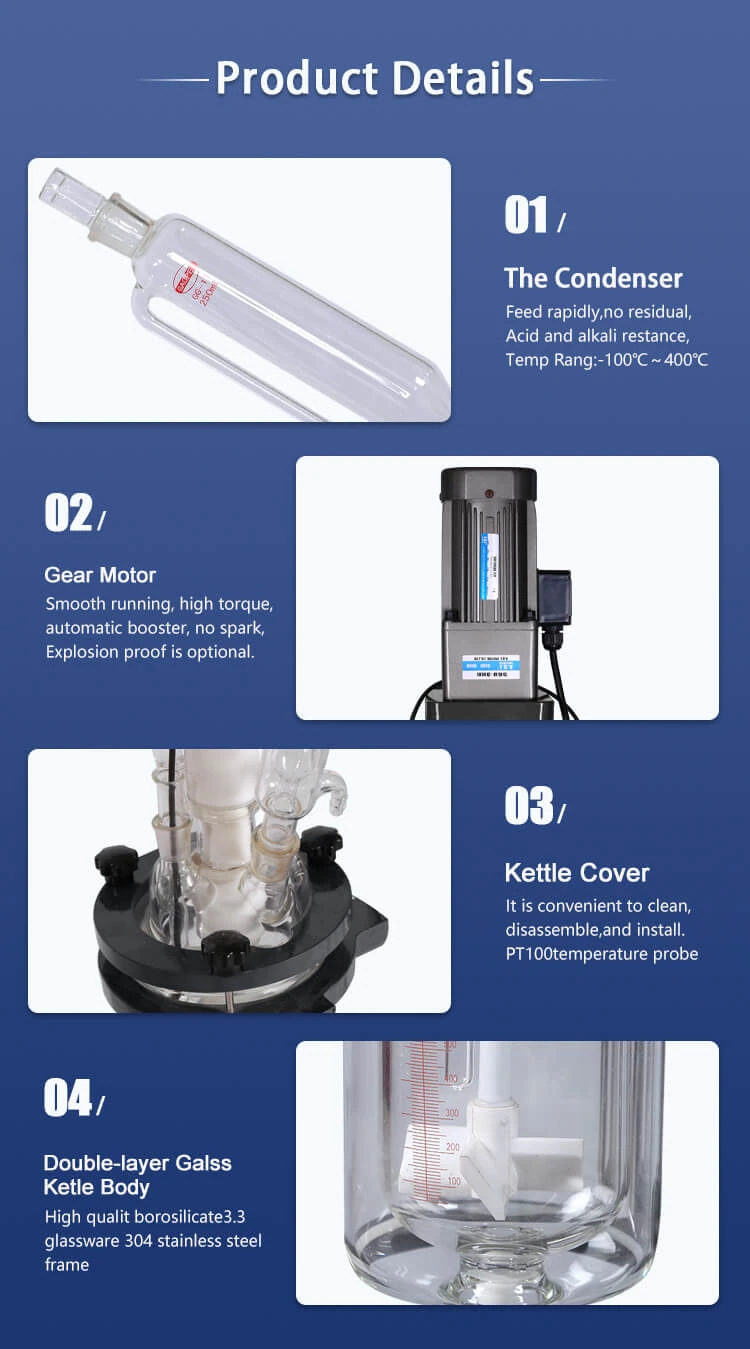
1.GG17 high-borosilicate glass with nice physical-chemical properties; experiment temperature -100 to 400 degree C; Resistant to strong acidic properties of materials; only touching with glass parts & PTFE, no cross-contamination.
2.Double cylinder; kettle cover is separated from kettle body. It is convenient to disassemble, clean and install.
3.Stirring adopts to mechanical sealing, it keeps higher vacuum degree among the same products in the market. It also keeps high vacuum degree when stirring.
4.Glass(PTFE)discharge valve, non-dead angle mixing, fast emptying, no residue.
5. Frequency control speed gear motor, smooth running,high torque, automatic booster, no spark, noise free, long life.
6.SUS frame and cast aluminum material kettle body support, elegant appearance, stable structure.
7.Circulating water/oil bath, high and low temperature machine can supply heating source; Cooling machine:cooling chiller,high and low temperature machine,convenient and practical
8.Scientific & innovative structure, practical, elegant appearance, domestic industry-leading.
9.Explosion proof is optional.
Precautions for small glass jacketed reactor:
1. Check the instrument carefully before use, whether the glass bottle is damaged, whether the interfaces are consistent, and handle with care.
2. Wipe each interface with a soft cloth (you can replace it with a napkin), and then apply a little vacuum grease. (Vacuum grease must be covered after use to prevent lime sand from entering.)
3. The electrical part must not enter the water, and it is strictly forbidden to be damp.
4. Turn on the power switch first, and then let the machine run from slow to fast. When stopping, make the machine stop, and then turn off the switch.
5. The PTFE switches everywhere should not be over-tightened, as it is easy to damage the glass.
6. When doing any repair or inspection on the machine, be sure to cut off the power supply and water source first.
7. Unscrew each PTFE switch after stopping the machine, and the PTFE piston will be deformed if it is still in the working state for a long time.
8. Clean the sealing ring regularly. The method is: take off the sealing ring, check whether there is dirt on the shaft, wipe it off with a soft cloth, apply a little vacuum grease, and reinstall it to keep the shaft and the sealing ring smooth.
9. The connectors should not be tightened too tightly, and should be loosened regularly to avoid the connectors being seized by long-term locking.
10. The authentic accessories of the original factory must be purchased. Random use of other accessories will cause fatal damage to the machine.
11. After each use, you must use a soft cloth to wipe off all kinds of oil stains, stains, and solvent residues left on the surface of the machine, and keep it clean.
Troubleshooting method for small glass jacketed reactor:
1. Turn on the power switch, the indicator light is off. The external power supply is not connected or is in poor contact. Please have a professional electrician check the power supply and socket.
2. The fuse is short-circuited. Turn the power switch to the OFF position, and then replace the fuse.
3. The power indicator light is on, but does not rotate. The rotating shaft is rusted Stop using it, contact the supplier Motor, electrical box failure The seven-pin plug is not connected Reconnect the seven-pin plug.
4. The vacuum suddenly disappears, the glass is cracked, and the switch is damaged. Check the glass parts and replace the switch.
5. There is a vacuum, but it cannot be pumped. The sealing ring is worn out, and the vacuum switch connected is leaking. Please replace the sealing ring and the switch.
6. Sometimes there is no vacuum when there is dirt on the steel shaft and the connector is loose. Please remove the dirt and check the vacuum gauge and vacuum pump.
7. The vacuum hose is aging Please replace the vacuum hose.
8. The main shaft is loose left and right, and the tightening screw is loose and tightened.
10. The temperature of the motor is too high (room temperature plus 40°C is normal) Overload stop, rotate the motor shaft by hand, check whether it is heavy, remove the dirt on the contact part between the sealing ring and the glass shaft, and apply vacuum grease.
11. The speed display does not match the actual voltage. The voltage is unstable and there are errors. Contact the supplier.
12. The shell is live and the heating pipe has cracks and water has entered. Please check it with a professional electrician.
Specifications
Main technical datas:
| Model | (EX)S-1L |
| Power supply | AC220V |
| Stirring power(W ) | 60 1/3 Gear Motor |
| Stirring speed(rpm) | 60~1400 |
| Motor torque | 2000g/cm |
| Reaction flask capacity | 1L |
| Note | Floor Type |
Detailed technical datas:
| Model | S-1 |
| Shaft diameter | 12mm |
| Stirring neck(flange) | Φ33mm 50mm |
| Thermometer(taper) | 19# Φ27mm |
| Condensing neck(1-5taper10-100round) | 24# Φ34mm |
| Liquid feeding neck(taper) | Φ24mm 34mm |
| Bottom discharge neck(flange) | PTFEΦ35mm 40mm |
| Jacket liquid Inlet/Outlet | Φ6mm 12mm |
| Stirrer length,diameter,weight | 465mm Φ80mm 0.4kg |
| Thermowell length,diameter,weight | 280mm Φ13mm 0.03kg |
| Stirring seal ( heitht,diameter,weight) | 180mm Φ50mm 0.6kg |
| Funnel (height, diameter,weight) | 350mm Φ50mm 0.3kg |
| Condenser (length,diameter,weight) | 375mm Φ40mm 0.25kg |
| PTFE bottom discharge (height, diameter, weight) | PTFE170mm Φ68mm 3kg |