Overview
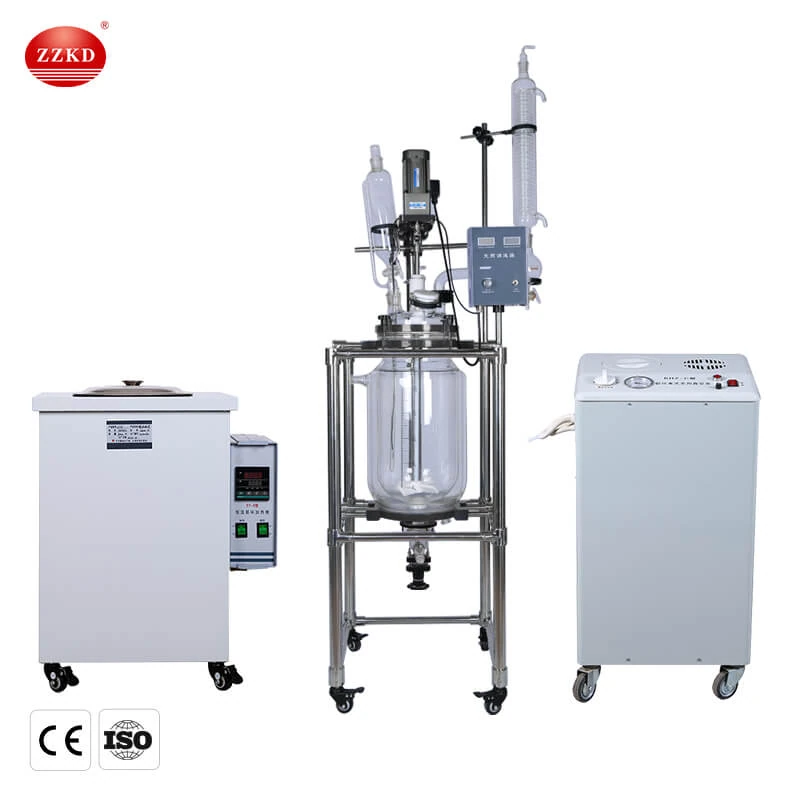
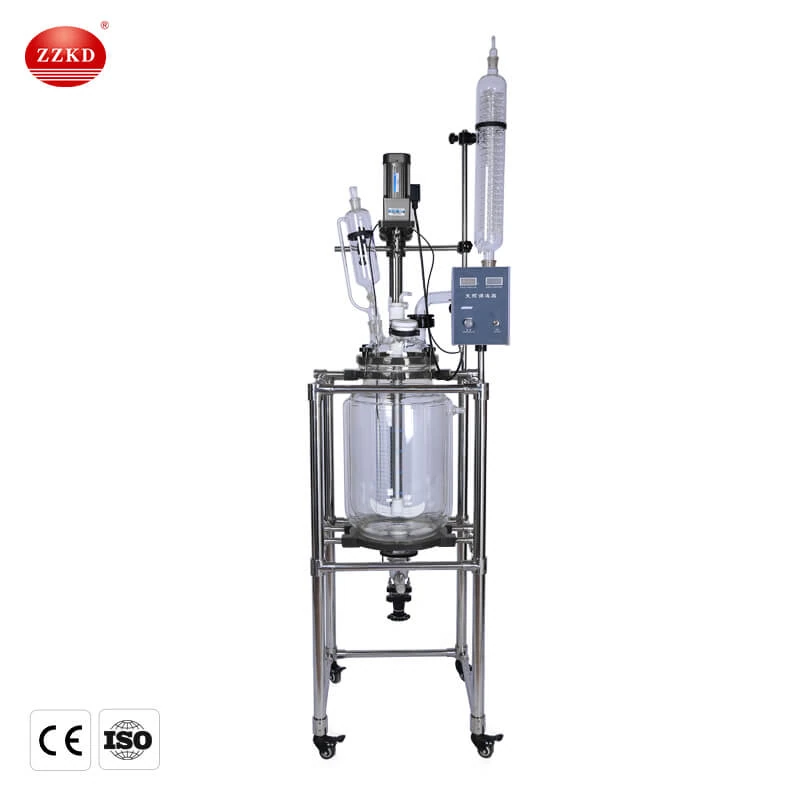
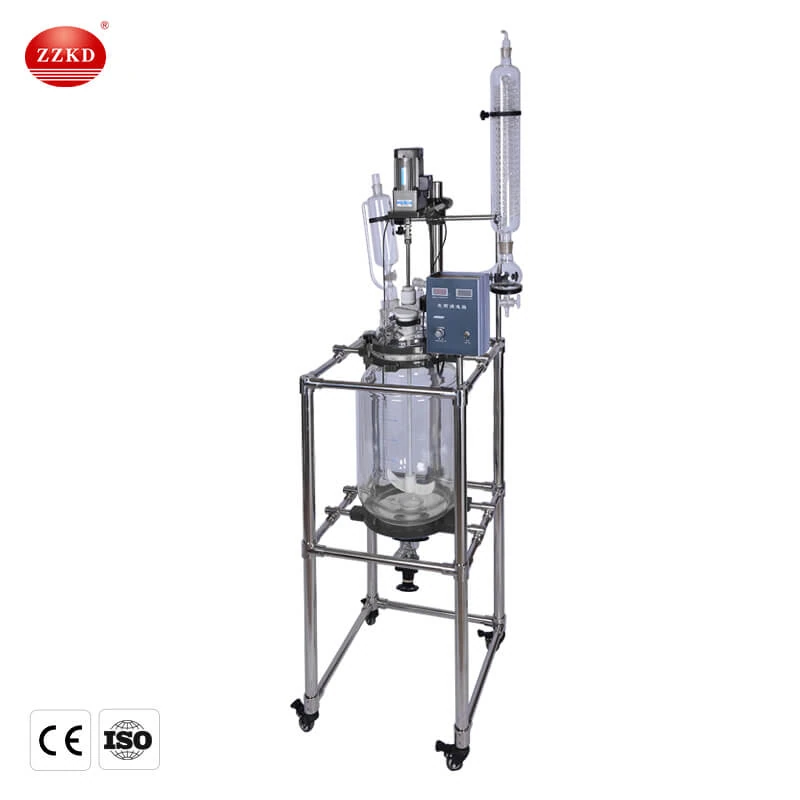
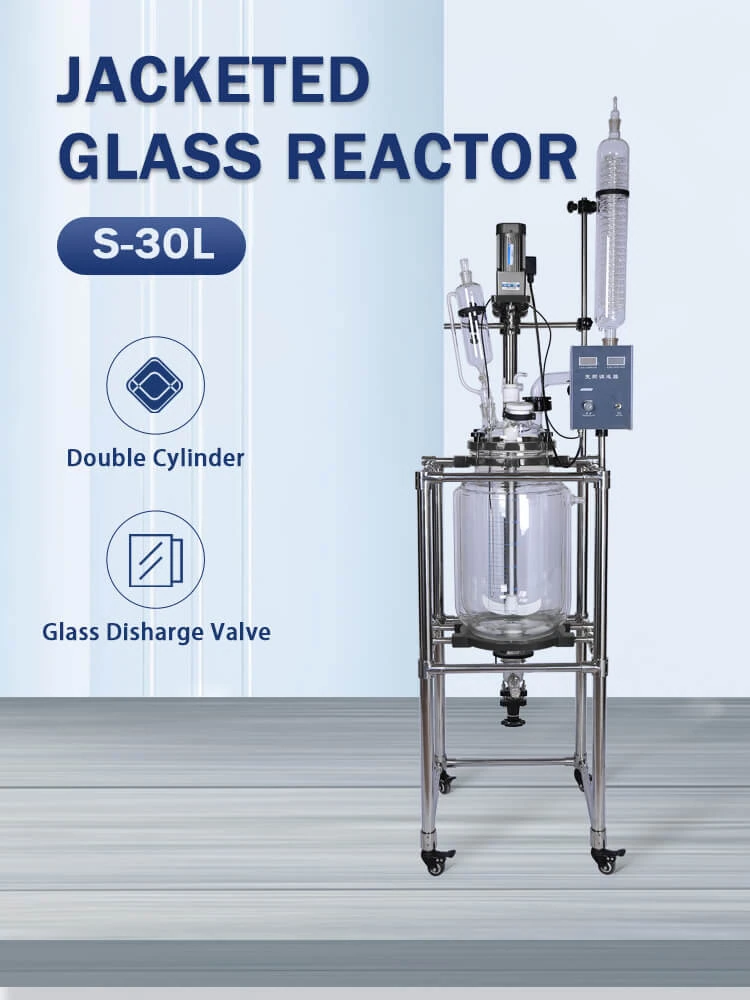
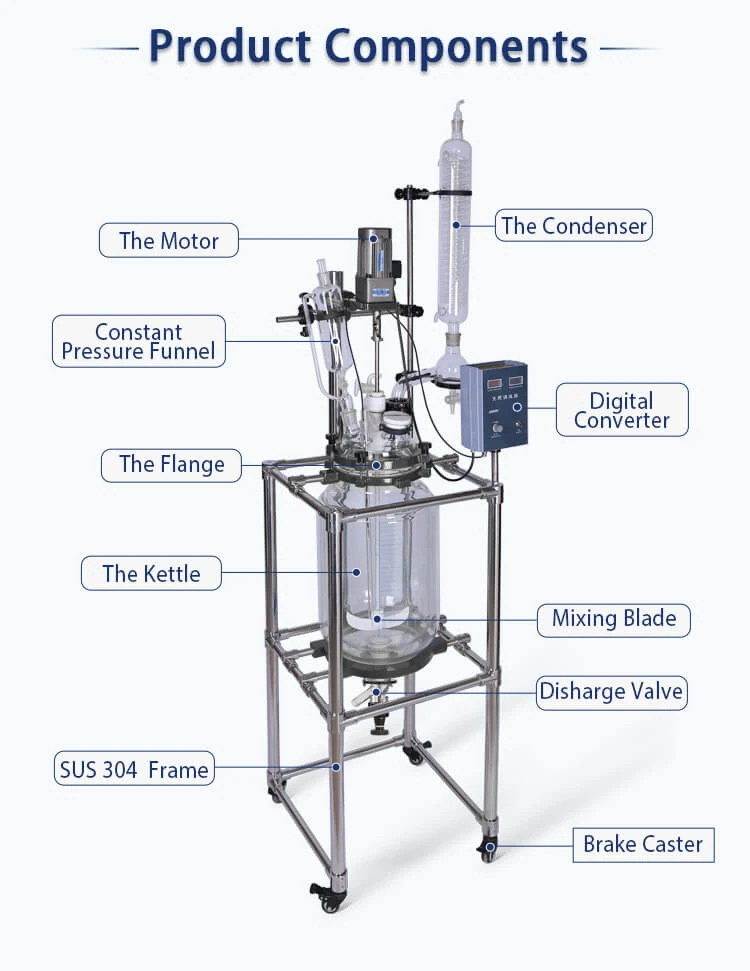
The jacketed glass reactor vessel adopts frequency conversion speed regulation, AC induction motor, constant speed, no brush, no spark, safe and stable, and can work continuously. The whole set of glass instruments is made of high borosilicate glass, which has good chemical and physical properties. The glass interlayer interface is connected to hot oil and circulated, which can be used for heating reaction. It can react at room temperature, and the reflected heat can be quickly taken away by tap water. The lower discharge port has a flange port and a PTFE valve, which can be disassembled to facilitate the discharge of solid materials.
How to choose the temperature control medium for the jacketed glass reactor vessel:
According to the required reaction temperature, choose temperature control substances with different characteristics, as the heat dissipating substance for reaction, for low temperature, choose ice alcohol bath; for normal temperature, choose water bath; for high temperature, choose oil bath. Of course, the specific situation is analyzed on a case-by-case basis.
When using ultra-low temperature or high temperature, the key to choosing the right medium is the viscosity. If the viscosity of the medium is too high, the circulating water pump may not be able to move it, and the actual effect of the material circulation system is not very good, and a good temperature control effect cannot be achieved. If the circulating water pump with high power is replaced rashly, the working pressure is too high, which may cause the jacketed glass reactor vessel to break. Generally, we will choose the corresponding heating medium according to our own products and supporting facilities.
How to use the jacketed glass reactor vessel:
1. Check whether the power supply voltage is consistent with the specifications provided on the machine nameplate.
2. Plug in the power plug, turn on the power switch on the inverter, and use the speed control knob to select a suitable speed.
3. The flow of materials and the power of the motor speed may resonate at a certain point, please change the speed of the motor to avoid resonance.
4. After the stirring rod is installed, it must be rotated by hand. Pay attention to whether the concentricity is good. If the concentricity is not good, loosen the heavy clamp, and then turn on the power after clamping. Adjust gradually from slow to fast.
5. Use the stirring rod regulator to make the stirring leaves 5cm up and down as needed.
6. If the sealing performance of the jacketed glass reactor vessel is found to be reduced, please check the rotating bearing in the stirrer sleeve.
7. The jacketed glass reactor vessels are all made of GG.17 low-expansion coefficient high-temperature resistant high-quality borosilicate glass. Users prepare reaction bottles and other glass instruments by themselves. Please confirm the glass material to ensure safe use.
8. The interlayer on the jacketed glass reactor vessel is externally connected to the circulation port. It can be heated by hot oil and low-temperature reaction can be carried out by cooling liquid. If it is heated by steam, it should not exceed 0.5K-1K (try not to use pressure steam to heat ).
9. When testing at low temperature, the discharge valve at the bottom will be frosted. When using the valve, it must be partially thawed first to prevent the glass from being broken.
10. If there are particulate objects in the solution during use, the residue may accumulate on the PTFE piston of the valve when discharging, and the air tightness will be affected when it is used again. Be sure to clean it after each discharge and use it again. .
Features
Jacketed glass reactor vessel features:
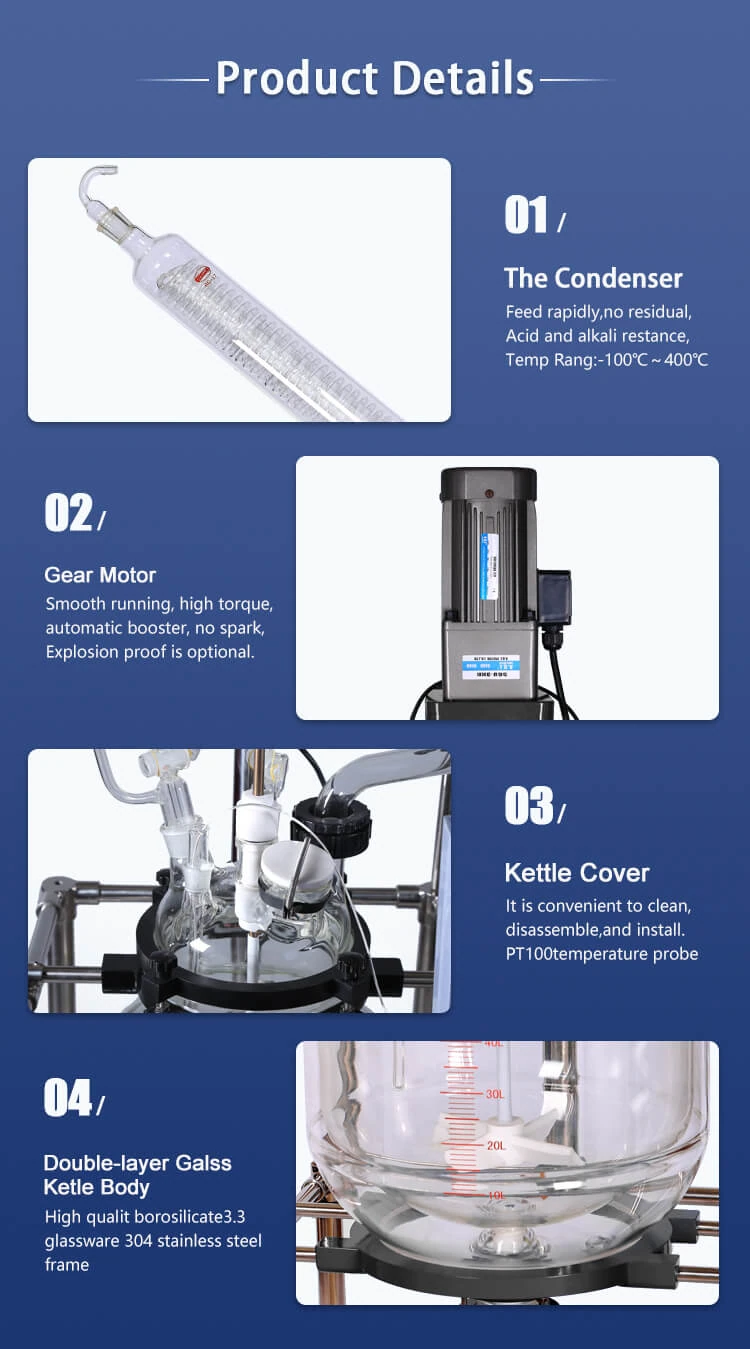
1.GG17 high-borosilicate glass with nice physical-chemical properties; experiment temperature -100 to 400 degree C; Resistant to strong acidic properties of materials; only touching with glass parts & PTFE, no cross-contamination.
2.Double cylinder; kettle cover is separated from kettle body. It is convenient to disassemble, clean and install.
3.Stirring adopts to mechanical sealing, it keeps higher vacuum degree among the same products in the market. It also keeps high vacuum degree when stirring.
4.Glass(PTFE)discharge valve, non-dead angle mixing, fast emptying, no residue.
5. Frequency control speed gear motor, smooth running,high torque, automatic booster, no spark, noise free, long life.
6.SUS frame and cast aluminum material kettle body support, elegant appearance, stable structure.
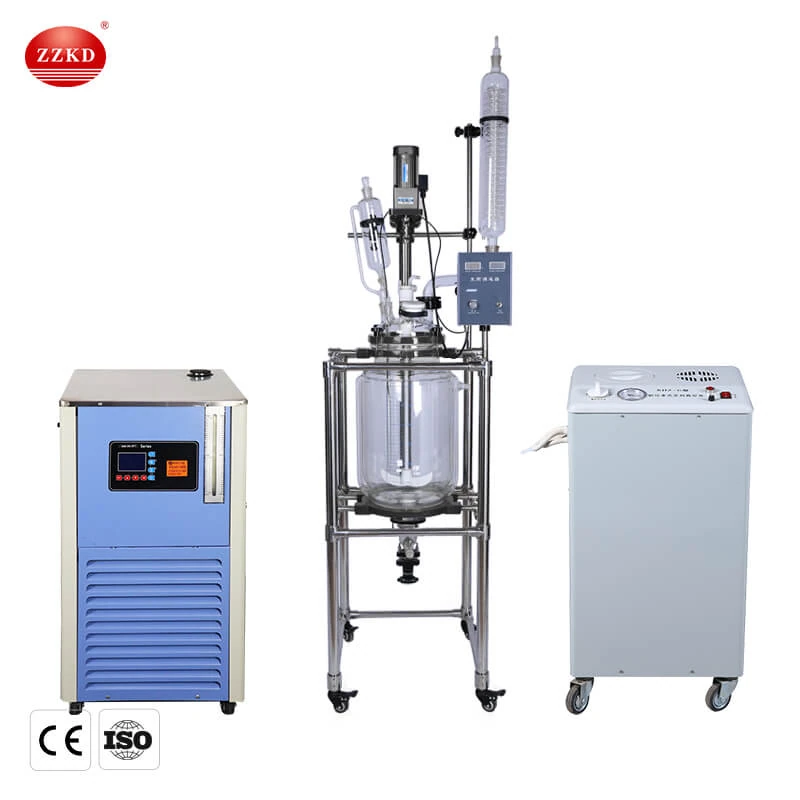
7.Circulating water/oil bath, high and low temperature machine can supply heating source; Cooling machine:cooling chiller,high and low temperature machine,convenient and practical
8.Scientific & innovative structure, practical, elegant appearance, domestic industry-leading.
9.Explosion proof is optional.
Jacketed glass reactor vessel maintenance and safety:
1. When using the double-layer glass reactor, it should be operated strictly according to the working pressure and working temperature marked on the product nameplate to avoid danger.
2. Strictly abide by the regulations on cooling and oil filling in the product instruction manual, and do a good job in the maintenance and maintenance of the equipment.
3. When using all valves, the valve stem should be turned slowly to press the cover tightly to achieve the sealing effect. It is not easy to use too much force when closing, so as not to damage the sealing surface.
4. The electrical control instruments of the double-layer glass reactor should be operated by special personnel, and overload protection facilities should be set up according to regulations.
5. The operation and maintenance personnel of the double-layer glass reactor should take off hard objects such as watches and rings during operation or maintenance, so as not to cause damage to the glass parts, especially the slight touch of the diamond ring on the glass parts will cause fatal damage. harm.
Common failure phenomena and causes of jacketed glass reactor vessel:
1. Turn on the power switch, the indicator light is off: the external power supply is not connected or the contact is poor. Please check the power supply and socket by a professional electrician.
2. The fuse is short-circuited: turn the power switch to the OFF position, and then replace the fuse.
3. The power indicator light is on, but does not rotate: the rotating shaft is rusted, stop using it, and contact the supplier. The motor and the electrical box are faulty, the seven-pin plug is not connected, and the seven-pin plug is reconnected.
4. Vacuum disappears suddenly: there is crack in the glass, the switch is damaged, check the glass parts, and replace the switch.
5. There is a vacuum, but it cannot be pumped: the sealing ring is worn out, and the vacuum switch connected to it leaks, please replace the sealing ring and switch.
6. Sometimes there is no vacuum: there is dirt on the steel shaft and the connector is loose. Please remove the dirt and check the vacuum gauge and vacuum pump.
7. The vacuum hose is aging: please replace the vacuum hose.
Specifications
Main technical datas:
| Model | (EX)S-30L |
| Power supply | AC220V |
| Stirring power(W ) | 120 1/3 Gear Motor |
| Rotary speed(rpm) | 0~600 |
| Torque(g/cm) | 1200 |
| Capacity(L) | 30 |
| Discharge method | Discharge from bottom, discharge valve |
Detailed technical datas:
| Model | S-30 |
| Shaft diameter | 16mm |
| Stirring neck (flange) | Φ33mm 50mm |
| Thermometer (taper) | 24#*Φ34 |
| Inlet/outlet volume gas (taper) | 34#*Φ45 |
| Solid feeding neck (flange) | Φ60mm 80mm |
| Condensing neck (1-5taper10-100round) | 50#*Φ60 |
| Liquid feeding neck(taper) | Φ40mm 50mm |
| Bottom discharge neck(flange) | Glass Φ30mm 70mm |
| Jacket liquid Inlet/Outlet | Φ12mm 24mm |
| Stirrer length,diameter,weight | 930mm Φ200mm 1kg |
| Thermowell length,diameter,weight | 615mm Φ15mm 0.1kg |
| Stirring seal (heitht,diameter,weight, ) | 190mm Φ50mm 0.55kg |
| Funnel (height diameter,weight,) | 555mm Φ95mm 1kg |
| Condenser (length,diameter,weight) | 830mm Φ100mm 2.5kg |
| Glass Bottom discharge | 210mm Φ160mm |