Overview
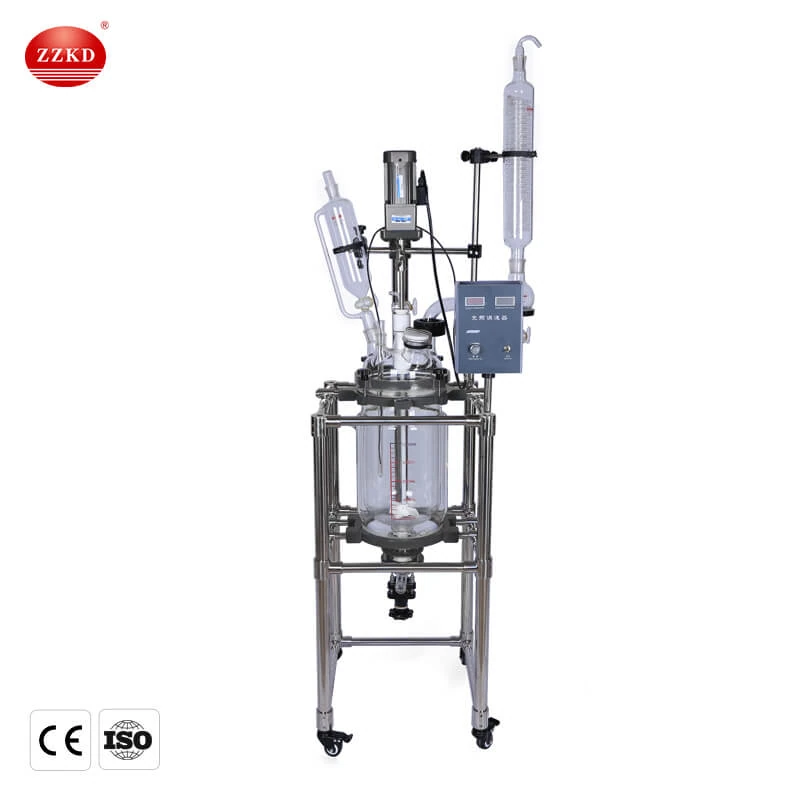
The 10L glass jacketed reactor passes through the interlayer, injects a constant temperature (high or low temperature) hot solution or cooling liquid, and heats or cools the materials in the reactor at a constant temperature, and can provide stirring. This equipment can carry out vacuum stirring reaction, distillation and concentration reaction, separation and extraction. For exothermic reaction experiment, tap water can be put into the jacket to take away the reaction heat. The material reacts in the reaction kettle, and can control the evaporation of the reaction solution. Reflux, after the reaction is completed, the material can be released from the discharge port at the bottom of the kettle, which is easy to operate.
The 10L glass jacketed reactor is injected with a constant temperature (high or low temperature) hot solution or cooling liquid through the double-layer reactor interlayer to heat or cool the materials in the reactor at a constant temperature, and can provide stirring. The materials are reacted in the reactor, and the evaporation and reflux of the reaction solution can be controlled. After the reaction, the materials can be released from the outlet at the bottom of the reactor, which is very convenient to operate.
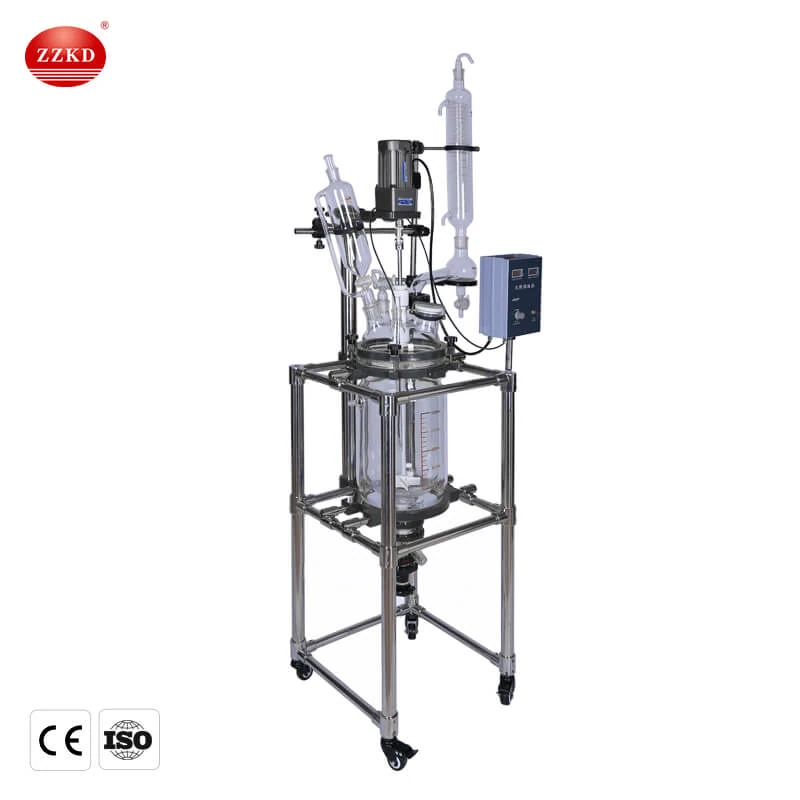
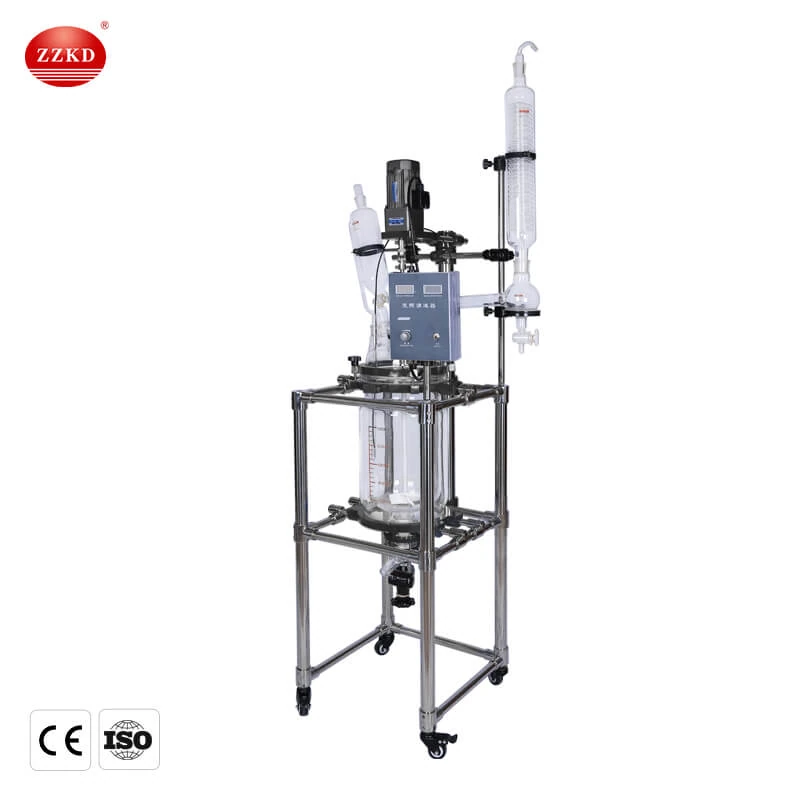
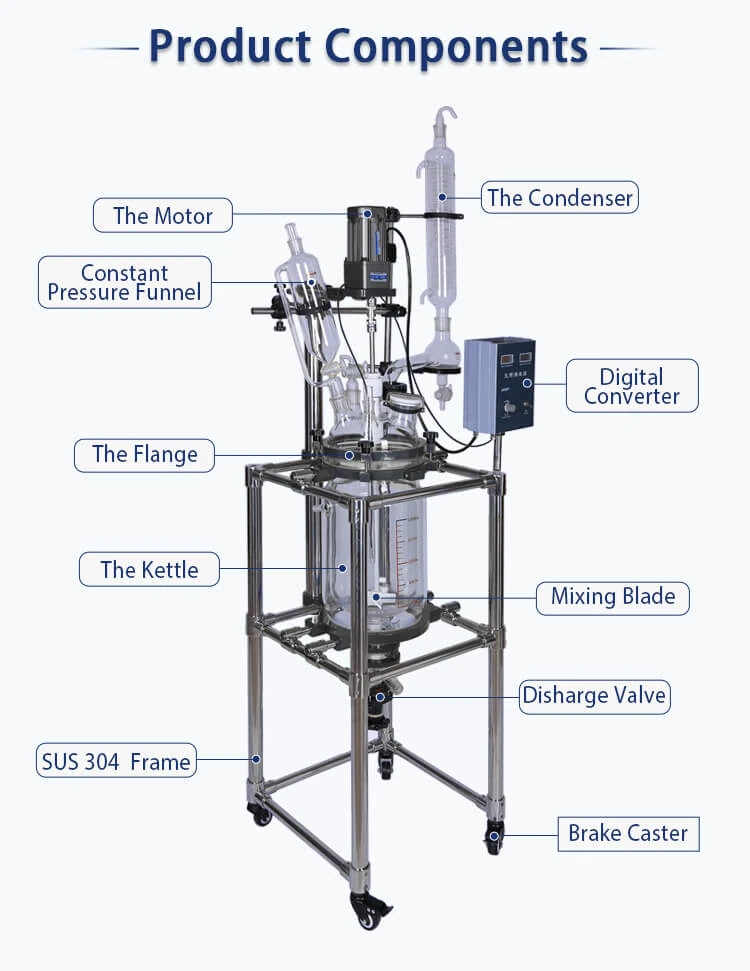
The 10L glass jacketed reactor is composed of frame part, glass part, fixing clip part and stirring part, which is easy to install.
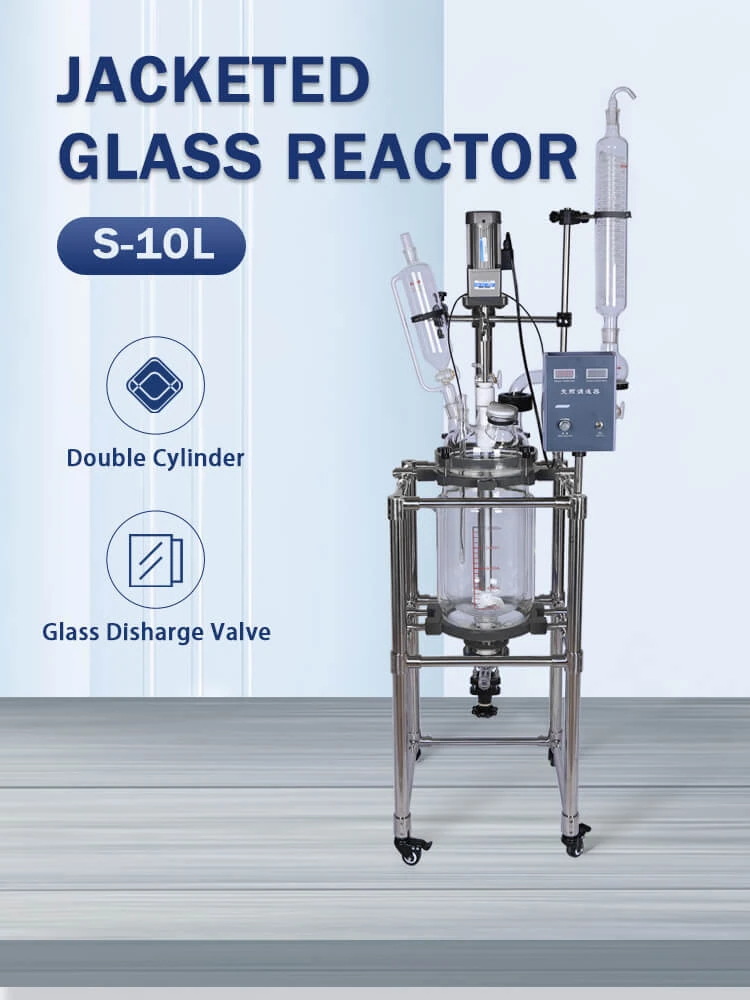
How to install the 10L glass jacketed reactor:
1. Take out the stirring sealing plug and stirring rod, unscrew the PTFE cap, and fix the stirring sealing plug on the stirring port of the covering flange.
2. Adjust the height of the stainless steel frame, taking the actual ground level as the standard, and tighten all the hexagon socket screws after stabilization.
3. The overall screws and clamps are all fixed tightly, and a condenser and a constant pressure funnel are installed with stainless steel support rods.
4. Install the stirring motor part, do not tighten the hexagon socket screw at this time. Assemble the stainless steel frame according to the standard frame, do not tighten any hexalobe stainless steel screws at this time.
5. Install the condensate return elbow clamp on the lid of the kettle, install the return pipe, and install the condenser. Install a constant pressure funnel on the lid of the kettle, add a thermometer casing, and add a glass vent valve.
6. Install the fixed kettle cover clamp, lift the stirring rod deep into the motor stirring universal joint, and use a small hexagonal stainless steel tool to clamp the inner hexagonal stainless steel screw.
7. Lock the pulley at the bottom of the frame and install the reactor body. This action needs to be coordinated by two people at the same time to adjust the horizontal and vertical positions of the reactor body. Install the position of the digital display inverter, and the installation is now complete.
How to use the 10L glass jacketed reactor:
1. Check whether the power supply voltage is consistent with the specifications provided on the machine nameplate.
2. Plug in the power plug, turn on the power switch on the inverter, and use the speed control knob to select a suitable speed.
3. The flow of materials and the power of the motor speed may resonate at a certain point, please change the speed of the motor to avoid resonance.
4. After the stirring rod is installed, it must be rotated by hand, pay attention to whether the concentricity is good, if the concentricity is not good, loosen the heavy clamp, and then turn on the power after clamping, and adjust it gradually from slow to fast.
5. Use the stir bar regulator to make the stirring leaves 5cm up and down as needed.
6. If the sealing performance of the kettle is found to be reduced, please check the rotating bearing in the agitator sleeve.
7. The glass instruments of the 10L glass jacketed reactor are all made of GG.17 low expansion coefficient and high temperature resistant borosilicate glass. The user prepares glass instruments such as reaction bottles by himself. Please confirm the correct glass material to ensure safe use.
8. The interlayer on the 10L glass-jacketed reactor is externally connected to the circulation port, which can be used for heating reaction when it is connected with hot oil, and can be used for low-temperature reaction when it can be supplied with cooling liquid. If it is heated by steam, it should not exceed 0.5K-1K. (Try not to use pressure steam to heat).
9. When the test is carried out at low temperature, the discharge valve at the bottom will be frosted. When using the valve, it must be partially thawed first to prevent the glass from being broken.
10. If there are particulate objects in the solution during use, the residue may accumulate on the PTFE piston of the valve when discharging, and the airtightness will be affected when it is used again. Be sure to
After discharging, wash it first and use it again.
Features
Features of 10L glass jacketed reactor:
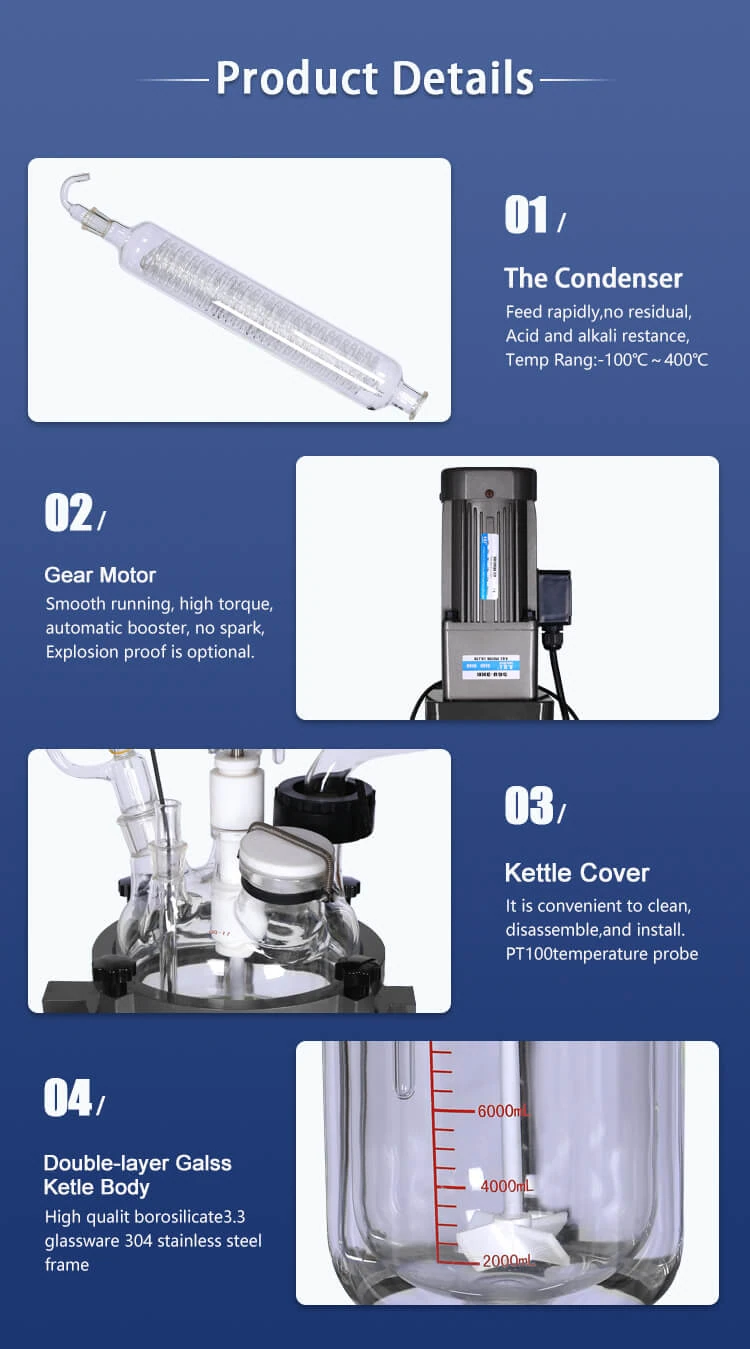
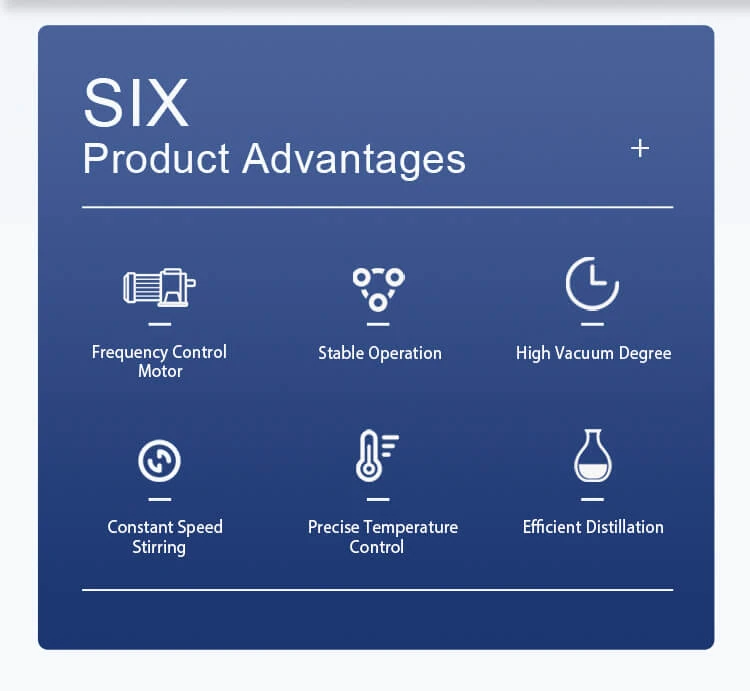
1.GG17 high-borosilicate glass with nice physical-chemical properties; experiment temperature -100 to 400 degree C; Resistant to strong acidic properties of materials; only touching with glass parts & PTFE, no cross-contamination.
2.Precision Mechanical seal stirring to keep high vacuum degree.
3.Glass(PTFE)discharge valve, no-dead angle mixing, fast no residue discharge.
4.Frequency control speed gear motor, smooth running,high torque, automatic booster , no spark, noise free, long life.
5.SUS frame and cast aluminum material kettle body support, simple as well as strong; stable structure
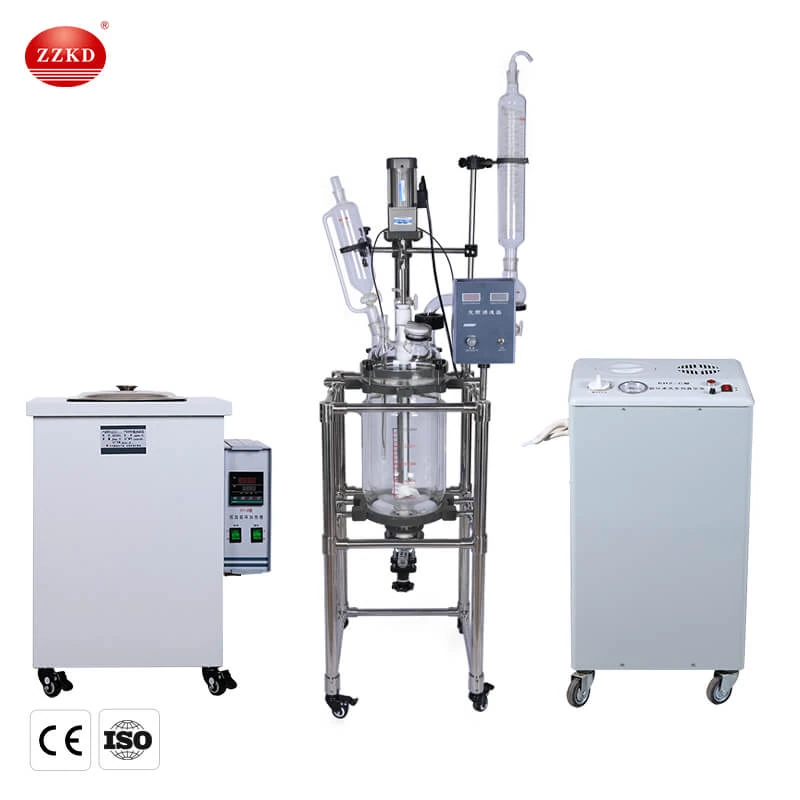
6.Circulating water/oil bath, heating mantle can supply the heating origin; Cooling mode machine:cool chiller, convenient and practical
7.Scientific & innovative structure, practical, strong,
8.Explosion-proof is optional.
Maintenance items for 10L glass jacketed reactor:
1. Check the instrument carefully before use, whether the glass bottle is damaged, whether the interfaces are consistent, and handle with care.
2. Note that this device is a fragile product, please handle it with care when using it, the damage of fragile products is not within the scope of our warranty, if the customer needs it, our company will charge the corresponding cost.
3. The PTFE switches everywhere should not be tightened too hard, as it is easy to damage the glass.
4. Turn on the power switch first, and then let the machine run from slow to fast. When stopping, make the machine stop, and then turn off the switch.
5. The connectors should not be screwed too tightly, and should be loosened regularly to avoid long-term tight locks that may cause the connectors to bite to death.
6. After each use, you must use a soft cloth to wipe off all kinds of oil stains, stains, and solvent residues left on the surface of the machine, and keep it clean.
7. Clean the sealing ring regularly. The method is: remove the sealing ring, check whether there is dirt on the shaft, wipe it clean with a soft cloth, then apply a little vacuum grease, and reinstall it to keep the shaft and the sealing ring smooth.
8. Unscrew each PTFE switch after stopping the machine, and the PTFE piston will be deformed if it is still in the working state for a long time.
9. The electrical part must not enter the water, and it is strictly forbidden to be damp.
10. Wipe each interface with a soft cloth (you can replace it with a napkin), and then apply a little vacuum grease. (Vacuum grease must be covered after use to prevent lime sand from entering)
11. It is necessary to purchase authentic accessories from the original factory. Random use of other accessories will cause fatal damage to the machine.
12. When doing any repair or inspection on the machine, be sure to cut off the power supply and water source first.
Specifications
Main technical data:
| Model | F-50L |
| Voltage(V) | AC220V |
| Mixing power(W) | GM 120W 1/3 |
| Speed | 60~600rpm |
| Torque | 1500g/cm |
| Capacity | 50L |
| Heating power | 5KW/3.5 |
| Temperature using range | 0-250℃ |