Laboratory equipment · Drug development
Jacketed Glass Reactors for Drug Development: Match the Vessel to the Study
What lab jacketed glass reactor is best for drug development? The useful answer starts with the study, not a universal ranking. A vessel for scarce-material experiments has different priorities from one used to explore solvent addition, crystallization, or a larger process-development batch.
A jacketed glass reactor is worth considering when the experiment calls for visual access to the contents, agitation, and heat exchange through a vessel jacket. Selection should connect those needs to the actual sample volume and proposed operating conditions. Temperature and pressure suitability, along with available accessories, depend on the specific model and configuration.
Start with sample volume, not the largest available vessel
In early drug development, material availability can limit the experiment before equipment capacity becomes a concern. Record the starting liquid charge, planned additions, expected solids, and the amount removed for analysis. Also allow for the largest volume reached during the procedure—not just the initial charge.
Nominal vessel capacity is not the same as a recommended working batch. A proposed batch needs adequate mixing, suitable impeller immersion, and headspace for the process. Foaming, reflux, suspended solids, and staged solvent additions can all influence the space required. Choosing a larger vessel simply to accommodate a possible future study may leave the current small batch poorly matched to the mixing arrangement.
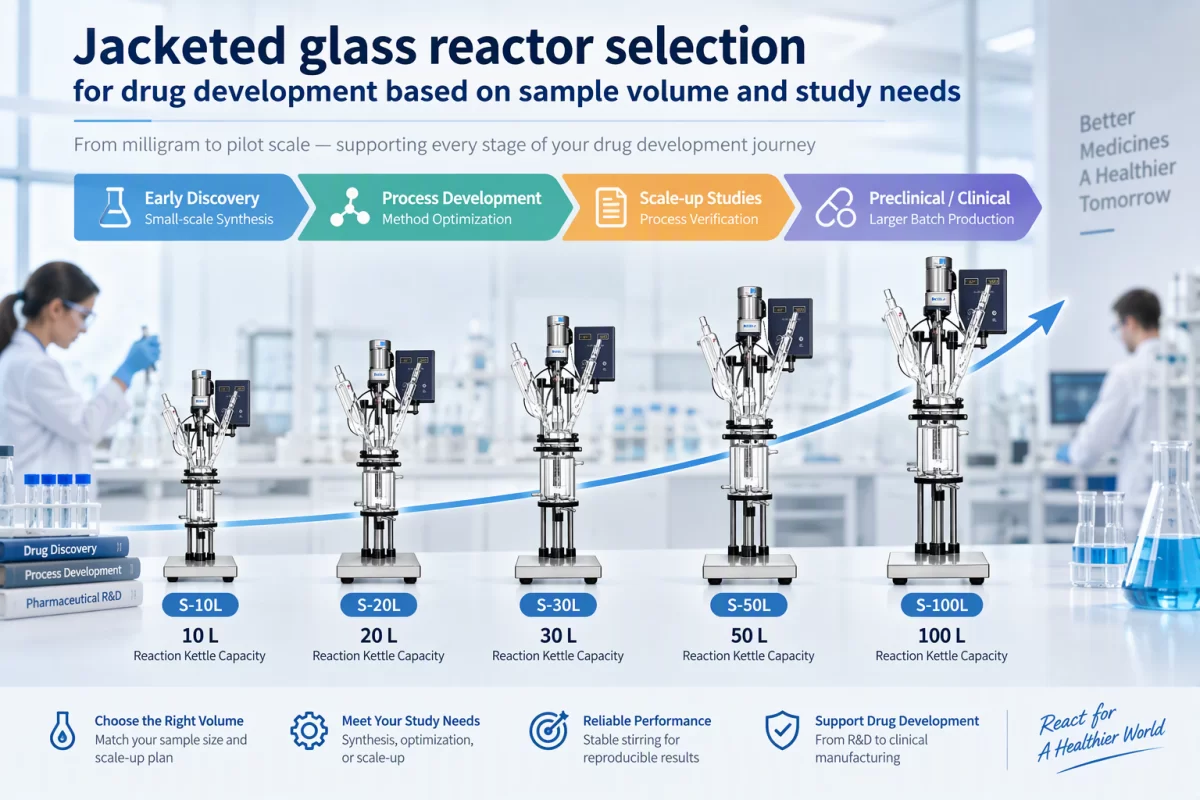
The Laboratory Jacketed Glass Reactor is a relevant starting point for discussing a study-specific setup. The S-series vessel capacities below provide concrete options for that discussion.
| Model | Reaction vessel capacity (L) |
|---|---|
| S-1L | 1 |
| S-2L | 2 |
| S-3L | 3 |
| S-5L | 5 |
| S-10L | 10 |
| S-20L | 20 |
| S-30L | 30 |
| S-50L | 50 |
| S-100L | 100 |
These are vessel capacities, not prescribed working volumes or guarantees of suitability for a particular drug-development process.
Make visual observation part of the experimental plan
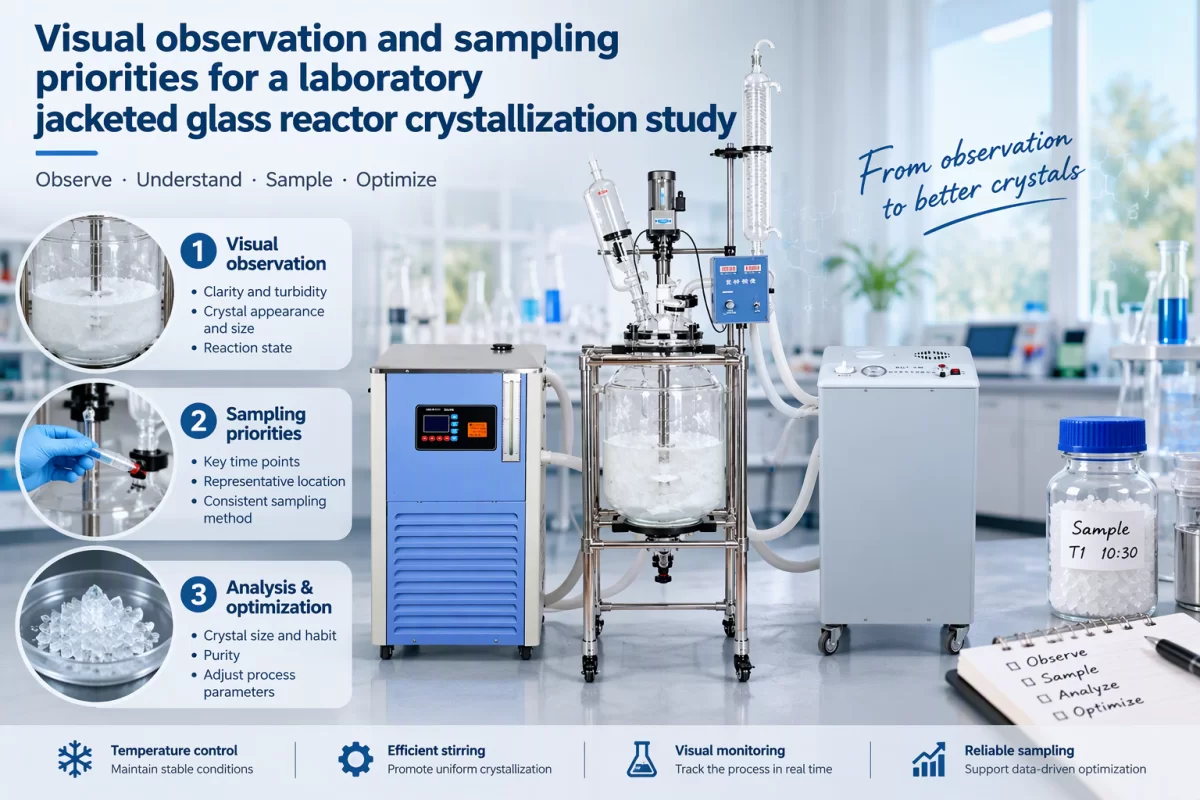
A transparent vessel can help researchers follow changes such as color development, phase separation, precipitation, foam formation, and solids settling. These observations are especially useful during exploratory work, when the behavior of the batch may be as important as the final analytical result.
Decide which changes need to remain visible and how they will be recorded. Lighting, probe placement, external tubing, and the position of the agitator can affect the view. Plan sampling around meaningful process events, such as the end of an addition or the appearance of solids, rather than treating visibility as a substitute for analytical testing.
For crystallization studies, useful observations include the onset of visible solids, changes in suspension behavior, and material collecting on the wall. A dedicated crystallization reactor is another page to consider when crystal formation is the central study objective. Its suitability should be assessed against the specific process requirements.
Match mixing and thermal control to process exploration
Drug-development experiments often examine more than a single reaction endpoint. Addition order, solvent composition, cooling sequence, and agitation can influence how a batch behaves. A useful reactor setup allows these variables to be studied deliberately, with the experimental conditions recorded well enough to compare successive runs.
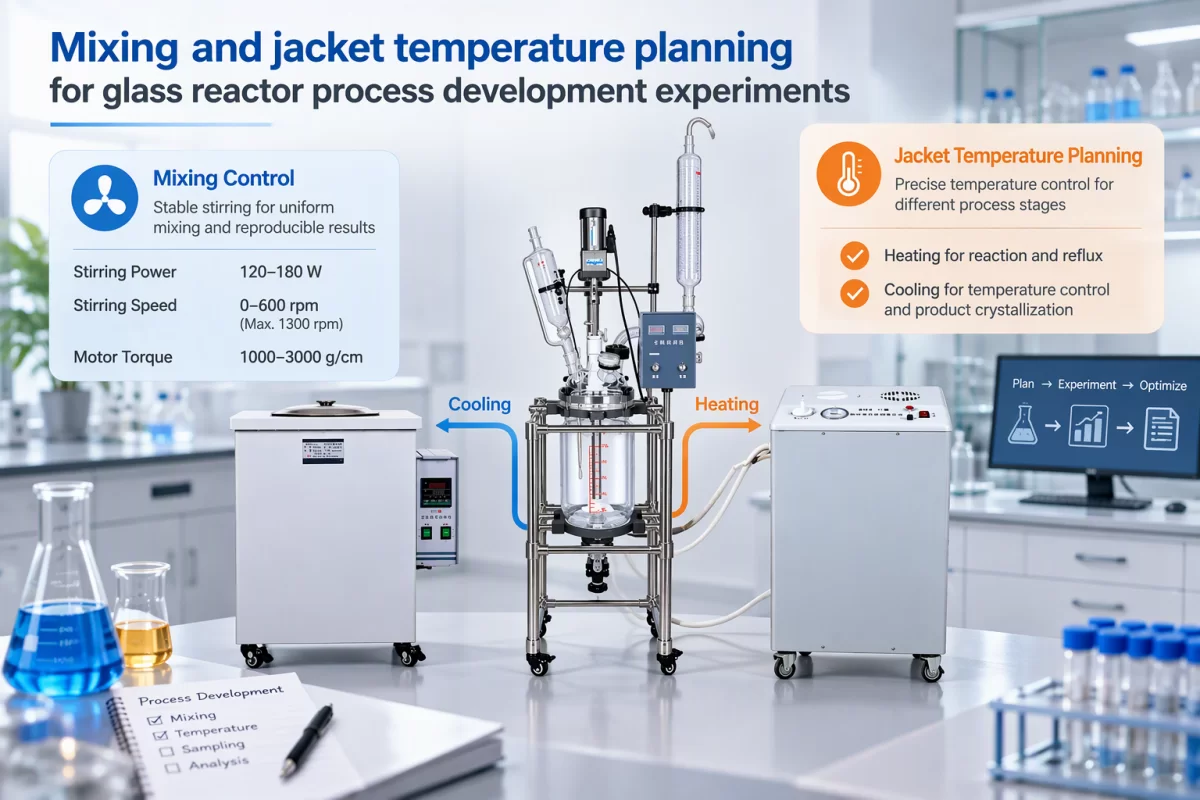
Mixing requirements should describe the material, not just a requested rotational speed. Identify whether the batch is a low-viscosity liquid, a two-phase mixture, or a suspension that changes as solids form. Impeller design, liquid depth, vessel geometry, and mechanical capability all affect mixing. The same speed in different vessel sizes does not necessarily produce equivalent conditions.
The jacket provides a route for heat exchange with a circulating medium, but reactor selection and circulator selection are connected decisions. Define the intended temperature profile, fluid compatibility, connection requirements, and anticipated heating or cooling demand. For cooling-focused work, the low-temperature cooling liquid circulating pump page is a relevant place to begin evaluating the external cooling equipment.
Keep the temperature of the circulating fluid separate from the measured batch temperature in the study record. Specify any vacuum or pressure requirement as an operating condition, not an assumed capability of glass equipment. The selected vessel, seals, connections, and accessories must be suitable for that duty.
Build a configuration request that supports a useful quotation
A capacity-only inquiry leaves important selection questions unanswered. A more useful request connects the reactor to the material and the experimental sequence. Include the following information when discussing a configuration:
- Material and batch: solvents, reagents, expected solids, viscosity behavior, and initial and maximum working volumes.
- Operating conditions: target batch temperatures, heating and cooling steps, and any vacuum or pressure requirement.
- Process operations: agitation, controlled additions, sampling, condensation, and discharge needs.
- Laboratory constraints: electrical supply, installation space, available utilities, and applicable site safety requirements.
- Documentation needs: any required material records, equipment documentation, or specified compliance evidence.
Company reference price
US$1,699 is our company’s reference price for planning discussions. It is not a model-specific quotation or a price for every configuration. The actual quotation depends on the selected configuration and the inquiry outcome.
The best fit is the vessel that answers the study question
For anyone asking what lab jacketed glass reactor is best for drug development, the practical answer is a study-matched system: enough capacity for the complete batch, useful visual access, appropriate mixing, and a thermal setup suited to the experiment. The S-series capacities provide a range of candidates, but capacity alone does not establish process suitability.
Start with the material available, the observations required, and the variables the study needs to explore. Then specify the operating conditions and accessories needed to make those experiments informative. That approach produces a more meaningful equipment choice than a general “best reactor” ranking.
Explore the laboratory jacketed glass reactor