Lab-Scale Rotovaps in Pilot Plants: Deciding When to Increase Capacity
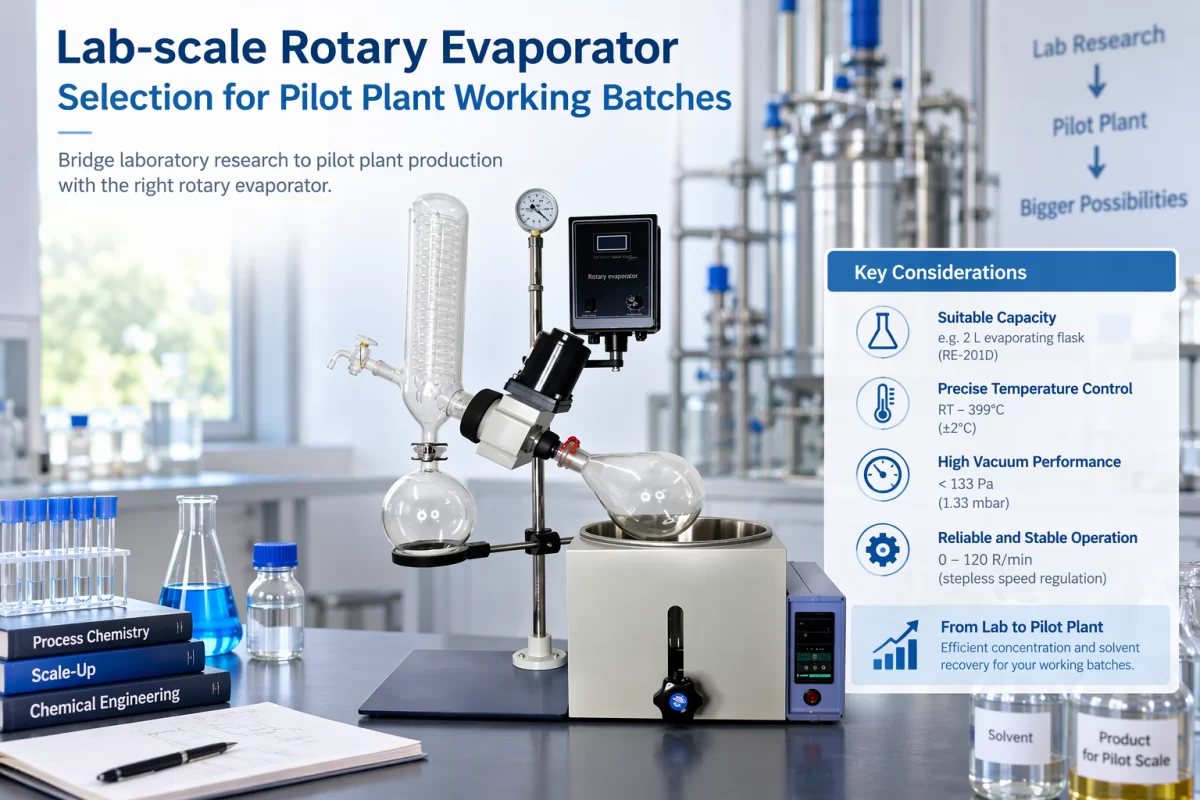
Understanding how to choose a lab-scale rotary evaporator for pilot plant work starts with the process, not the capacity label. A small rotovap can support formulation trials, solvent screening, and selected pilot batches. Increasing capacity becomes worthwhile when the working charge, solvent removal duty, or handling workload exceeds what the existing setup can manage within the required schedule.
“Lab-scale” and “pilot” describe how equipment is used; they are not universal flask-size categories. The useful question is whether the complete evaporation system fits the material, batch plan, and available utilities.
Start with the working batch, not the nominal flask volume
Define the liquid charged per run, the solvent volume to be removed, and the required final concentration. Nominal evaporating flask capacity is not a recommended working fill. The charge needs enough room for rotation, vapor disengagement, and any foaming or bumping associated with the material.
A compact unit remains useful when batches are modest, recipes change frequently, and cleaning between materials is more important than processing a large quantity at once. The 2L rotary evaporator product page is a relevant starting point for evaluating smaller-format equipment alongside the actual working-charge requirement.
For a representative trial, record the complete cycle: charging, establishing operating conditions, evaporation, discharge, and cleaning. Dividing solvent volume by evaporation time alone can underestimate the equipment time needed for a pilot campaign.
When can a small rotary evaporator still serve a pilot plant?
I would keep the smaller unit when representative batches meet the required endpoint within the available shift and remain manageable to charge, discharge, and clean. Pilot work often needs flexibility and repeatable operating records more than the largest possible flask.
Choose pilot plant rotovap conditions around the solvent
Solvent behavior affects the operating pressure, heating strategy, and condenser duty. A volatile solvent may need careful vacuum adjustment and adequate cooling to prevent excessive vapor reaching the pump. A less volatile solvent may require a different pressure–temperature combination, while heat-sensitive products place limits on exposure time and material temperature.
Mixed solvents need particular attention because the composition changes during concentration. The conditions that work at the beginning of a run may not suit the final stage. Foaming, increasing viscosity, and solids formation can also make a previously comfortable working charge difficult to handle.
- Define the solvent system: identify major components and any expected changes during evaporation.
- Set product limits: specify the acceptable temperature exposure and the required concentration or residual-solvent endpoint.
- Assess compatibility: select wetted materials, seals, tubing, and pump components suitable for the process chemicals.
- Address site safety: evaluate flammable vapor handling, ventilation, electrical suitability, and the installation environment.
A larger flask is not a substitute for a solvent-specific operating method. Establish stable conditions with a representative material before deciding how much additional capacity is useful.
Check cooling and vacuum before increasing flask size
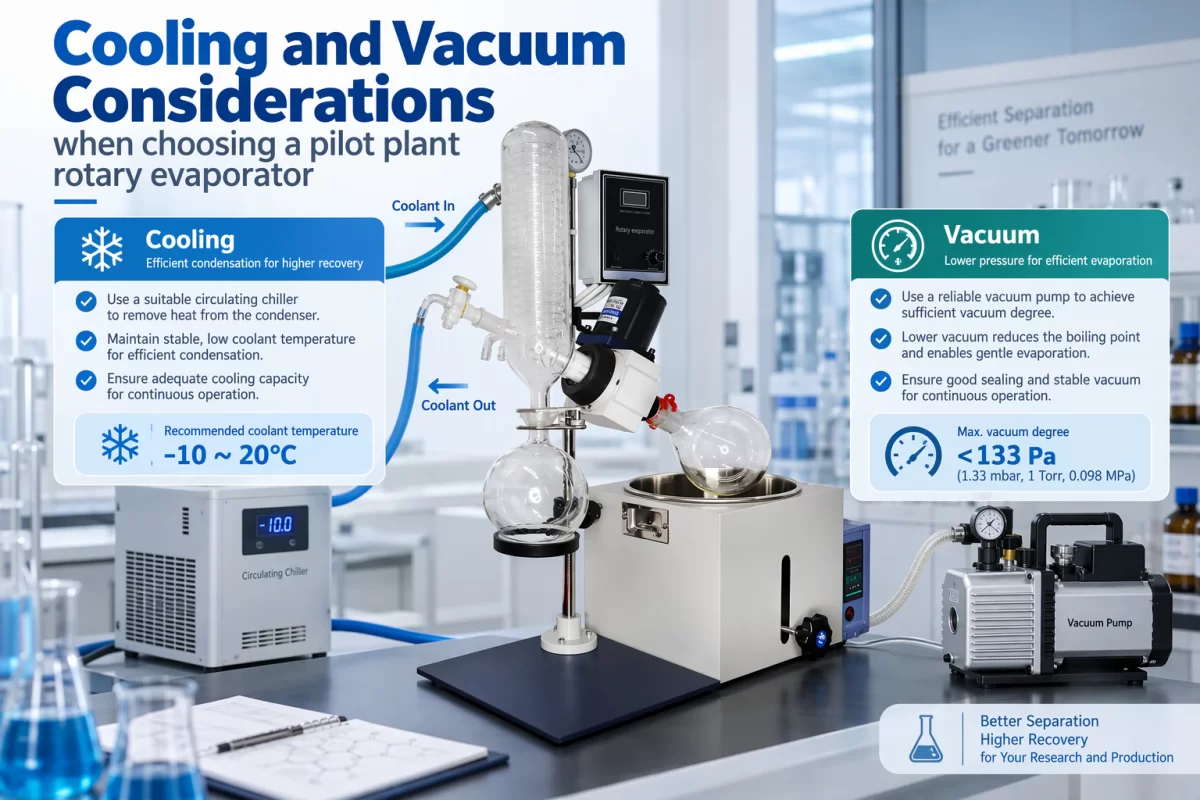
The evaporation vessel, bath, condenser, cooling circuit, and vacuum system operate together. If cooling cannot remove the vapor load, a larger charge may extend the run without delivering the expected throughput improvement. Likewise, an unsuitable pump, leaking connections, or restrictive vapor paths can limit performance independently of flask volume.
Evaluate the chiller at the intended coolant temperature and operating load rather than relying on a headline rating. The low-temperature cooling liquid circulating pump page provides a relevant route for discussing the cooling side of a rotary evaporator system. Selection should account for the solvent, condenser requirements, hoses, and installation conditions.
Does a larger flask automatically shorten evaporation time?
I would not assume so. A larger vessel can reduce batch splitting, but the benefit depends on heat input, condensation, vacuum stability, and material behavior. I would first identify whether the existing bottleneck is vessel capacity, utilities, or handling.
Compare model capacities without treating them as scale labels
The following model-specific flask capacities provide a starting point for comparing equipment. They describe the evaporating and receiving vessels, not a guaranteed working charge or solvent throughput.
| Model | Evaporating flask (L) | Receiving flask (L) |
|---|---|---|
| RE-201D | 2 | 1 |
| RE-301 | 3 | 2 |
| RE-501 | 5 | 3 |
| R1005 | 5 | 3 |
| R1010 | 10 | 5 |
| R1020 | 20 | 10 |
| R1050 | 50 | 20 |
Receiving flask capacity also matters: plan recovered-solvent handling around the selected system’s collection arrangement and operating procedure.
Installation space can influence the decision as much as vessel size. For example, the R1020 has listed outline dimensions of 1250 × 600 × 2100 mm. These dimensions are not a complete installation envelope; allow additional space for glassware handling, connections, service access, and the surrounding safety arrangement.
When repeated batch splitting is the main constraint, the 20L rotovap product page offers a larger-format option to evaluate. Compare the proposed equipment and supporting utilities against the process workload rather than assuming that a capacity increase produces a proportional throughput increase.
Recognize the practical boundary of a small rotovap
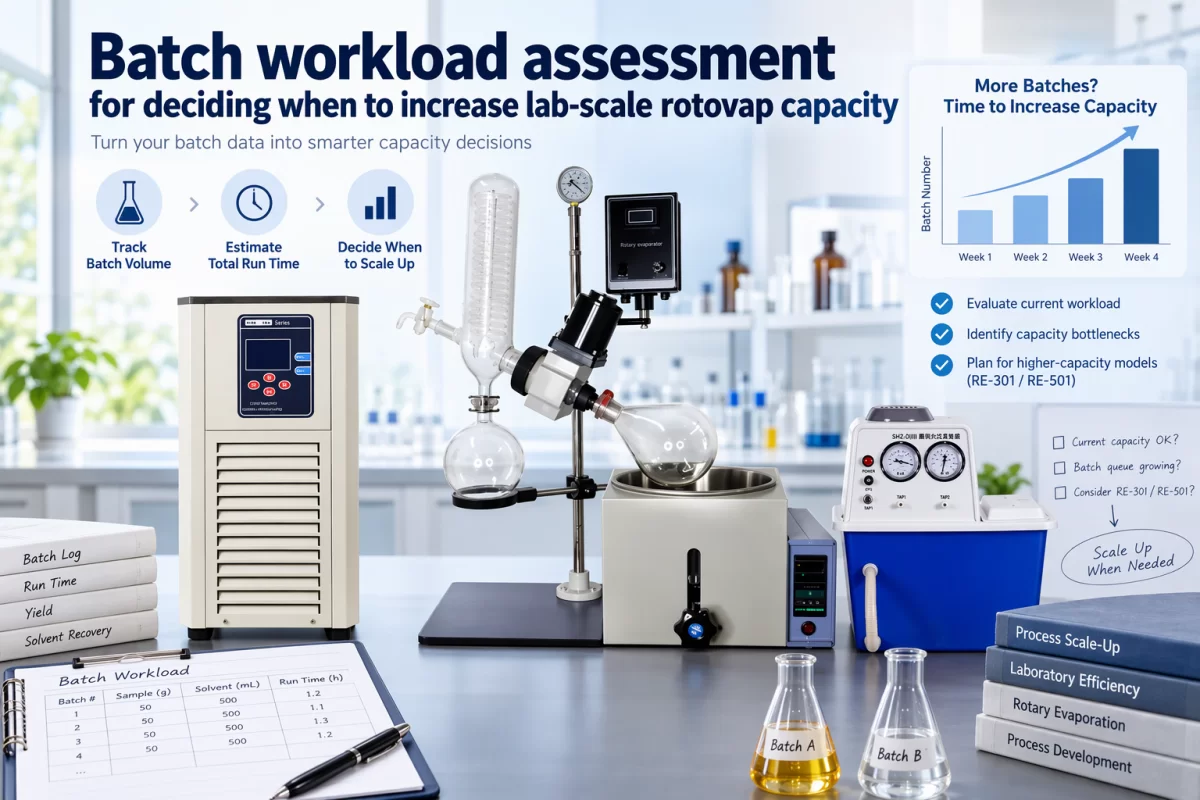
A capacity increase is worth evaluating when the existing unit repeatedly requires extra runs, occupies an excessive share of the production schedule, or creates substantial transfer and cleaning work. These are stronger signals than an occasional unusually large batch.
- Measure the baseline: record representative batch charges, solvent recovery, endpoint, total cycle time, and operator involvement.
- Identify the constraint: distinguish insufficient vessel room from limited cooling, unstable vacuum, foaming, or slow handling.
- Compare alternatives: consider improving utilities, retaining a small unit for development, or moving routine batches to larger equipment.
- Evaluate the proposed system: assess representative material behavior and site utilities before setting production expectations.
What evidence supports moving to a larger rotary evaporator?
I would look for repeated batch records showing that vessel size and the associated handling workload remain the main limits after operating conditions are stabilized. The larger system should address those limits while preserving controllable evaporation and practical cleaning.
Budget for the complete operating setup
Equipment purchasing should include the rotary evaporator and the supporting items needed for the intended process. Cooling equipment, vacuum equipment, solvent protection measures, connections, and installation requirements can affect the overall budget. Compare quotation scope carefully so that a bare unit and a system package are not treated as equivalent purchases.
Our company’s reference price: US$1,480. This is a general budgeting reference, not a quotation for a particular model or complete system. The actual quotation depends on the selected configuration and the inquiry result.
For a suitable proposal, provide the solvent composition, working batch volume, solvent removal target, acceptable product temperature, required batch schedule, site utilities, and configuration needs.
Choose capacity that fits the pilot plant process
Knowing how to choose a lab-scale rotary evaporator for pilot plant work means balancing batch size with solvent behavior and supporting conditions. Keep the smaller rotovap when it delivers manageable, repeatable batches. Evaluate larger equipment when measured workload shows that vessel capacity and handling are the persistent constraints.
The right next step is a process-based comparison of the rotary evaporator, cooling, vacuum, collection arrangement, and installation needs. Share the intended material and batch plan with KD Instrument to discuss a matching configuration and quotation.