Scaling Pharma Production with Jacketed Steel Reactors: Plan Cleaning and Changeovers
Selecting stainless steel jacketed reactors for pharmaceutical scale-up production involves more than increasing vessel size. Larger batches also change how operators drain residues, reach product-contact surfaces, manage cleaning liquids, and separate one material campaign from the next. Planning these activities before equipment selection helps turn a vessel purchase into a workable production workflow.
A Stainless Steel Reactor can be considered for this role, with materials and configuration selected around the actual process. The vessel itself does not establish pharmaceutical manufacturing compliance: equipment qualification, cleaning validation, operating procedures, and facility controls remain part of the intended application.
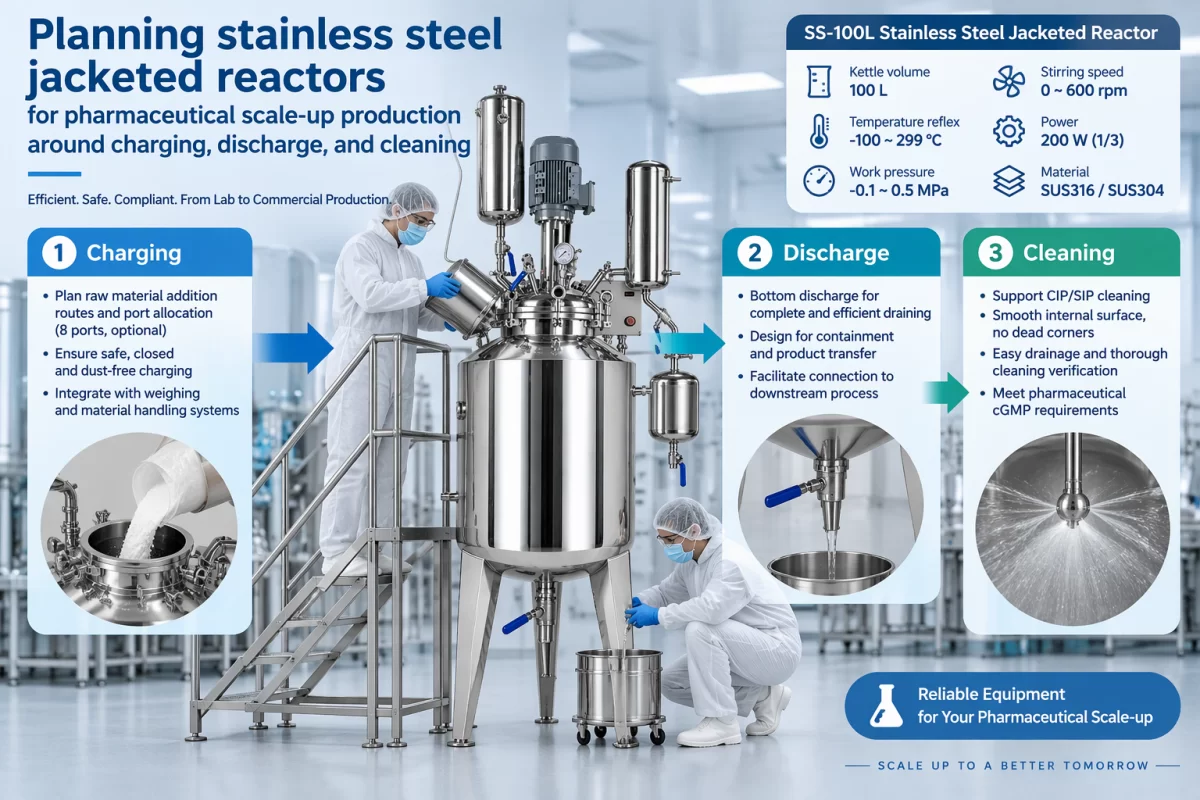
Plan jacketed reactor scale-up around the complete batch cycle
A useful capacity assessment includes charging, processing, discharge, cleaning, inspection, and release for the next batch. Reaction time alone can give an incomplete picture of equipment availability. A larger vessel may handle more material while also requiring additional time for transfer, cooling before cleaning, dismantling accessories, or drying after the final rinse.
Start with a batch-cycle map. Record the expected material state at each step, including viscosity changes, suspended solids, sticky residues, and any tendency to crystallize during cooling. Identify where material can remain after discharge: outlet valves, transfer hoses, agitator components, sampling connections, and attached condensers all deserve attention when present in the selected system.
Does a larger reactor automatically increase usable production capacity?
I would assess capacity through the complete cycle rather than vessel volume alone. If cleaning and equipment release take longer after scale-up, the added batch size may not translate directly into more completed batches. I recommend estimating turnaround time alongside the planned working charge.
Match the stainless steel reactor configuration to the process
For an equipment discussion at this scale, the 100L Stainless Steel Reactor is a relevant starting point. The SS-100L model is listed in the reactor series with the following characteristics. Vessel volume should not be treated as an approved working fill; the intended charge must account for mixing, foaming, additions, and required headspace.
| Selection item | Listed characteristic | Planning relevance |
|---|---|---|
| Model | SS-100L | Identifies the vessel under discussion |
| Vessel volume | 100 L | Starting point for working-charge assessment |
| Vessel structure | Double-wall stainless steel | Consider process and jacket circuits separately |
| Agitator type | Paddle | Assess against viscosity and solids behavior |
| Speed control | Digital-display frequency-conversion regulation | Supports discussion of operating control requirements |
Specify product-contact metal, agitator material, seals, gaskets, and connection types as a coordinated package. Stainless steel selection should reflect the process chemicals, cleaning agents, exposure conditions, and contamination controls. Do not assume that a material suitable for the vessel wall is automatically suitable for every seal or accessory.
Jacket utilities also belong in the selection discussion. Define the intended temperature cycle, utility fluid, connection arrangement, and isolation procedure. Heating or cooling capability is not a substitute for demonstrating that the actual batch reaches the required process conditions.
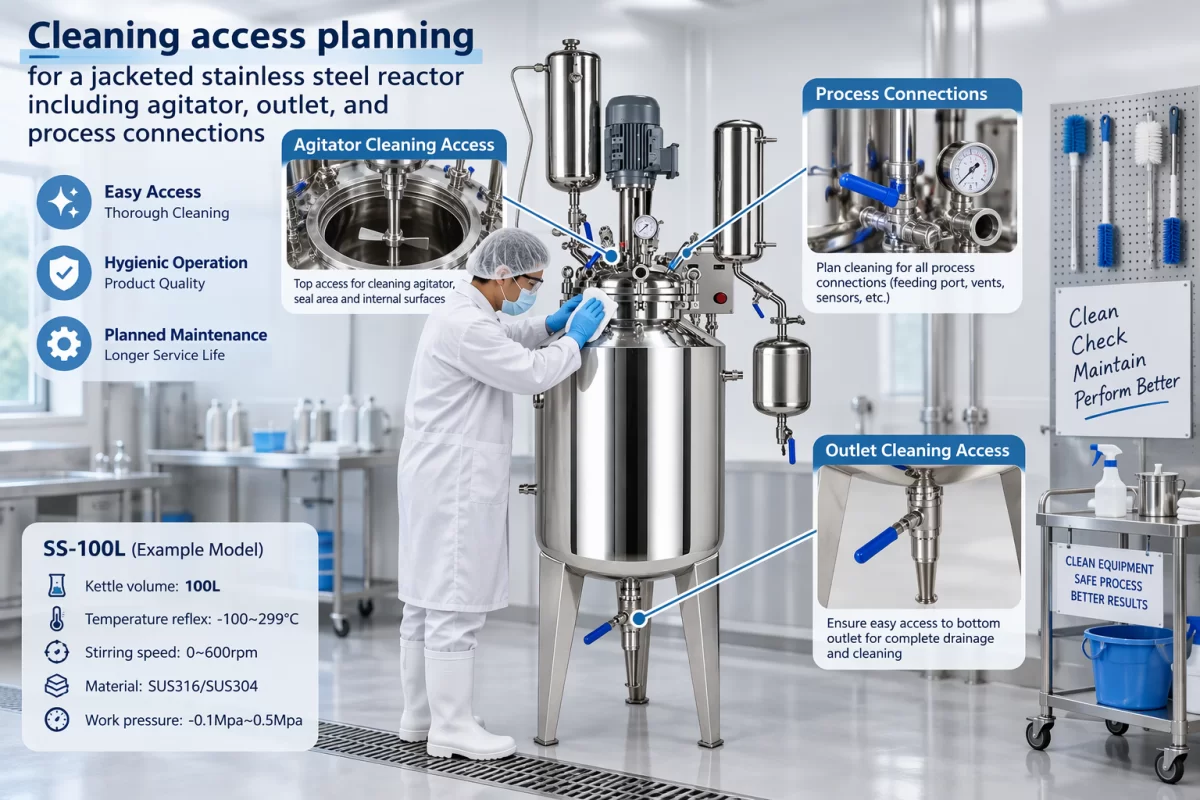
Design cleaning access before defining the changeover schedule
Cleaning should address the complete product-contact path, not only the visible interior. List components that require removal, inspection, soaking, flushing, or separate cleaning. Review whether operators can safely reach them and whether lifting, tool access, drainage collection, or additional floor space will be needed.
- Residue behavior: identify solvents or cleaning agents compatible with both the residue and equipment materials.
- Coverage: consider agitator surfaces, lid connections, valve internals, and any attached process lines.
- Drainage: plan how retained process liquid and final rinse liquid will be removed and collected.
- Verification: define inspection and sampling locations according to product risk and the site's cleaning program.
- Reassembly: include seal inspection, correct component installation, and readiness checks before charging.
Can a stainless steel vessel be assumed to support validated clean-in-place operation?
I would not make that assumption from the vessel material or jacketed construction. A clean-in-place approach needs a suitable arrangement, demonstrated cleaning coverage, and an application-specific validation strategy. Where manual cleaning is planned, I would evaluate access, disassembly effort, and operator safety just as carefully.
Keep materials separated throughout batch changeovers
Material segregation extends beyond the reactor. Charging containers, transfer hoses, collection vessels, sampling tools, and waste connections can carry material between campaigns. Establish which items are dedicated, which are shared, and how their cleaned status is identified. Where product hazards require stronger controls, evaluate dedicated equipment or a more restrictive campaign strategy.
A practical changeover sequence begins with controlled discharge and recovery of remaining material. It then moves through isolation, cleaning, inspection, drying where required, reassembly, and documented release. Distinguish equipment that is dirty, being cleaned, clean but awaiting checks, or ready for use. Physical tags and records should agree before the next material is introduced.
Where a process continues into solid-liquid separation, review the transfer boundary with downstream equipment such as an agitated nutsche filter-dryer. The connecting line and receiving equipment need their own cleaning and segregation assessment; selecting a reactor does not establish the suitability of the downstream arrangement.
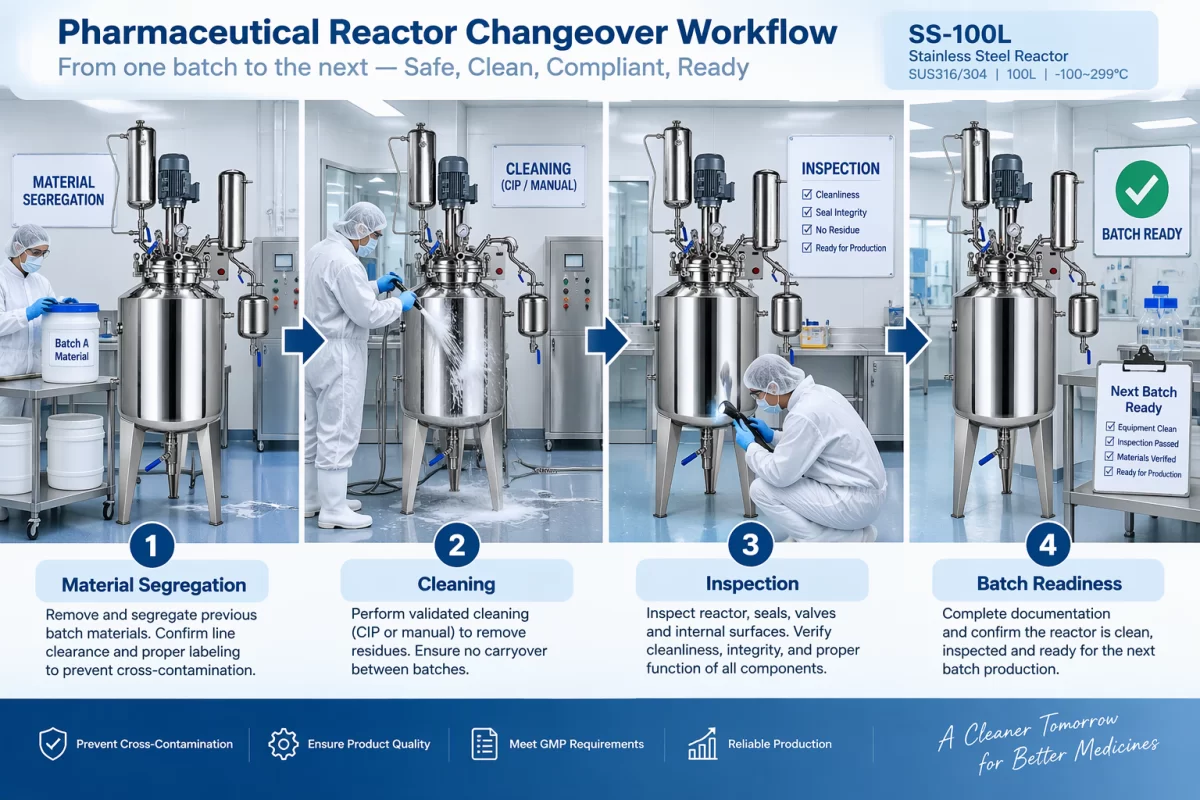
What should determine the cleaning endpoint between different products?
I recommend a risk-based endpoint tied to the previous material, the next product, and the site's acceptance criteria. Visual inspection can be useful, but it should not be treated as proof that every relevant residue has been removed. Sampling locations and analytical methods should match the cleaning strategy.
Budget for the configured system and its operating workflow
Our company's reference price is US$1,820. This is a general reference for the company's stainless steel reactor offerings, not a quotation for the SS-100L configuration. The actual quotation depends on the selected configuration and inquiry results.
Procurement should also consider the equipment surrounding the vessel: temperature-control utilities, transfer arrangements, cleaning accessories, spare seals, and handling provisions. Separating these items in the purchasing scope helps avoid treating a vessel-only price as the cost of a complete operational installation.
Make cleaning and changeovers part of scale-up selection
Stainless steel jacketed reactors for pharmaceutical scale-up production should be selected with the entire batch lifecycle in view. Vessel size, material compatibility, cleaning access, drainage, and equipment segregation all influence whether the proposed arrangement fits the intended operation.
Define the process and changeover requirements first, then develop the stainless steel reactor configuration around them. This provides a clearer basis for equipment selection, a more useful quotation, and a practical starting point for the site's qualification and cleaning program.